

• Home
  • About
    • Members
    • Associate Members
    • Former members
  • Thematic Areas
    • Containers
    • Cruise
    • European Port Policy
    • Ports & COVID-19
  • PortStudies
  • Presentations
  • Noticeboard
  • Viewpoints
  • PortLibrary
  • PortReport
PortEconomics
  • March 19th, 2026
PortEconomics
  • Home
  • About
    • Members
    • Associate Members
    • Former members
  • Thematic Areas
    • Containers
    • Cruise
    • European Port Policy
    • Ports & COVID-19
  • PortStudies
    Rhine-Scheldt delta port system

    Rhine-Scheldt delta port system

    A metric of global maritime supply chain disruptions: The global supply chain stress index - maritime (GSCSI-M)

    A metric of global maritime supply chain disruptions: The global supply chain stress index - maritime (GSCSI-M)

    ESG disclosure as a proxy of port corporate communication and sustainable management strategy: An LDA approach

    ESG disclosure as a proxy of port corporate communication and sustainable management strategy: An LDA approach

    From coal exports to green steel production? The role of circular economy precincts for sustainable port diversification

    From coal exports to green steel production? The role of circular economy precincts for sustainable port diversification

    Maritime transport in net zero

    Maritime transport in net zero

  • Presentations
    PortGraphic: Container port dynamics near Gibraltar

    PortGraphic: Container port dynamics near Gibraltar

    Top-10 PortReads in 2025

    Top-10 PortReads in 2025

    Port reform: World Bank publishes the third edition of its port reform toolkit

    Port reform: World Bank publishes the third edition of its port reform toolkit

    When will we admit that maritime transport will not be decarbonised by 2050?

    When will we admit that maritime transport will not be decarbonised by 2050?

    Digital technologies for efficient and resilient sea-land logistics

    Digital technologies for efficient and resilient sea-land logistics

  • Noticeboard
    Call for papers: Contemporary Maritime Economics: Transformations and Emerging Perspectives

    Call for papers: Contemporary Maritime Economics: Transformations and Emerging Perspectives

    ECONSHIP2026: Call for papers

    ECONSHIP2026: Call for papers

    Call for papers: 1st Florence Maritime Regulation Conference

    Call for papers: 1st Florence Maritime Regulation Conference

    PortEconomics co-director appointed Senior Scientific Advisor to the Florence School of Regulation

    PortEconomics co-director appointed Senior Scientific Advisor to the Florence School of Regulation

    Jean Monnet Chair in European Port Policy

    Jean Monnet Chair in European Port Policy

  • Viewpoints
    Commission unveils new EU Ports Strategy

    Commission unveils new EU Ports Strategy

    PortGraphic: Top-15 EU container ports in Q3 2025

    PortGraphic: Top-15 EU container ports in Q3 2025

    Maritime transport in net zero

    Maritime transport in net zero

    Portgraphic: Top-15 EU container ports in H1 2025

    Portgraphic: Top-15 EU container ports in H1 2025

    Portgraphic: fleet capacity (owned/chartered) of container shipping lines

    Portgraphic: fleet capacity (owned/chartered) of container shipping lines

  • PortLibrary
  • PortReport
How dependent are north-european ports on containers?Containers

How dependent are north-european ports on containers?

July 13th, 2015 Containers, Featured, Viewpoints

READ ALSO

Mobility in European container port rankings
As expected, large containerships are arriving in Latin America
Port Connectivity; Piraeus in the global sea transport network
Rhine-Scheldt delta port system

By Theo Notteboom

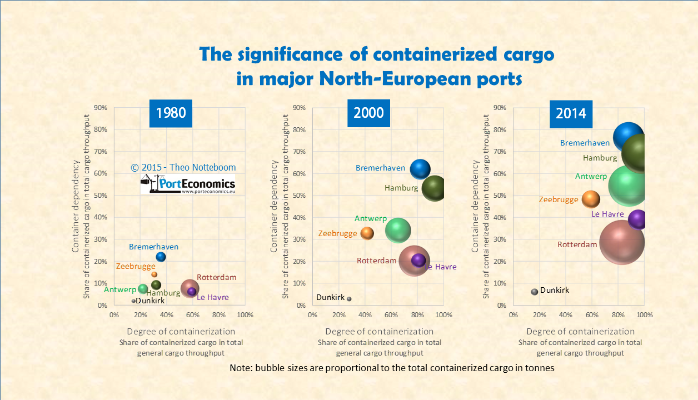
Discussions on port development, planning and competitiveness often tend to revolve around container flows. Quite a few ports around the world have developed some kind of ‘container fetish’, implying they have developed a very strong focus on container throughput. But how dependent are ports on container traffic?

The infographic shows the evolution in some of the main north-European container ports. Three dimensions are presented. The vertical axis shows the container dependency or the share of container throughput in the total throughput of the port. The horizontal axis depicts the degree of containerization or the share of containerized cargo in the total general cargo traffic of the port (i.e. total traffic minus liquid and dry bulk traffic). The size of the bubbles is proportional to the containerized cargo volume expressed in tonnes. The graphs below give a more detailed picture of the evolution of the container dependency and the degree of containerization in the respective ports for the period 1980-2014. Other ports in the region such as Amsterdam, Zeeland Seaports, Ghent and Wilhelmshaven were not listed given very low container traffic figures during the period of observation.
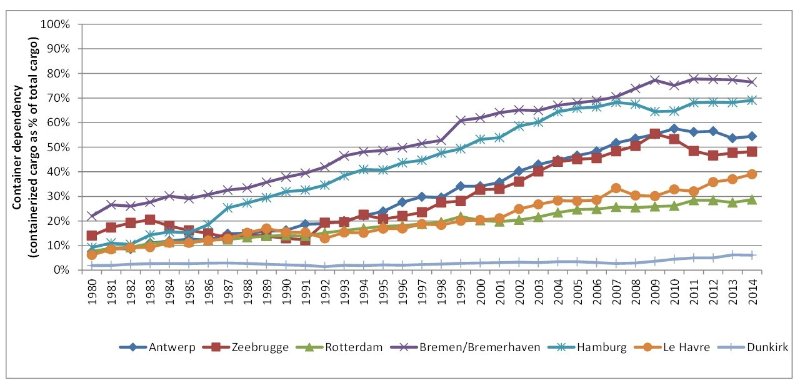
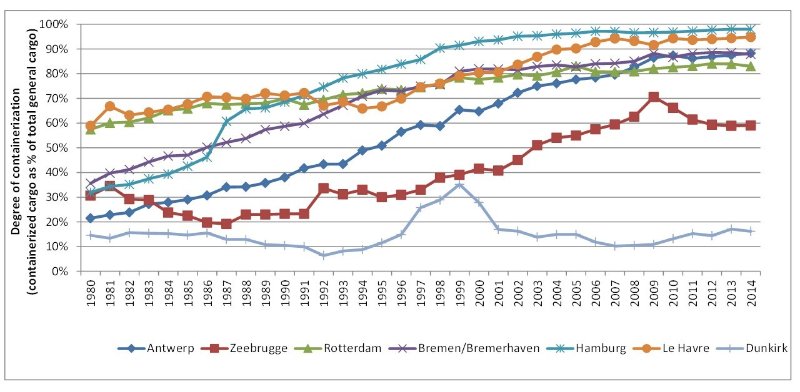
The graphs reveal that the path to increased containerization has not been the same in all ports. Rotterdam and Le Havre have always combined a high degree of containerization with a rather low container dependency. The German ports of Bremen/Bremerhaven and Hamburg have the highest container dependency. They have gone through a strong growth phase in the degree of containerization during the 1980s. At present, almost all general cargo in Hamburg is containerized. The Belgian coastal port of Zeebrugge witnessed a gradual but rather volatile increase in the importance of container traffic. Antwerp, Europe’s largest port in conventional general/breakbulk cargo, saw a very steep rise of the degree of containerization from about 21.5% in 1980 to an elevated 88.3% in 2014. The containerization of conventional general cargo and commodities such as tobacco, coffee, cacao and bananas is one of the factors behind the growth of containerization. Except for Zeebrugge and Dunkirk, all large container ports have reached containerization degrees in excess of 80%. Since almost all break bulk cargo that could be containerized (i.e. in terms of dimensions, weights, etc.) has been containerized, this substitution process is essentially near to completion, except for increasing flows of bulky commodities that are still in the process of being containerized.

The economic crisis made a number of ports to refocus on other cargo flows while not ignoring containerized cargo. For example, several ports such as Antwerp have witnessed strong traffic growth in oil products in recent years following the increasing role of traders in this line of business and the associated development of additional large-scale tank storage capacity. Many ports have developed a strong interest in project cargo, the offshore industry, the recycling business, and biomass and other renewable energy (e.g. ports acting as key nodes in the construction process of large-scale windmill farms on land and in the sea). Are these signs that ports’ container fetish might become somewhat weaker in the years to come?

For further information on the containerization of commodities: Rodrigue, J.-P., Notteboom, T. (2014), Looking inside the box: evidence from the containerization of commodities and the cold chain. Maritime Policy and Management, vol. 42, no. 3, pp. 207-227.
Next article The production of capitalist ‘‘smooth’’ space in global port operations
Previous article How dependent are west-med ports on containers?

Theo Notteboom

Dr. Theo Notteboom is co-founder and co-director of PortEconomics. He is a professor in port and maritime economics and management with about 25 years of experience in this area. His work is widely cited. He is a regular speaker at international conferences and a rapporteur/expert to leading organizations in the field. He is Chair Professor at Ghent University in Belgium. He is a visiting Research Professor at China Institute of FTZ Supply Chain of Shanghai Maritime University. He also is part-time Professor at University of Antwerp and the Antwerp Maritime Academy in Belgium. He previously held a full-time position as High-end Foreign Expert / Professor at Dalian Maritime University in China (2014-2016) and an MPA visiting professorship in port management at Nanyang Technological University (NTU) in Singapore. He is immediate past President (2010-2014) and Council Member of International Association of Maritime Economists (IAME). Between October 2006 and October 2014 he was President of ITMMA of the University of Antwerp. Between 2009 and 2014 he was Chairman of the Board of Directors of Belgian Institute of Transport Organizers (BITO), an institute of the Belgian Federal Government.

Related Posts

Rhine-Scheldt delta port system Featured

Rhine-Scheldt delta port system

Commission unveils new EU Ports Strategy European Port Policy

Commission unveils new EU Ports Strategy

PortGraphic: Container port dynamics near Gibraltar Containers

PortGraphic: Container port dynamics near Gibraltar

Weekly Timeline
Mar 9th 4:35 PM
Featured

Rhine-Scheldt delta port system

Mar 6th 1:23 PM
Thematic Area

Commission unveils new EU Ports Strategy

Feb 18th 1:46 PM
Thematic Area

PortGraphic: Container port dynamics near Gibraltar

Feb 12th 12:25 PM
Featured

A metric of global maritime supply chain disruptions: The global supply chain stress index – maritime (GSCSI-M)

Jan 14th 12:56 PM
Noticeboard

Call for papers: Contemporary Maritime Economics: Transformations and Emerging Perspectives

Tweets by @PortEconomics
  • Containers
  • Cruise
  • EPP
  • Ports & COVID-19
  • Back to top
About PortEconomics

PortEconomics is a web-based initiative aiming to advance knowledge exchange on seaport studies. Established by maritime economists affiliated to academic institutions in Belgium, Greece and the Netherlands. It provides freely accessible research, education, information, and network-building material on critical issues of port economics, management and policies.

Additional Information
  • About
  • Login
  • Register
  • Edit Profile
  • Contact us
  • PortProfessionals
  • PortReport Series
  • Terms and Conditions
  • Cookie Policy
© PortEconomics 2025. All rights reserved.
Produced by PortEconomics
Manage Consent
To provide the best experiences, we use technologies like cookies to store and/or access device information. Consenting to these technologies will allow us to process data such as browsing behavior or unique IDs on this site. Not consenting or withdrawing consent, may adversely affect certain features and functions.
Functional Always active
The technical storage or access is strictly necessary for the legitimate purpose of enabling the use of a specific service explicitly requested by the subscriber or user, or for the sole purpose of carrying out the transmission of a communication over an electronic communications network.
Preferences
The technical storage or access is necessary for the legitimate purpose of storing preferences that are not requested by the subscriber or user.
Statistics
The technical storage or access that is used exclusively for statistical purposes. The technical storage or access that is used exclusively for anonymous statistical purposes. Without a subpoena, voluntary compliance on the part of your Internet Service Provider, or additional records from a third party, information stored or retrieved for this purpose alone cannot usually be used to identify you.
Marketing
The technical storage or access is required to create user profiles to send advertising, or to track the user on a website or across several websites for similar marketing purposes.
  • Manage options
  • Manage services
  • Manage {vendor_count} vendors
  • Read more about these purposes
View preferences
  • {title}
  • {title}
  • {title}