


• Home
  • About
    • Members
    • Associate Members
    • Former members
  • Thematic Areas
    • Containers
    • Cruise
    • European Port Policy
    • Ports & COVID-19
  • PortStudies
  • Presentations
  • Noticeboard
  • Viewpoints
  • PortLibrary
  • PortReport
PortEconomics
  • March 20th, 2026
PortEconomics
  • Home
  • About
    • Members
    • Associate Members
    • Former members
  • Thematic Areas
    • Containers
    • Cruise
    • European Port Policy
    • Ports & COVID-19
  • PortStudies
    Rhine-Scheldt delta port system

    Rhine-Scheldt delta port system

    A metric of global maritime supply chain disruptions: The global supply chain stress index - maritime (GSCSI-M)

    A metric of global maritime supply chain disruptions: The global supply chain stress index - maritime (GSCSI-M)

    ESG disclosure as a proxy of port corporate communication and sustainable management strategy: An LDA approach

    ESG disclosure as a proxy of port corporate communication and sustainable management strategy: An LDA approach

    From coal exports to green steel production? The role of circular economy precincts for sustainable port diversification

    From coal exports to green steel production? The role of circular economy precincts for sustainable port diversification

    Maritime transport in net zero

    Maritime transport in net zero

  • Presentations
    PortGraphic: Container port dynamics near Gibraltar

    PortGraphic: Container port dynamics near Gibraltar

    Top-10 PortReads in 2025

    Top-10 PortReads in 2025

    Port reform: World Bank publishes the third edition of its port reform toolkit

    Port reform: World Bank publishes the third edition of its port reform toolkit

    When will we admit that maritime transport will not be decarbonised by 2050?

    When will we admit that maritime transport will not be decarbonised by 2050?

    Digital technologies for efficient and resilient sea-land logistics

    Digital technologies for efficient and resilient sea-land logistics

  • Noticeboard
    Call for papers: Contemporary Maritime Economics: Transformations and Emerging Perspectives

    Call for papers: Contemporary Maritime Economics: Transformations and Emerging Perspectives

    ECONSHIP2026: Call for papers

    ECONSHIP2026: Call for papers

    Call for papers: 1st Florence Maritime Regulation Conference

    Call for papers: 1st Florence Maritime Regulation Conference

    PortEconomics co-director appointed Senior Scientific Advisor to the Florence School of Regulation

    PortEconomics co-director appointed Senior Scientific Advisor to the Florence School of Regulation

    Jean Monnet Chair in European Port Policy

    Jean Monnet Chair in European Port Policy

  • Viewpoints
    Commission unveils new EU Ports Strategy

    Commission unveils new EU Ports Strategy

    PortGraphic: Top-15 EU container ports in Q3 2025

    PortGraphic: Top-15 EU container ports in Q3 2025

    Maritime transport in net zero

    Maritime transport in net zero

    Portgraphic: Top-15 EU container ports in H1 2025

    Portgraphic: Top-15 EU container ports in H1 2025

    Portgraphic: fleet capacity (owned/chartered) of container shipping lines

    Portgraphic: fleet capacity (owned/chartered) of container shipping lines

  • PortLibrary
  • PortReport
Dutch and Belgian container ports: life in the fast laneContainers

Dutch and Belgian container ports: life in the fast lane

November 9th, 2018 Containers, European Port Policy, Featured

READ ALSO

PortGraphic: Container port dynamics near Gibraltar
Call for papers: Contemporary Maritime Economics: Transformations and Emerging Perspectives
PortGraphic: Top-15 EU container ports in Q3 2025
Rhine-Scheldt delta port system

By Theo Notteboom

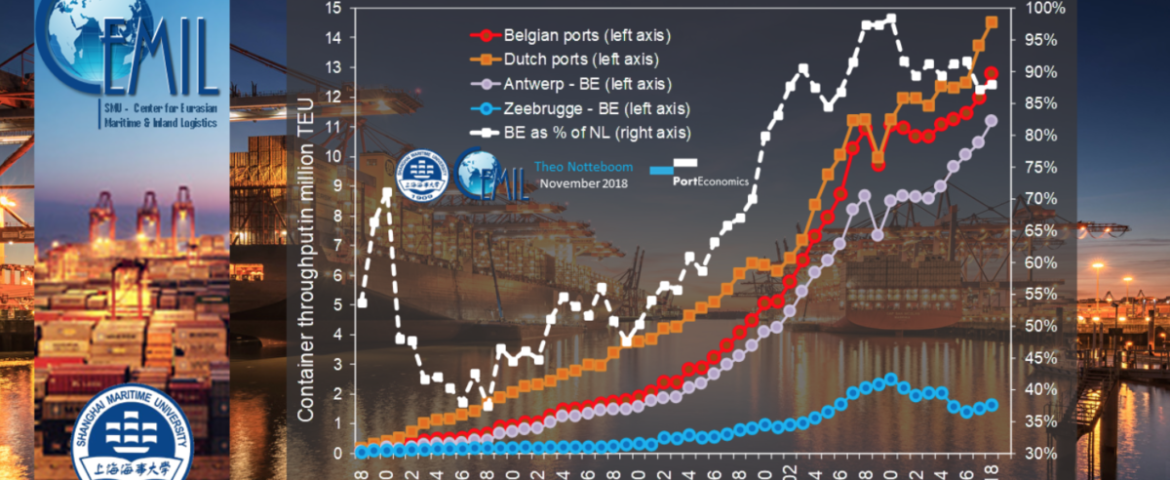
Belgian and Dutch container ports are located in the Rhine-Scheldt Delta, the largest container port region in Europe in volume terms. Dutch and Belgian ports together handled 25.8 million TEU in 2017 or 7.9% more than in 2016. The Belgian-Dutch port region recorded a year-on-year growth of 6.2% in Q1-Q3 2018, so growth remains strong. In 2017, 23.9% of the total European container port traffic was handled by Belgian and Dutch ports. With these figures, the Rhine-Scheldt Delta port region is the most important port region in Europe.

23.9% of the total European container port traffic is handled by Belgian and Dutch ports.

Rotterdam continues to dominate the Dutch container port system handling 13.73 million TEU in 2017 or 99.2% of all container volumes handled in Dutch ports. Just before the crisis, Amsterdam’s container business saw a temporary rise, but Rotterdam’s share in total Dutch throughput never dropped below 98.6%.

Rotterdam continues to dominate the Dutch container port system

The Belgian container port system relies on two ports: upstream port Antwerp and coastal port Zeebrugge, with the port of Ghent (now part of North Sea Port after the merger with Dutch neighbour Zeeland Seaports) handling a very small container volume. Antwerp had a strong growth in container throughput of 7.5% in 2015 and continued this path with a healthy 4% growth in 2016 and 2017 and a 6.8% growth based on Q3 2018 figures. The Scheldt port, Europe’s second largest container port, reached just over 10.45 million TEU in 2017, thereby broadening the throughput gap with Hamburg, Europe’s third largest container port.

Antwerp is broadening the throughput gap with Hamburg, Europe’s third largest container port.

The Belgian port of Zeebrugge initially overcame the crisis very well, even becoming the ninth largest container port in Europe in 2010, but afterwards booked traffic losses. This trend further reinforced in 2015 and 2016 with a significant drop in container volumes of 23.8% in 2015 and a further drop of some 10% in 2016. While Antwerp reaped the full benefits of the reshuffling in strategic alliances in liner shipping including an increase in Far East service calls, the same developments negatively affected Zeebrugge’s position. Since 2017, Zeebrugge’s volumes are on the rise again with a growth of 8.7% in 2017 and 6.3% in Q1-Q3 2018.

Since 2017, Zeebrugge’s volumes are on the rise again.

The graph shows that combined container volumes in the Belgian container ports closed in fast on Dutch ports during the 1990s and the early 2000s. In 2010 the gap was almost closed, but since 2011 the traffic difference increased to 8-12%. Antwerp is feeling the full impact of the move of the MPET terminal from the Delwaidedock on the right bank of the Scheldt River to the Deurganckdock on the left bank, giving MSC and its 2M partner Maersk Line much needed room for further growth. Antwerp is also waiting for the formal approval by the Flemish government of the much-needed container terminal capacity extension. The plan on the table right now involves the addition of at least 7 million TEU of capacity by creating new terminal patches around the Deurganckdock and the Noordzeeterminal and by the construction of a new dock accessible via the Deurganckdock. The port of Rotterdam is seeing the full impact of the two large scale new container facilities at Maasvlakte 2 and other facilities such as Euromax. Zeebrugge is trying to renew its position in the deepsea container business while consolidating its position as the no. 1 car handling port in the world and a key roro port for the UK market. A possible alliance or merger between the port authorities of Antwerp and Zeebrugge is currently being considered and analysed. Next to the more political debate surrounding this issue, attention is going to the potential business rationale driving possible far-reaching cooperation schemes.
Next article ESPO’s Liber Amicorum: PortEconomics joins celebrations of 25 years ESPO
Previous article Measuring environmental efficiency of cruise companies considering corporate social responsibility

Theo Notteboom

Dr. Theo Notteboom is co-founder and co-director of PortEconomics. He is a professor in port and maritime economics and management with about 25 years of experience in this area. His work is widely cited. He is a regular speaker at international conferences and a rapporteur/expert to leading organizations in the field. He is Chair Professor at Ghent University in Belgium. He is a visiting Research Professor at China Institute of FTZ Supply Chain of Shanghai Maritime University. He also is part-time Professor at University of Antwerp and the Antwerp Maritime Academy in Belgium. He previously held a full-time position as High-end Foreign Expert / Professor at Dalian Maritime University in China (2014-2016) and an MPA visiting professorship in port management at Nanyang Technological University (NTU) in Singapore. He is immediate past President (2010-2014) and Council Member of International Association of Maritime Economists (IAME). Between October 2006 and October 2014 he was President of ITMMA of the University of Antwerp. Between 2009 and 2014 he was Chairman of the Board of Directors of Belgian Institute of Transport Organizers (BITO), an institute of the Belgian Federal Government.

Related Posts

Rhine-Scheldt delta port system Featured

Rhine-Scheldt delta port system

Commission unveils new EU Ports Strategy European Port Policy

Commission unveils new EU Ports Strategy

PortGraphic: Container port dynamics near Gibraltar Containers

PortGraphic: Container port dynamics near Gibraltar

Weekly Timeline
Mar 9th 4:35 PM
Featured

Rhine-Scheldt delta port system

Mar 6th 1:23 PM
Thematic Area

Commission unveils new EU Ports Strategy

Feb 18th 1:46 PM
Thematic Area

PortGraphic: Container port dynamics near Gibraltar

Feb 12th 12:25 PM
Featured

A metric of global maritime supply chain disruptions: The global supply chain stress index – maritime (GSCSI-M)

Jan 14th 12:56 PM
Noticeboard

Call for papers: Contemporary Maritime Economics: Transformations and Emerging Perspectives

Tweets by @PortEconomics
  • Containers
  • Cruise
  • EPP
  • Ports & COVID-19
  • Back to top
About PortEconomics

PortEconomics is a web-based initiative aiming to advance knowledge exchange on seaport studies. Established by maritime economists affiliated to academic institutions in Belgium, Greece and the Netherlands. It provides freely accessible research, education, information, and network-building material on critical issues of port economics, management and policies.

Additional Information
  • About
  • Login
  • Register
  • Edit Profile
  • Contact us
  • PortProfessionals
  • PortReport Series
  • Terms and Conditions
  • Cookie Policy
© PortEconomics 2025. All rights reserved.
Produced by PortEconomics
Manage Consent
To provide the best experiences, we use technologies like cookies to store and/or access device information. Consenting to these technologies will allow us to process data such as browsing behavior or unique IDs on this site. Not consenting or withdrawing consent, may adversely affect certain features and functions.
Functional Always active
The technical storage or access is strictly necessary for the legitimate purpose of enabling the use of a specific service explicitly requested by the subscriber or user, or for the sole purpose of carrying out the transmission of a communication over an electronic communications network.
Preferences
The technical storage or access is necessary for the legitimate purpose of storing preferences that are not requested by the subscriber or user.
Statistics
The technical storage or access that is used exclusively for statistical purposes. The technical storage or access that is used exclusively for anonymous statistical purposes. Without a subpoena, voluntary compliance on the part of your Internet Service Provider, or additional records from a third party, information stored or retrieved for this purpose alone cannot usually be used to identify you.
Marketing
The technical storage or access is required to create user profiles to send advertising, or to track the user on a website or across several websites for similar marketing purposes.
  • Manage options
  • Manage services
  • Manage {vendor_count} vendors
  • Read more about these purposes
View preferences
  • {title}
  • {title}
  • {title}