

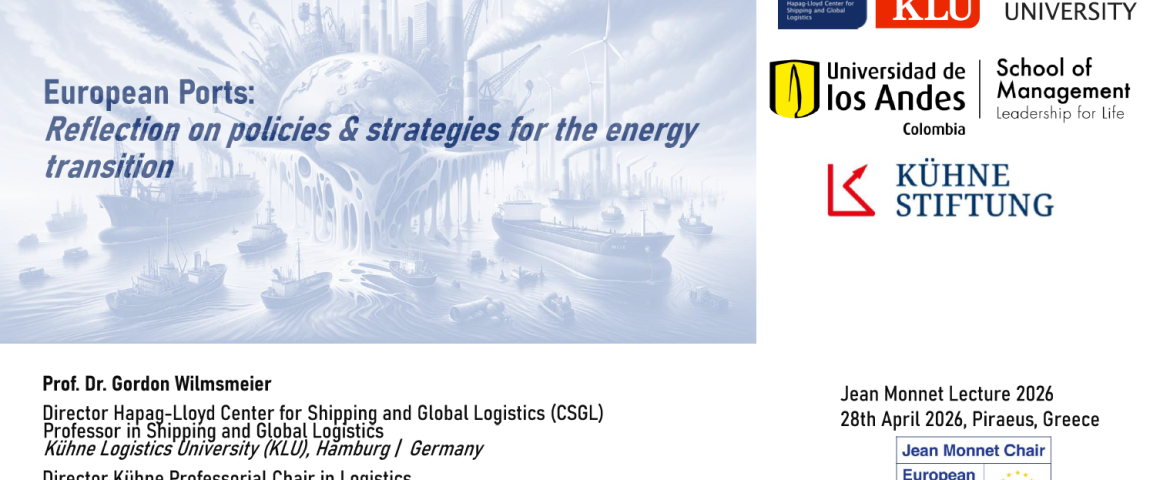
The transformation of European ports is becoming a central issue in the global energy transition. As highlighted in the presentation of PortEconomics member Gordon Wilmsmeier, ports are no longer simple nodes of transport but strategic hubs within complex energy and logistics systems. The current global risk landscape, shaped by climate change, geopolitical tensions, and economic uncertainty, is directly influencing port development and operations.
Ports play a critical role in enabling decarbonization by facilitating cleaner shipping, supporting the adoption of alternative fuels, and integrating renewable energy into their infrastructure. They act as key interfaces between energy production, industrial demand, and global trade flows. Around 40% of energy commodities pass through ports, underlining their importance in the transition process.
However, this transition is not only technological but also structural and political. The spatial configuration of low-carbon value chains is evolving, affecting regional economies and global logistics networks. Ports must adapt to these changes while balancing competitiveness, sustainability, and resilience.
Policy and strategy are essential in guiding this transformation. While targets such as net-zero emissions are important, the real challenge lies in defining practical pathways to achieve them. Effective policymaking requires coordination among multiple stakeholders, including governments, port authorities, energy providers, and local communities.
Moreover, ports face strong inertia due to existing infrastructures and institutional frameworks. Change is therefore gradual and path-dependent, requiring innovative strategies to overcome resistance and align long-term investments with sustainability goals.
Successful energy transition in ports depends on collaboration, realistic planning, and measurable impact. Evaluating actions based on emissions reduction, cost efficiency, and implementation time is crucial for prioritising initiatives.
In a rapidly changing, multipolar world, ports must shift from optimising efficiency to ensuring systemic robustness. Their ability to adapt to uncertainty and manage complex interdependencies will determine their future role in global trade and energy systems.
The lecture of Prof. Gordon Wilmsmeier was given in the context of the Jean Monnet Chair in European Port Policy (JMC-EPP) at the University of Piraeus. Find more about the JMC-EPP here.
Download the full presentation of the lecture via PortEconomics.