


• Home
  • About
    • Members
    • Associate Members
    • Former members
  • Thematic Areas
    • Containers
    • Cruise
    • European Port Policy
    • Ports & COVID-19
  • PortStudies
  • Presentations
  • Noticeboard
  • Viewpoints
  • PortLibrary
  • PortReport
PortEconomics
  • September 24th, 2026
PortEconomics
  • Home
  • About
    • Members
    • Associate Members
    • Former members
  • Thematic Areas
    • Containers
    • Cruise
    • European Port Policy
    • Ports & COVID-19
  • PortStudies
    Geopolitical leverage through the international activities of State-Owned Enterprises (SOEs) in ports and maritime logistics

    Geopolitical leverage through the international activities of State-Owned Enterprises (SOEs) in ports and maritime logistics

    Risk-driven supply chain designs – a re-assessment with geopolitical and geoeconomic considerations

    Risk-driven supply chain designs – a re-assessment with geopolitical and geoeconomic considerations

    Rhine-Scheldt delta port system

    Rhine-Scheldt delta port system

    A metric of global maritime supply chain disruptions: The global supply chain stress index - maritime (GSCSI-M)

    A metric of global maritime supply chain disruptions: The global supply chain stress index - maritime (GSCSI-M)

    ESG disclosure as a proxy of port corporate communication and sustainable management strategy: An LDA approach

    ESG disclosure as a proxy of port corporate communication and sustainable management strategy: An LDA approach

  • Presentations
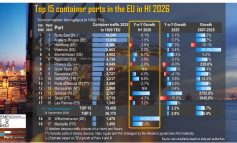
    Top-15 EU container ports in H1 2026

    Top-15 EU container ports in H1 2026

    European ports: The need to avoid the great divide

    European ports: The need to avoid the great divide

    Florence maritime regulation conference: PortEconomics members shape maritime regulation

    Florence maritime regulation conference: PortEconomics members shape maritime regulation

    New edition: Developing ports as business ecosystems

    New edition: Developing ports as business ecosystems

    European Ports: Reflection on policies and strategies for the energy transition

    European Ports: Reflection on policies and strategies for the energy transition

  • Noticeboard
    Call for papers: Contemporary Maritime Economics: Transformations and Emerging Perspectives

    Call for papers: Contemporary Maritime Economics: Transformations and Emerging Perspectives

    ECONSHIP2026: Call for papers

    ECONSHIP2026: Call for papers

    Call for papers: 1st Florence Maritime Regulation Conference

    Call for papers: 1st Florence Maritime Regulation Conference

    PortEconomics co-director appointed Senior Scientific Advisor to the Florence School of Regulation

    PortEconomics co-director appointed Senior Scientific Advisor to the Florence School of Regulation

    Jean Monnet Chair in European Port Policy

    Jean Monnet Chair in European Port Policy

  • Viewpoints
    Top-15 EU container ports in H1 2026

    Top-15 EU container ports in H1 2026

    European ports: The need to avoid the great divide

    European ports: The need to avoid the great divide

    New edition: Developing ports as business ecosystems

    New edition: Developing ports as business ecosystems

    Maritime and port strategies as state policies: an introductory approach

    Maritime and port strategies as state policies: an introductory approach

    European Ports: Reflection on policies and strategies for the energy transition

    European Ports: Reflection on policies and strategies for the energy transition

  • PortLibrary
  • PortReport
COVID-19 and maritime transport: impact and responsesEuropean Port Policy

COVID-19 and maritime transport: impact and responses

October 28th, 2020 European Port Policy, Featured, Ports & COVID-19, Thematic Area

READ ALSO

Geopolitical leverage through the international activities of State-Owned Enterprises (SOEs) in ports and maritime logistics
European ports: The need to avoid the great divide
Florence maritime regulation conference: PortEconomics members shape maritime regulation
Top-15 EU container ports in H1 2026

“COVID-19 and maritime transport: impact and responses”  is a report produced under Phase I of the maritime supply chain component of the United Nations Development Account (UNDA) project on “Transport and trade connectivity in the age of pandemics: Contactless, seamless and collaborative UN solutions”.

About the Report

The report was prepared by Porteconomics co-director Thanos Pallis under the overall guidance of Shamika N. Sirimanne, Director of the Division on Technology and Logistics of UNCTAD. It benefited from substantive contributions by Jan Hoffmann, Frida Youssef, Hassiba Benamara, and Ahmad Ayoub, Trade Logistics Branch, Division on Technology and Logistics.

Beyond the extensive published information, the section on responses and adjustments introduced by ports has benefited from insights generated as part of the discussions and documents produced by the COVID-19 Task Force of the International Association of Ports and Harbors (IAPH). Furthermore, it builds on the findings reported in the various issues of the publication: Notteboom T. and Pallis A.A. (2020). IAPH-WPSP COVID-19 Port Economic Impact Barometer.

Introduction

Maritime transport underpins global supply chain linkages and economic interdependency with shipping and ports estimated to handle over 80 per cent of global merchandise trade by volume and more than 70 per cent by value. As a result, when disruptive factors such as pandemics occur, the sector works as a transmission channel that sends shockwaves across supply chains and regions.

Strengthening the capacity of countries to anticipate and recover from disruptions affecting their maritime supply chain is crucial. This requires a good understanding of how the COVID-19 affected the sector, including the challenges faced and the solutions that had been adopted. Therefore, and building on its broad mandate in the field of transport and trade facilitation, UNCTAD carried out a preliminary assessment of the immediate impacts of the COVID-19 disruption on the maritime supply chain and trade over the first half of 2020.

The assessment was articulated around the following issues:

  • Impacts of the COVID-19 on the maritime supply chain and challenges faced.
  • Response measures introduced by relevant stakeholders.
  • Lessons learned and implications for the maritime supply chain of the future.

Against this background, Chapters 1 and 2 of the report describe the immediate impacts of the pandemic on maritime trade flows, ship calls, and liner shipping connectivity in the first half of 2020. Chapter 3 highlights relevant responses and adjustments made at the port level as well as by other stakeholders across the maritime supply chain to cope with the disruption and maintain business continuity, while at the same time, protecting workers and ensuring timely delivery of essential goods during the crisis.

 Download the report here – enjoy its reading:  ➡️ COVID-19 and maritime transport: impact and responses

The assessment has generated some key findings and identified some lessons and good practices that could be leveraged to develop guidance and tools with a view to greater maritime supply chain resilience and preparedness in the face of shocks and disruptions.
Next article Brand strategies of container shipping lines following mergers and acquisitions: carriers’ visual identity options
Previous article Port and dry port life cycles: aligning systems complexity

Related Posts

Top-15 EU container ports in H1 2026 Containers

Top-15 EU container ports in H1 2026

Geopolitical leverage through the international activities of State-Owned Enterprises (SOEs) in ports and maritime logistics Category

Geopolitical leverage through the international activities of State-Owned Enterprises (SOEs) in ports and maritime logistics

European ports: The need to avoid the great divide European Port Policy

European ports: The need to avoid the great divide

Weekly Timeline
Sep 22nd 10:21 AM
Thematic Area

Top-15 EU container ports in H1 2026

Sep 17th 12:11 PM
Category

Geopolitical leverage through the international activities of State-Owned Enterprises (SOEs) in ports and maritime logistics

Jul 22nd 3:50 PM
Thematic Area

European ports: The need to avoid the great divide

Jul 21st 1:41 PM
Thematic Area

Florence maritime regulation conference: PortEconomics members shape maritime regulation

Jul 2nd 2:45 PM
Presentations

New edition: Developing ports as business ecosystems

Tweets by @PortEconomics
  • Containers
  • Cruise
  • EPP
  • Ports & COVID-19
  • Back to top
About PortEconomics

PortEconomics is a web-based initiative aiming to advance knowledge exchange on seaport studies. Established by maritime economists affiliated to academic institutions in Belgium, Greece and the Netherlands. It provides freely accessible research, education, information, and network-building material on critical issues of port economics, management and policies.

Additional Information
  • About
  • Login
  • Register
  • Edit Profile
  • Contact us
  • PortProfessionals
  • PortReport Series
  • Terms and Conditions
  • Cookie Policy
© PortEconomics 2025. All rights reserved.
Produced by PortEconomics
Manage Consent
To provide the best experiences, we use technologies like cookies to store and/or access device information. Consenting to these technologies will allow us to process data such as browsing behavior or unique IDs on this site. Not consenting or withdrawing consent, may adversely affect certain features and functions.
Functional Always active
The technical storage or access is strictly necessary for the legitimate purpose of enabling the use of a specific service explicitly requested by the subscriber or user, or for the sole purpose of carrying out the transmission of a communication over an electronic communications network.
Preferences
The technical storage or access is necessary for the legitimate purpose of storing preferences that are not requested by the subscriber or user.
Statistics
The technical storage or access that is used exclusively for statistical purposes. The technical storage or access that is used exclusively for anonymous statistical purposes. Without a subpoena, voluntary compliance on the part of your Internet Service Provider, or additional records from a third party, information stored or retrieved for this purpose alone cannot usually be used to identify you.
Marketing
The technical storage or access is required to create user profiles to send advertising, or to track the user on a website or across several websites for similar marketing purposes.
  • Manage options
  • Manage services
  • Manage {vendor_count} vendors
  • Read more about these purposes
View preferences
  • {title}
  • {title}
  • {title}