


• Home
  • About
    • Members
    • Associate Members
    • Former members
  • Thematic Areas
    • Containers
    • Cruise
    • European Port Policy
    • Ports & COVID-19
  • PortStudies
  • Presentations
  • Noticeboard
  • Viewpoints
  • PortLibrary
  • PortReport
PortEconomics
  • March 21st, 2026
PortEconomics
  • Home
  • About
    • Members
    • Associate Members
    • Former members
  • Thematic Areas
    • Containers
    • Cruise
    • European Port Policy
    • Ports & COVID-19
  • PortStudies
    Rhine-Scheldt delta port system

    Rhine-Scheldt delta port system

    A metric of global maritime supply chain disruptions: The global supply chain stress index - maritime (GSCSI-M)

    A metric of global maritime supply chain disruptions: The global supply chain stress index - maritime (GSCSI-M)

    ESG disclosure as a proxy of port corporate communication and sustainable management strategy: An LDA approach

    ESG disclosure as a proxy of port corporate communication and sustainable management strategy: An LDA approach

    From coal exports to green steel production? The role of circular economy precincts for sustainable port diversification

    From coal exports to green steel production? The role of circular economy precincts for sustainable port diversification

    Maritime transport in net zero

    Maritime transport in net zero

  • Presentations
    PortGraphic: Container port dynamics near Gibraltar

    PortGraphic: Container port dynamics near Gibraltar

    Top-10 PortReads in 2025

    Top-10 PortReads in 2025

    Port reform: World Bank publishes the third edition of its port reform toolkit

    Port reform: World Bank publishes the third edition of its port reform toolkit

    When will we admit that maritime transport will not be decarbonised by 2050?

    When will we admit that maritime transport will not be decarbonised by 2050?

    Digital technologies for efficient and resilient sea-land logistics

    Digital technologies for efficient and resilient sea-land logistics

  • Noticeboard
    Call for papers: Contemporary Maritime Economics: Transformations and Emerging Perspectives

    Call for papers: Contemporary Maritime Economics: Transformations and Emerging Perspectives

    ECONSHIP2026: Call for papers

    ECONSHIP2026: Call for papers

    Call for papers: 1st Florence Maritime Regulation Conference

    Call for papers: 1st Florence Maritime Regulation Conference

    PortEconomics co-director appointed Senior Scientific Advisor to the Florence School of Regulation

    PortEconomics co-director appointed Senior Scientific Advisor to the Florence School of Regulation

    Jean Monnet Chair in European Port Policy

    Jean Monnet Chair in European Port Policy

  • Viewpoints
    Commission unveils new EU Ports Strategy

    Commission unveils new EU Ports Strategy

    PortGraphic: Top-15 EU container ports in Q3 2025

    PortGraphic: Top-15 EU container ports in Q3 2025

    Maritime transport in net zero

    Maritime transport in net zero

    Portgraphic: Top-15 EU container ports in H1 2025

    Portgraphic: Top-15 EU container ports in H1 2025

    Portgraphic: fleet capacity (owned/chartered) of container shipping lines

    Portgraphic: fleet capacity (owned/chartered) of container shipping lines

  • PortLibrary
  • PortReport
Blockchains for logistics: from hype to relevance?Category

Blockchains for logistics: from hype to relevance?

June 25th, 2018 Category, Featured, Viewpoints

READ ALSO

Port reform: World Bank publishes the third edition of its port reform toolkit
In a tight spot: American ports in global supply chains
Cruise industry in 2025 at a glance
Rhine-Scheldt delta port system

By Jean-Paul Rodrigue

An artificial consensus

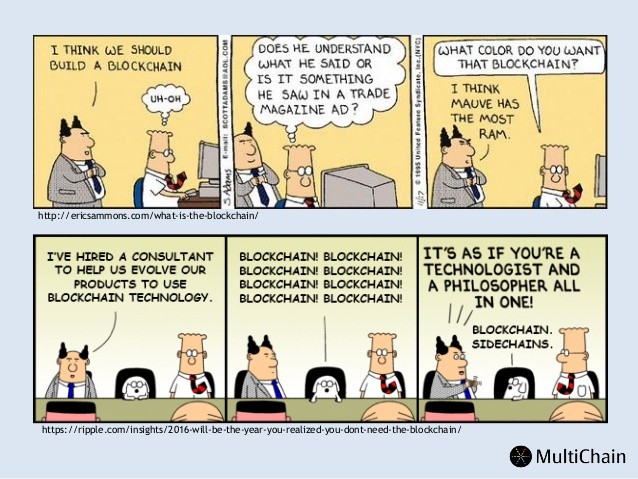
While presenting at recent transportation trade conferences I expressed rather skeptical views about the potential of Blockchains for logistics, which raised a few eyebrows and critiques. The industry is currently drinking its own cool-aid and caught in the standard hype cycle where the benefits of a new technology are exaggerated while the complexity and costs of its implementation are discounted. Many do not understand well what it entails from a technological, managerial and operational standpoint, but are ready to endorse the hype that Blockchains are going to revolutionize supply chains because they are supposed to revolutionize supply chains. This is the classic circular logic flaw. Even worst, many who claim about the merits of the technology have limited experience or particular knowledge on the issue and are simply repeating marketing statements put forward their corporation or organization, further promoting cognitive dissonance. The discourse does not yet match the reality. This is why that at this point I say ‘bullshit’.

There is a need to go beyond this emerging artificial consensus and cognitive dissonance until there is solid evidence of the effective operational applications of Blockchains in logistics; from hype to relevance. A good share of the trade literature and opinions issued on the topic enthusiastically underline the benefits of Blockchains while the discourse remains at that level; Blockchains are beneficial because they are beneficial. What we have so far is rather partial information and many actors (shipping lines, logistics service providers, port authorities, etc.) seriously committed to explore its potential and develop operational systems that are due to transform the world of logistics ‘any time soon’. I am quite confident that impressive results are very likely emerge, but beforehand one has to have the intellectual integrity to acknowledge that transportation and logistics are complex systems to manage and that fitting Blockchains to support this complexity is much easier said than done. Be prepared for disappointments and spectacular failures.

The promise of blockchains

At this point, this is where Blockchains stand at; A promise that could either fall short or be reached beyond expectations. Looking more closely at this promise requires the understanding of a technology which in appearance may look straightforward, but actually requires an effort to get a reasonable grasp of. A review of the technology underlines the following:

  • The core principles of a Blockchain (distributed electronic ledger) based on the creation and transmission of unique digital objects (blocks) shared across a network of servers (nodes). It implies an implicit level of digital trust where each transaction is verifiable and immutable.
  • The commercial purpose of a Blockchain is to generate value to logistics chains. Due to the transactional intensity of logistics, the main value proposition involves contract management, coordination (stakeholders able to more effectively share information) and dis-intermediation (stakeholders able to directly interact without a third party). Automated settlements (smart contracts) can also be arranged so that payments are done when a set of conditions have been met and verified (e.g. a shipment has been received at a warehouse).
  • The expected benefits of Blockchains on supply chains are related to its velocity (less latency, improved inventory management), visibility (tracking enabling coordination) and tracing (an immutable encoded sequence of events).
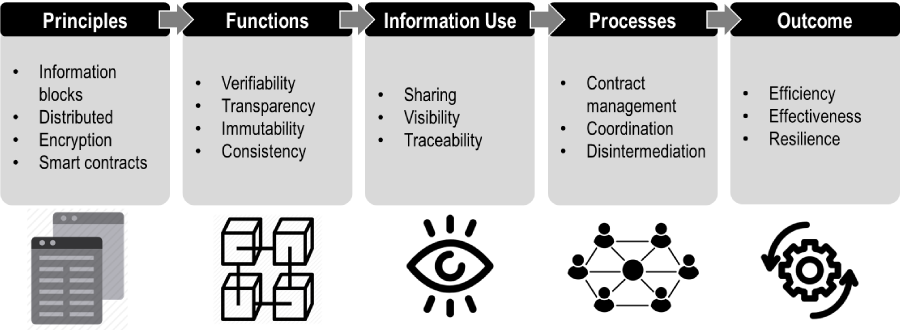
All of the above can certainly be an attractive proposition but it is important to underline that most of it remains largely unproven.

A complex puzzle

Blockchains for logistics are therefore a complex puzzle where several pieces must fit together to reach effective outcomes. Among the most importance pieces:

  • A common platform. An important factor in the success of containerization was the fact that the container became a standard open source product open to all. What would be the state of the global economy and international trade if the container was not an open source and subject to different standards? The current risk is that competing Blockchain platforms are developed, leading to duplication. Who will be able to set the standard and have it accepted?
  • A network able to handle the massive distributed computing and storage load. A distributed network may have a higher cost than a centralized network even if this network is more resilient. Who will provide the infrastructure and the energy in a profitable fashion to avoid free riders?
  • Stakeholders along a continuous supply chain willing to collaborate and trust the platform. The electronic coordination of a Blockchain platform is a complex social coordination problem between service providers, users and regulators. How can the diverging and competing interests of stakeholders be reconciled?
  • Sensors and other means to update a massive amount of digital information (blocks) related to supply chain management. Technically, each action performed on a unit of cargo needs to be appended to the Blockchain, which requires a sensor for input. Since the Blockchain itself is assumed to be secure from tampering, what are the risks that its numerous inputs are not?

We are starting to see partial answers to these questions. A large amount of experimentation about the technology over numerous contexts and platforms is underway. These pilots are going to reveal important lessons and information about the actual strengths and pitfalls of Blockchains and how to make them deliver value for its users.

The history of innovation and its diffusion tells us that eventually the hype will be over and the true relevance of a technology is assessed. A similar pattern applies to Blockchains. It needs to be tested and validated. Until then, I will keep saying ‘bullshit’ until we get a clearer view that is less associated with marketing statements and circular logic.


Next article PortEconomics coordinated Chios Symposium on European port policy marked by success
Previous article Port co-operation: types, drivers and impediments

Related Posts

Rhine-Scheldt delta port system Featured

Rhine-Scheldt delta port system

Commission unveils new EU Ports Strategy European Port Policy

Commission unveils new EU Ports Strategy

PortGraphic: Container port dynamics near Gibraltar Containers

PortGraphic: Container port dynamics near Gibraltar

Weekly Timeline
Mar 9th 4:35 PM
Featured

Rhine-Scheldt delta port system

Mar 6th 1:23 PM
Thematic Area

Commission unveils new EU Ports Strategy

Feb 18th 1:46 PM
Thematic Area

PortGraphic: Container port dynamics near Gibraltar

Feb 12th 12:25 PM
Featured

A metric of global maritime supply chain disruptions: The global supply chain stress index – maritime (GSCSI-M)

Jan 14th 12:56 PM
Noticeboard

Call for papers: Contemporary Maritime Economics: Transformations and Emerging Perspectives

Tweets by @PortEconomics
  • Containers
  • Cruise
  • EPP
  • Ports & COVID-19
  • Back to top
About PortEconomics

PortEconomics is a web-based initiative aiming to advance knowledge exchange on seaport studies. Established by maritime economists affiliated to academic institutions in Belgium, Greece and the Netherlands. It provides freely accessible research, education, information, and network-building material on critical issues of port economics, management and policies.

Additional Information
  • About
  • Login
  • Register
  • Edit Profile
  • Contact us
  • PortProfessionals
  • PortReport Series
  • Terms and Conditions
  • Cookie Policy
© PortEconomics 2025. All rights reserved.
Produced by PortEconomics
Manage Consent
To provide the best experiences, we use technologies like cookies to store and/or access device information. Consenting to these technologies will allow us to process data such as browsing behavior or unique IDs on this site. Not consenting or withdrawing consent, may adversely affect certain features and functions.
Functional Always active
The technical storage or access is strictly necessary for the legitimate purpose of enabling the use of a specific service explicitly requested by the subscriber or user, or for the sole purpose of carrying out the transmission of a communication over an electronic communications network.
Preferences
The technical storage or access is necessary for the legitimate purpose of storing preferences that are not requested by the subscriber or user.
Statistics
The technical storage or access that is used exclusively for statistical purposes. The technical storage or access that is used exclusively for anonymous statistical purposes. Without a subpoena, voluntary compliance on the part of your Internet Service Provider, or additional records from a third party, information stored or retrieved for this purpose alone cannot usually be used to identify you.
Marketing
The technical storage or access is required to create user profiles to send advertising, or to track the user on a website or across several websites for similar marketing purposes.
  • Manage options
  • Manage services
  • Manage {vendor_count} vendors
  • Read more about these purposes
View preferences
  • {title}
  • {title}
  • {title}