Thematic Area

January 4th, 2026
Thematic Area

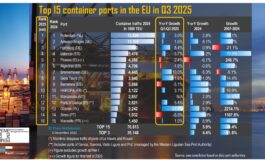
By Theo Notteboom Following a strong recovery in 2024 after a challenging 2023, the first nine months of 2025 reveal a shift in growth dynamics across the top 15 EU container ports: Only three ports achieved double-digit growth: Gdansk leads with an impressive 21.7% increase, largely driven by the launch of its newest terminal at the Baltic Hub. Gioia Tauro continues its upward trajectory, fueled by MSC’s sustained investment and operations. Bremerhaven tops 10% growth and is expected to move from the seventh place in 2024 to the...
December 15th, 2025
Thematic Area

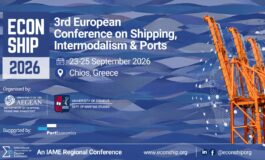
Navigating the Maritime Future: Building Competitive, Sustainable, and Resilient Maritime Supply Chains23-25 September 2026, Chios, Greece Following the successful first editions of 2011 and 2015, ECONSHIP returns, inviting researchers from Europe and around the globe to submit papers on the theme “Navigating the Maritime Future: Building Competitive, Sustainable, and Resilient Maritime Supply Chains”. Proudly supported by PortEconomics, the 3rd edition of the European Conference on Shipping, Intermodalism and Ports –...
December 1st, 2025
Thematic Area

The 1st Florence Maritime Regulation Conference aims to discuss regulatory advancements that accelerate the competitiveness and sustainable development of shipping, ports, and related maritime supply chains in the EU and beyond. Shipping, ports, and related supply chains are cornerstones of the European economy and world trade, which are shaped by regulatory initiatives developing at national, regional, or global scales. The European Union is currently developing a comprehensive strategy to support the long-term competitiveness of the...
November 25th, 2025
Thematic Area

The European Commission has awarded a Jean Monnet Chair to PortEconomics co-director and University of Piraeus, Department of Maritime Studies Professor Thanos Pallis.  Jean Monnet Chairs are specialised teaching posts for university professors, aimed at deepening teaching and research in European Union studies and fostering dialogue between academia and society, both in the Member States of the European Union and in other countries. Co-funded by the European Union, the Jean Monnet Chair in European Port Policy aims to promote the...
October 5th, 2025
Thematic Area

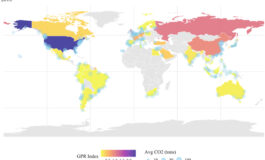
The geopolitical risks and the port-related Carbon Emissions are the theme of the latest portstudy by PortEconomics member Pierre Cariou (co-authored with Chengkun Li and Dr Dong Yang) published in the scholarly journal Transport Policy. The article addresses geopolitical risks (GPR) and their environmental implications for port-related emissions. Using a monthly panel dataset covering 269 container ports across 40 countries and regions from 2016 to 2023 and employing a system generalized method of moments (SYS-GMM) estimator, it confirms that...
October 2nd, 2025
Thematic Area

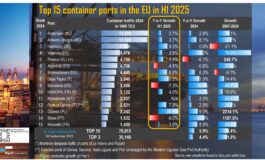
Following the strong recovery of European container ports in 2024 after the turbulence of 2023, the first half of 2025 reveals a reshuffling of growth dynamics across the top 15 EU container ports. While overall volumes remain steady, the latest figures highlight significant regional divergences and notable winners. PortEconomics member Theo Notteboom analyses, the data shows both continuity and shifts in Europe’s container port hierarchy. ✅ Baltic Hub propels Gdansk to the topGdansk leads the European ranking in terms of...
September 18th, 2025
Thematic Area

By Theo Notteboom The global container shipping fleet has experienced significant growth over the past few decades, driven by the steady rise in international trade. Shipping lines have expanded their fleets either through organic growth—as in the case of MSC—or through a combination of organic growth and mergers & acquisitions, like Maersk. Today, the top 20 container carriers collectively operate a fleet (including both owned and chartered vessels) with a total capacity of 30 million TEU. Three years ago, this figure...
August 12th, 2025
Thematic Area

The World Bank published the third edition of the Port Reform Toolkit - highlighting, among others the transformation of ports in recent years and the emerging issues to address. The enhanced Port Reform Toolkit 3.0 begins by analysing global trends and their impact on ports. Module 2 introduces concepts of change management. Then, in eight substantive modules, we explore port governance, privatisation, regulation, finance, and labour arrangements, followed by new modules that are now at the core of future-proofing ports:...
Page 1 of 58123...