Containers

November 16th, 2018
Containers

PortEconomics member, and winner of the 2018 Onassis prize in Shipping, Mary Brooks provides her views on liner shipping industry, in her interview reported via a podcast produced by Supplychainbrain.com. "For the ocean shipping business today, it’s tough enough navigating the rough waters caused by economic cycles. But do carriers sometimes make their own waves? Container shipping is an expensive business. Capital costs are immense, and ships must be planned and built well in advance of their entry into the trades. Matching supply with...
November 9th, 2018
Containers

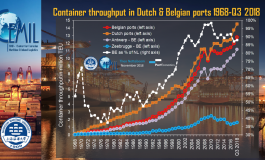
By Theo Notteboom Belgian and Dutch container ports are located in the Rhine-Scheldt Delta, the largest container port region in Europe in volume terms. Dutch and Belgian ports together handled 25.8 million TEU in 2017 or 7.9% more than in 2016. The Belgian-Dutch port region recorded a year-on-year growth of 6.2% in Q1-Q3 2018, so growth remains strong. In 2017, 23.9% of the total European container port traffic was handled by Belgian and Dutch ports. With these figures, the Rhine-Scheldt Delta port region is the most important port...
October 30th, 2018
Containers

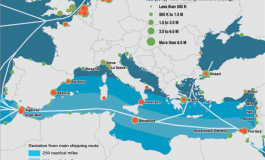
The Mediterranean has been one of the most active trading areas for millennia. Trade- and by extension connectivity- between Mediterranean riparian countries is one of the oldest and most studied topics in economic history. The Mediterranean has complex trade patterns and routes- but with key differences from the past. It is no longer an isolated world economy: it is both a trading area and a transit area linking Europe and North Africa with the rest of the world through the hub-and-spoke structure of maritime...
October 24th, 2018
Containers

Almost from its inception, there has been a clear upward trend in the disruptive force of the container during its use. However, a relative decrease in container movement has been seen in recent years, the explanation of which goes beyond disturbances in the world economy. PortEconomics member Ricardo J. Sánchez along with Eliana Barleta, note that the inter-annual change in throughput with respect to changes in GDP is declining. To understand this phenomenon, Ricardo and Eliana have examined variations in containerization, notably factors...
October 22nd, 2018
Containers

Efficiency improvements are inherent to the sustainability of global supply chains. Supply chains are highly dependent on a diversity of material flows handled by numerous actors (suppliers, carriers, manufacturers, distributors, etc.) and the efficiency of these flows impacts the environmental performance of the supply chain. Yet, there is no particularly clear strategy about improving the efficiency of supply chains, notably from an environmental perspective. The debate about whether environmental efficiency is better achieved through...
October 8th, 2018
Containers

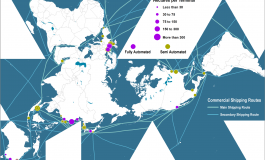
By Jean-Paul Rodrigue Automation is an emerging trend in port terminal development, but taking place at different scale, pace and locations. There are various degrees of automation and in many ways automation is present in a large number of terminals depending how it is defined and if it focuses on infrastructure (e.g. stacking cranes) or information systems (e.g. yard management). The most common definition classifies terminals as fully or semi automated, which is a rather partial one. For instance, a fully automated terminals is...
October 1st, 2018
Containers

How individual factors contribute to the carbon footprint associated with international maritime container supply chains? This is the key question of the latest port study co-authored by PortEconomics members Pierre Cariou, Francesco Parola and Theo Notteboom. The authors advance their research providing four key contributions: Identify six key contributing factors to container shipping emissions Develop a model to isolate the contribution of individual factors. Apply the model to long-term emissions associated to 187 container...
September 4th, 2018
Containers

How the strategic planning of a liner alliance affects the development prospects of a container port? How the relations inside the alliance are reflected on port selection?  Shipping strategies and the rise of global liner alliances is the subject of PortEconomics member George Vaggelas' most recent port study. George has identified the linkages between an alliance and the ownership structure of a container port and the port's importance for the global trade, in order to better understand the evolvement of alliances strategies. His...
August 29th, 2018
Containers

By Theo Notteboom Recently, it was announced that the project to deepen and widen the river Elbe, the nautical access to the port of Hamburg, got the green light. The river Elbe was deepened for the last time in 1999. The idea to improve the nautical conditions on the Elbe is on the table already for many years but project approval was stalled due to environmental issues and procedural complexities. Dredging projects are sensitive in political, port and community circles given the investments involved and the associated economic and...
June 4th, 2018
Containers

By Jean Paul Rodrigue Automation is bringing a series of paradoxes to the shipping industry. Since maritime shipping is in the derived demand business, it is misleading to assume that automation does not affect the demand for shipping as well. Although automation is mostly considered by the industry at the port terminal level, it also takes place across entire supply chains, a process associated with the fourth industrial revolution (manufacturing 4.0/4IR). The impacts of automation may thus be more significant on the...
Page 16 of 34...1415161718...