Thematic Area

April 10th, 2018
Thematic Area

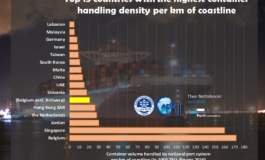
By Theo Notteboom The graph shows the annual container volume handled by a country’s port system per km of coastline. Belgium takes the no. 1 spot closely followed by Singapore. The list contains some other smaller nations with big container ports such as the Netherlands and Malta. The Belgian case is a bit special given that the nautical access via the river Scheldt to Antwerp (no. 2 container port in Europe) for a large part runs over Dutch territory. But even if we take Antwerp’s volume out, Belgium still makes it to the top 5...
April 3rd, 2018
Thematic Area

By Thanos Pallis The launching of the World Ports Sustainability Programme (WPSP) by the International Association of Ports and Harbours (IAPH), the American Association of Port Authorities (AAPA), the European Sea Ports Organisation (ESPO), AIVP – The Worldwide Network of Port Cities (AIVP) and the World Association for Waterborne Transport Infrastructure (PIANC) in March is a major step towards a responsible growth of the port industry. It is a most welcomed initiative by all of us serving ports and the maritime world. WPSP aims to...
April 2nd, 2018
Thematic Area

The relationship between space and institutional change by studying the evolution and development of Hongkong International Terminals (HIT), a Hong Kong-based firm with a highly-established institutional system, in the early 1990s is the theme of the latest port study of PortEconomics member Adolf Ng co authored with Kenneth Wong, K. (Hutchison Port Holdings Limited, Hong Kong, China), Eva C. Shou (Independent Business Professional, Hong Kong, China) and Changmin Jiang (University of Manitoba). The port study investigates how HIT has...
March 27th, 2018
Thematic Area

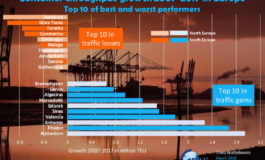
By Theo Notteboom The portgraphic shows the changes in container throughput in European ports between pre-crisis year 2007 and last year. We use absolute growth figures in TEU. The total container throughput in the entire European container port system increased by some 17 million TEU between 2007 and 2017, but not all ports saw traffic gains. Hamburg's volume in 2017 was still 1.07 million TEU below the 2007 volume. Among the losers, we also find Med hubs such as Gioia Tauro and north European ports that were hit hard by the rather recent...
March 26th, 2018
Thematic Area

By Peter de Langen Many port development companies, including port authorities, develop commercial strategies which guide their commercial and investment activities. One common ambition in those strategies is the aim to expand the hinterland The Port of Algeciras aims to serve the Madrid metro area, where Valencia is currently dominant; Rotterdam and Antwerp aim to improve competitiveness in Bavaria, where German ports, especially Hamburg, are dominant; and various US East Coast ports aim to expand their hinterland to destinations such...
March 19th, 2018
Thematic Area

¿Quo vadis América Latina? by Gordon Wilmsmeier El sector marítimo y portuario está experimentando cambios profundos en su organización (concentración de la oferta, alianzas estratégicas, integración vertical entre operadores de terminales y navieras) y tecnología (mayor oferta de capacidad de buques y puertos, automatización y electrificación de terminales portuarias, mayor eficiencia en propulsión de buques, etc.). Estos cambios son globales y ya han comenzado a llegar a nuestra región. ¿Los actores públicos,...
March 18th, 2018
Thematic Area

By Jean-Paul Rodrigue Before going into the specifics about the potential impacts of automation of maritime shipping, it is important to underline that although automation can be solely considered at the port terminal level, it also takes place across entire supply chains. The fourth industrial revolution: The big picture of value chains Actors usually optimize the systems they can control and benefit from, but a common mistake is not to consider the larger impacts of the technologies they are using, both upstream and downstream...
March 13th, 2018
Thematic Area

What are investment needs of European ports and what are the financial challenges in order to address these needs? PortEconomics co-director Peter de Langen has co-authored a study for the European Sea Ports Organisation (ESPO), examining ‘The Infrastructure Investment needs and Financing Challenge of European Ports’, so as to answer these questions.Among others, the study focuses on the diversity of port investments, make the case for investments in basic port infrastructures, explains how investment needs of EU ports are...
March 10th, 2018
Thematic Area

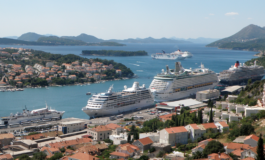
As data of cruise traffic hosted by European ports were revealed this week at the 2018 edition of the annual Seatrade Cruise Global event, held in Florida, US, it is worth diving in the details to better understand the trends in the Mediterranean cruise port system. Analysis by Thanos Pallis While this has been the year that the ‘2 million cruise passengers per year’ club has expanded to three - with Balearic islands ports (2,1 m.) joining Barcelona (2,7 m.), and Civitavecchia (2,2 m.) - statistics revealed another challenging year...
February 28th, 2018
Thematic Area

By Theo Notteboom The cargo volume handled remains a key performance indicator for ports. While also other indicators related to logistics performance, sustainability, innovation and economic impact are gaining ground, it remains relevant to observe how cargo volumes have evolved over time. The table shows the top 15 container ports in the European Union in 2017 based on container throughput expressed in TEU. It also includes container growth figures compared to 2016 and pre-crisis year 2007. What do the figures reveal? Top 15:...
Page 33 of 58...3132333435...