Thematic Area

June 1st, 2015
Thematic Area

The OECD International Transport Forum (ITF) brings cruise and cruise ports at the centre of  discussions during the 2015 ITF/OECD Summit on "Transport, Tourism and Trade", with PortEconomics  co-director Thanos Pallis preparing the background discussion Paper to inform the high-level discussions that took place during the summit. Thanos contributes with a report covering the state of the art and growth potential of cruise shipping (Chapter 1), the characteristics, performance and competition of modern cruise ports (Chapter 2), and the...
May 31st, 2015
Thematic Area

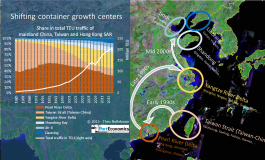
By Theo Notteboom Only 25 years ago, the container port system in mainland China was still in its infancy stage. During that time, Hong Kong acted as the only container gateway to China and Taiwanese ports Kaohsiung and Keelung benefited from Taiwan's economic success story in international trade. In May 1980, the Chinese government established the Shenzhen Special Economic Zone, the first special economic zone in China. By the late 1980s, mainland Chinese ports in the Pearl River Delta saw the first fruits of this opening up policy. Growth...
May 31st, 2015
Thematic Area

With cruise activities in the Mediterranean and its adjoining seas increasing, the cruise world takes initiatives to handle the produced externalities, including the wastes produced on cruise ships. In recent times, cruise lines and ports have put a lot of efforts into reducing, selecting and managing generated wastes implementing the requirements of the international regulatory framework (MARPOL 73/78) as well as those imposed by the European legislation. Thanos Pallis and Aimilia Papachristou in their latest port study that was presented at...
May 28th, 2015
Thematic Area

Port users perceptions of their experience in a given port, do matter and port performance measurement needs to take this into account argue Thanos Pallis and George Vaggelas in their latest port study that was presented at the 5th International Symposium on Ship Operations, Management & Economics (SOME 2015) held in Athens, Greece, 28-29 May 2015. The port industry is experiencing an ongoing transformation due to changes in its internal and external envi-ronment. Nowadays the industry is characterized by fierce competition of...
May 11th, 2015
Thematic Area

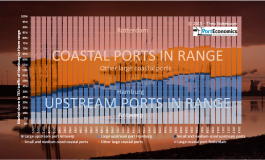
By Theo Notteboom One could think that the days for upstream ports are counted given a growing demand for a good nautical accessibility and a fast turnaround time for the ever larger container vessels. A closer look at Antwerp and Hamburg, two of the largest upstream container ports in the world, urges us to think again. In the past few decades the large upstream ports in the Hamburg-Le Havre range have gradually gained market share at the expense of large coastal ports. In the late 1970s, Antwerp on the river Scheldt and Hamburg on the...
May 7th, 2015
Thematic Area

By Thanos Pallis The deployment of bigger cruise vessels along the globe are associated with the continuous increase of the average number cruise passengers that reach a cruise port via one call alone. The figures of the Mediterranean and the adjoining seas, the second biggest cruise region of the world provides a clear examble of this trend. During the last five years, the average number of passengers per cruise call increased by 13,3%, or from 1.657 to 1.878 passengers per call. The increase within the last decade is even more...
May 3rd, 2015
Thematic Area

Last month, DP World bought the Maher terminal in Prince Rupert, with a 2014 throughput of a little over 600,000 teu for more than a half billion US dollar - just under $1,000 per teu handled, comments Peter de Langen at his "The Analyst" column in Port Strategy. Two aspects of this deal are interesting. First, the price seems to indicate huge confidence in growing volumes: the terminal is to be expanded to a capacity of about 1.35m teu, with studies on the feasibility of a further expansion to about 2.5m teu. Second, the fact that the...
April 27th, 2015
Thematic Area

Current heterogeneity in EU port regulation is having an impact on the competitiveness of ports. Port Authorities have to take into account a wide range of goals in order to manage the interactions with private operators responsible for port activities. Thus, some trade-offs emerge, as in some cases a revenue stream or a strategic objective for the Port Authority may imply a cost for the concessionaire. PortEconomics member Francesco Parola, along with Claudio Ferrari (University of Genova) and Alessio Tei (University of Genova), study how...
April 21st, 2015
Thematic Area

By Theo Notteboom Operational co-operation between container shipping companies comes in many forms ranging from slot-chartering and vessel-sharing agreements to multi-trade strategic alliances. The first strategic alliances between shipping lines date back to the mid-1990s, a period that coincided with the introduction of the first post-Panamax containers vessels on the Europe-Far East trade. In 1997, about 70% of the services on the main East-West trades were supplied by the four main strategic alliances. Today, four large alliances are...
April 14th, 2015
Thematic Area

By Theo Notteboom Container port rankings look at individual ports. Following such an approach Shanghai is the largest container port in the world (35.28 million TEU in 2014) followed by Singapore (33.87 million TEU). Such rankings can be a bit misleading as regions with several medium-sized container ports might seem less important than regions with only one large load centre. When grouping seaports together in multiple-port regions we get a better picture of the container port handling hotspots in the world. The chart provides an...
Page 48 of 58...4647484950...