Viewpoints

March 26th, 2018
Viewpoints

By Peter de Langen Many port development companies, including port authorities, develop commercial strategies which guide their commercial and investment activities. One common ambition in those strategies is the aim to expand the hinterland The Port of Algeciras aims to serve the Madrid metro area, where Valencia is currently dominant; Rotterdam and Antwerp aim to improve competitiveness in Bavaria, where German ports, especially Hamburg, are dominant; and various US East Coast ports aim to expand their hinterland to destinations such...
March 19th, 2018
Viewpoints

¿Quo vadis América Latina? by Gordon Wilmsmeier El sector marítimo y portuario está experimentando cambios profundos en su organización (concentración de la oferta, alianzas estratégicas, integración vertical entre operadores de terminales y navieras) y tecnología (mayor oferta de capacidad de buques y puertos, automatización y electrificación de terminales portuarias, mayor eficiencia en propulsión de buques, etc.). Estos cambios son globales y ya han comenzado a llegar a nuestra región. ¿Los actores públicos,...
February 18th, 2018
Viewpoints

By Theo Notteboom Last week, the Rotterdam Port Authority presented the port’s cargo throughput figures for 2017. With a 10.9% y-o-y growth, the Dutch port handled 13.73 million TEU in 2017. The strong results in 2017 reinforced Rotterdam’s position as the largest European container port, followed by Antwerp (10.45 million in 2017, a growth of 4.1%), Hamburg (8.82 million TEU, -1%), Bremerhaven (5.54 million TEU, +0.9%) and Valencia (4.83 Million TEU, +2.3%). With a 10.9% y-o-y growth, the Dutch port handled 13.73 million TEU in...
February 10th, 2018
Viewpoints

PortEconomics member Cesar Ducruet - along with Justin Berli (CNRS) - address the distribution of the largest containerships across the globe, and build a picture of the global network has been published in the PortEconomics partner in publishing magazine Port Technology International. Many issues have been raised since the advent of socalled ‘mega-ships’, ranging from port capacity issues, competitiveness, shipping alliances, and technological change, but the precise geography of their circulation had remained somewhat overlooked...
January 31st, 2018
Viewpoints

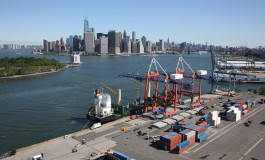
By Peter de Langen The inevitable is likely to happen to the Red Hook Container Terminal in Brooklyn, New York After decades of policy to keep the terminal open to ensure that Brooklyn continues to have a blue collar ‘working waterfront’, the only container terminal in the state of New York may finally close down and give way to the development of urban functions. The state governor Andrew Cuomo has suggested a “more productive community use” for the approximately 80 acres of waterfront land. Even though the announcement...
January 15th, 2018
Viewpoints

By Peter de Langen In November, Associated British Ports (ABP), the UK’s leading port operator, launched its transformed property arm with a 960-hectare land bank, marking a further step in the gradual transition of the group from port operator to a development company of port, logistics and manufacturing complexes in 21 UK ports, writes Peter de Langen. ABP owns around 5,000 hectares of land, of which around 900 hectares is available for development. In its 2017 first half year trading update, ABP noted that it aims to build a...
December 27th, 2017
Viewpoints

By Jean-Paul Rodrigue The St. Lawrence, as a gateway to Eastern Canada, is contemplating an emerging risk in the Post Panamax context, which is undermining its commercial viability for containerized maritime shipping. The Port of Quebec handled containers in the early stages of containerization, but by the late 1970s all this traffic shifted to Montreal because of its notable market advantage and excellent connectivity to the Ontario and Midwest hinterland. However, technical changes in containership sizes are gradually challenging...
December 4th, 2017
Viewpoints

By Theo Notteboom A look at the changing container port volume 'skyline' in Europe. The movie shows the evolution of the TEU volumes between 1985 and 2016. You can see the sheer size of north European container ports (Rotterdam, Antwerp, Hamburg, etc.), the recent rise of new container hubs (Piraeus, Gdansk, Sines, etc.), the emergence of Mediterranean transhipment hubs in the mid-1990s (Algeciras, Gioia Tauro, Marsaxlokk, etc.) and the impact of the financial-economic crisis on port volumes in 2009. ...
November 28th, 2017
Viewpoints

By Peter de Langen In May 2016 a lease agreement was signed between Feadship, a leading builder of mega-yachts, and Port of Amsterdam (PoA). Yet, Amsterdam’s vision document, officially launched a year earlier in June 2015 did not mention mega-yachts as a potentially relevant market segment. The lease agreement was interesting as the activity does not generate substantial cargo volumes and thus is not well aligned with PoA’s traditional business model in which revenues from ships have a central place. This example...
November 7th, 2017
Viewpoints

By Peter de Langen This year saw positive news for the two large new port development projects in North West Europe: JadeWeserPort and London Gateway Both ports, sometimes cited as unsuccessful port development projects, are on a slower development path than initially foreseen but now seem to have developed the critical mass for further growth. And they have managed to grow in complicated market environments. This is in sharp contrast to a previous ‘newcomer’, Zeebrugge, that also managed to attract substantial volumes - over...
Page 12 of 29...1011121314...