

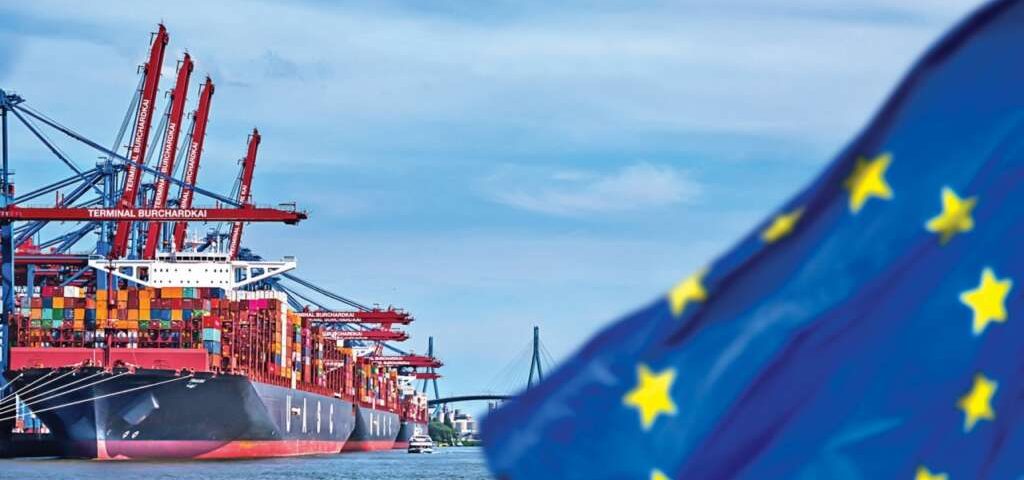
The European Commission adopted the EU Ports Strategy, a comprehensive framework to step up the competitiveness, resilience, security, and sustainability of Europe’s ports.
The Strategy puts forward actions focused on five priorities to address the most pressing challenges:
-
- Strengthen competitiveness, innovation and digitalisation
-
- To improve coherence and coordination, the Commission will develop criteria and guiding principles for EU funding and investments in third-country ports.
- The Commission will also develop criteria and guidance on foreign ownership and control, focusing on ports identified as strategic dual-use infrastructure.
- The Commission will support the digital and green transformation by promoting innovation, and scale-up and uptake of innovative technologies.
-
- Advance energy transition, sustainability and clean industries
-
- The Commission will accelerate permit-granting and provide faster assessment procedures for strategic energy and environmental port projects.
- The upcoming Electrification Action Plan will support port electrification, grid access, and the deployment of clean energy.
- The Commission will promote partnerships for energy cooperation in and around port areas to ensure the sustainable use of energy, including hydrogen.
-
- Protect and secure ports
-
- The Commission will strengthen port security by updating and revising existing guidance, including on emerging threats, and promote a global level playing field for EU port security.
- To fight drug trafficking, building on the work of the European Ports Alliance public-private partnership, the Commission will establish frameworks for third-country port assessments and for background checks for port workers. The Strategy will improve the alignment of customs controls across EU ports and strengthen security protocols worldwide.
- The Commission will establish a forum for Member States’ cybersecurity and port authorities to exchange best practices, and will carry out an EU-wide security risk assessment to identify the most pressing cybersecurity risks and appropriate measures to mitigate them.
-
- Access to finance and investments
-
- Building on existing EU funding instruments, including the Connecting Europe Facility, Cohesion Policy funds, and InvestEU, the Commission will support ports with clear, targeted funding principles to improve the coordination and efficiency of EU financing.
- The Commission will also facilitate access to advisory services and de-risking tools, with particular attention to the needs of small and medium-sized ports.
-
- Social cohesion, skills and quality jobs
-
- The Strategy recognises the important role of small and medium-sized ports and outlines specific initiatives in innovation, clean energy, security, and connectivity to support these ports.
- The Commission will support the development of a skilled next-generation workforce across all blue economy sectors through actions under the Blue Generational Renewal Strategy. A new Pact for Skills for the ports sector will focus on upskilling, reskilling and inclusion of workers.
- The Commission will also prepare guidance on the application of maritime safety legislation to port workers on board ships, as well as on safe handling of alternative fuels in ports.
-
- Strengthen competitiveness, innovation and digitalisation
To ensure effective implementation, the Commission will establish a high-level Maritime Industries and Ports Board, chaired by the responsible Commissioner and EVPs.
PortEconomics members will contribute to the forthcoming dialogue and its content through a number of initiatives – stay tuned!!
For more on EPP, visit the Jean Monnet Chair in European Port Policy, chaired by PortEconomics co-director Prof. Thanos Pallis, here.