
• Home
  • About
    • Members
    • Associate Members
    • Former members
  • Thematic Areas
    • Containers
    • Cruise
    • European Port Policy
    • Ports & COVID-19
  • PortStudies
  • Presentations
  • Noticeboard
  • Viewpoints
  • PortLibrary
  • PortReport
PortEconomics
  • September 26th, 2026
PortEconomics
  • Home
  • About
    • Members
    • Associate Members
    • Former members
  • Thematic Areas
    • Containers
    • Cruise
    • European Port Policy
    • Ports & COVID-19
  • PortStudies
    Geopolitical leverage through the international activities of State-Owned Enterprises (SOEs) in ports and maritime logistics

    Geopolitical leverage through the international activities of State-Owned Enterprises (SOEs) in ports and maritime logistics

    Risk-driven supply chain designs – a re-assessment with geopolitical and geoeconomic considerations

    Risk-driven supply chain designs – a re-assessment with geopolitical and geoeconomic considerations

    Rhine-Scheldt delta port system

    Rhine-Scheldt delta port system

    A metric of global maritime supply chain disruptions: The global supply chain stress index - maritime (GSCSI-M)

    A metric of global maritime supply chain disruptions: The global supply chain stress index - maritime (GSCSI-M)

    ESG disclosure as a proxy of port corporate communication and sustainable management strategy: An LDA approach

    ESG disclosure as a proxy of port corporate communication and sustainable management strategy: An LDA approach

  • Presentations
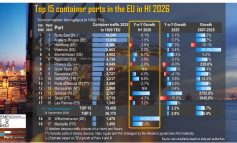
    Top-15 EU container ports in H1 2026

    Top-15 EU container ports in H1 2026

    European ports: The need to avoid the great divide

    European ports: The need to avoid the great divide

    Florence maritime regulation conference: PortEconomics members shape maritime regulation

    Florence maritime regulation conference: PortEconomics members shape maritime regulation

    New edition: Developing ports as business ecosystems

    New edition: Developing ports as business ecosystems

    European Ports: Reflection on policies and strategies for the energy transition

    European Ports: Reflection on policies and strategies for the energy transition

  • Noticeboard
    Call for papers: Contemporary Maritime Economics: Transformations and Emerging Perspectives

    Call for papers: Contemporary Maritime Economics: Transformations and Emerging Perspectives

    ECONSHIP2026: Call for papers

    ECONSHIP2026: Call for papers

    Call for papers: 1st Florence Maritime Regulation Conference

    Call for papers: 1st Florence Maritime Regulation Conference

    PortEconomics co-director appointed Senior Scientific Advisor to the Florence School of Regulation

    PortEconomics co-director appointed Senior Scientific Advisor to the Florence School of Regulation

    Jean Monnet Chair in European Port Policy

    Jean Monnet Chair in European Port Policy

  • Viewpoints
    Top-15 EU container ports in H1 2026

    Top-15 EU container ports in H1 2026

    European ports: The need to avoid the great divide

    European ports: The need to avoid the great divide

    New edition: Developing ports as business ecosystems

    New edition: Developing ports as business ecosystems

    Maritime and port strategies as state policies: an introductory approach

    Maritime and port strategies as state policies: an introductory approach

    European Ports: Reflection on policies and strategies for the energy transition

    European Ports: Reflection on policies and strategies for the energy transition

  • PortLibrary
  • PortReport
PortEconomics member leads Center for Eurasian Maritime & Inland Logistics (CEMIL) in ShanghaiFeatured

PortEconomics member leads Center for Eurasian Maritime & Inland Logistics (CEMIL) in Shanghai

November 20th, 2017 Featured, Noticeboard

READ ALSO

Top-15 EU container ports in H1 2026
Florence maritime regulation conference: PortEconomics members shape maritime regulation
PortGraphic: Container port dynamics near Gibraltar
Top-15 EU container ports in H1 2026

PortEconomics co-director Prof. Theo Notteboom will lead the newly established Center of Eurasian Maritime and Inland Logistics (CEMIL) of Shanghai Maritime University (SMU), which was inaugurated in Shanghai on Nov 20, 2017.  The research center is part of the China Insititute of FTZ Supply Chain, a key institute of SMU. CEMIL’s mission is ‘Bridging Asia and Europe through maritime and logistics research’.

Theo CEMIL 1

SMU President Huang Youfang shaking hands with CEMIL Director & PortEconomics co-director Prof. Theo Notteboom during the unveiling of the CEMIL inauguration plaque on 20 November 2017 in Shanghai

CEMIL’s permanent staff and associate experts are committed to promote a better understanding of seaside and landside logistics for an improved connectivity in and between Europe and Asia based on in-depth research and experience. Next to deploying in-house expertise, CEMIL also teams up with the world’s top research centers in the field to initiate new research tracks relevant to transport and logistics on the Asia-Europe trade route. The center’s focus is on business and policy relevant research based on academic rigour. CEMIL will strongly focus on the academic valorization of research outcomes via publications in academic journals and books. CEMIL will also host international events and round tables in view of research exchange and discussion.

During the inauguration ceremony of CEMIL in Shanghai, SMU president Huang Youfang underlined the long history of SMU in communicating and cooperating with European universities and research centers. The Belt and Road initiative initiated in 2013 by PRC’s president Xi Jinping created a great momentum and golden opportunity for Chinese universities to strengthen joint research activities with overseas partners. President Huang noted that “The establishment of CEMIL provides an important platform for Chinese and European scholars to engage in research and cooperation in maritime and logistics, widening both parties’ horizons in the field”.  Along the same lines, SMU Vice-President Yan Wei said that “We have a shared responsibility to enhance a closer communication between China and Europe in maritime and logistics research”. CEMIL’s Director, Theo Notteboom, pointed out that the new center will actively contribute to current managerial and policy debates on economic, logistic and maritime relations between Asia/China and Europe.

CEMIL of SMU is located in one of the world’s largest and most dynamic maritime and logistics hubs. The port of Shanghai is the world’s largest container port handling 37.1 million TEU in 2016, and the world’s second port in terms of overall cargo throughput. The port is a major gateway to China (in particular to the vast Yangtze basin) and home to world-leading maritime and logistics companies such as Cosco and SIPG. Shanghai is a key city in the Free Trade Zone (FTZ) policy of the Chinese government. Shanghai Maritime University (SMU) is a multi-disciplinary university that encompasses areas in engineering, management, economics, law and science, with a special emphasis on shipping technology, economics and management. SMU was established by the Ministry of Communications in 1959. SMU has over 20,000 full-time students, of whom over 17,000 are undergraduates and over 3,000 are postgraduate students. As a “cradle of international shipping specialists”, the university has produced specialists of various types at various levels for the country’s shipping industry. SMU has established close ties with over 70 institutions around the world and keeps close contacts with international shipping organizations and institutions, such as International Maritime Organization (IMO).

The CEMIL offices are located at the Lingang new campus of Shanghai Maritime University, a new urban and business area developed in proximity of the 32 km Donghai bridge which gives access to the vast Yangshan container port complex of the port of Shanghai. CEMIL can be reached via [email protected] .

Next article PORTOPIA: port users' perceptions on port performance
Previous article A global analysis of port industry performance

Related Posts

Top-15 EU container ports in H1 2026 Containers

Top-15 EU container ports in H1 2026

Geopolitical leverage through the international activities of State-Owned Enterprises (SOEs) in ports and maritime logistics Category

Geopolitical leverage through the international activities of State-Owned Enterprises (SOEs) in ports and maritime logistics

European ports: The need to avoid the great divide European Port Policy

European ports: The need to avoid the great divide

Weekly Timeline
Sep 22nd 10:21 AM
Thematic Area

Top-15 EU container ports in H1 2026

Sep 17th 12:11 PM
Category

Geopolitical leverage through the international activities of State-Owned Enterprises (SOEs) in ports and maritime logistics

Jul 22nd 3:50 PM
Thematic Area

European ports: The need to avoid the great divide

Jul 21st 1:41 PM
Thematic Area

Florence maritime regulation conference: PortEconomics members shape maritime regulation

Jul 2nd 2:45 PM
Presentations

New edition: Developing ports as business ecosystems

Tweets by @PortEconomics
  • Containers
  • Cruise
  • EPP
  • Ports & COVID-19
  • Back to top
About PortEconomics

PortEconomics is a web-based initiative aiming to advance knowledge exchange on seaport studies. Established by maritime economists affiliated to academic institutions in Belgium, Greece and the Netherlands. It provides freely accessible research, education, information, and network-building material on critical issues of port economics, management and policies.

Additional Information
  • About
  • Login
  • Register
  • Edit Profile
  • Contact us
  • PortProfessionals
  • PortReport Series
  • Terms and Conditions
  • Cookie Policy
© PortEconomics 2025. All rights reserved.
Produced by PortEconomics
Manage Consent
To provide the best experiences, we use technologies like cookies to store and/or access device information. Consenting to these technologies will allow us to process data such as browsing behavior or unique IDs on this site. Not consenting or withdrawing consent, may adversely affect certain features and functions.
Functional Always active
The technical storage or access is strictly necessary for the legitimate purpose of enabling the use of a specific service explicitly requested by the subscriber or user, or for the sole purpose of carrying out the transmission of a communication over an electronic communications network.
Preferences
The technical storage or access is necessary for the legitimate purpose of storing preferences that are not requested by the subscriber or user.
Statistics
The technical storage or access that is used exclusively for statistical purposes. The technical storage or access that is used exclusively for anonymous statistical purposes. Without a subpoena, voluntary compliance on the part of your Internet Service Provider, or additional records from a third party, information stored or retrieved for this purpose alone cannot usually be used to identify you.
Marketing
The technical storage or access is required to create user profiles to send advertising, or to track the user on a website or across several websites for similar marketing purposes.
  • Manage options
  • Manage services
  • Manage {vendor_count} vendors
  • Read more about these purposes
View preferences
  • {title}
  • {title}
  • {title}