

• Home
  • About
    • Members
    • Associate Members
    • Former members
  • Thematic Areas
    • Containers
    • Cruise
    • European Port Policy
    • Ports & COVID-19
  • PortStudies
  • Presentations
  • Noticeboard
  • Viewpoints
  • PortLibrary
  • PortReport
PortEconomics
  • March 19th, 2026
PortEconomics
  • Home
  • About
    • Members
    • Associate Members
    • Former members
  • Thematic Areas
    • Containers
    • Cruise
    • European Port Policy
    • Ports & COVID-19
  • PortStudies
    Rhine-Scheldt delta port system

    Rhine-Scheldt delta port system

    A metric of global maritime supply chain disruptions: The global supply chain stress index - maritime (GSCSI-M)

    A metric of global maritime supply chain disruptions: The global supply chain stress index - maritime (GSCSI-M)

    ESG disclosure as a proxy of port corporate communication and sustainable management strategy: An LDA approach

    ESG disclosure as a proxy of port corporate communication and sustainable management strategy: An LDA approach

    From coal exports to green steel production? The role of circular economy precincts for sustainable port diversification

    From coal exports to green steel production? The role of circular economy precincts for sustainable port diversification

    Maritime transport in net zero

    Maritime transport in net zero

  • Presentations
    PortGraphic: Container port dynamics near Gibraltar

    PortGraphic: Container port dynamics near Gibraltar

    Top-10 PortReads in 2025

    Top-10 PortReads in 2025

    Port reform: World Bank publishes the third edition of its port reform toolkit

    Port reform: World Bank publishes the third edition of its port reform toolkit

    When will we admit that maritime transport will not be decarbonised by 2050?

    When will we admit that maritime transport will not be decarbonised by 2050?

    Digital technologies for efficient and resilient sea-land logistics

    Digital technologies for efficient and resilient sea-land logistics

  • Noticeboard
    Call for papers: Contemporary Maritime Economics: Transformations and Emerging Perspectives

    Call for papers: Contemporary Maritime Economics: Transformations and Emerging Perspectives

    ECONSHIP2026: Call for papers

    ECONSHIP2026: Call for papers

    Call for papers: 1st Florence Maritime Regulation Conference

    Call for papers: 1st Florence Maritime Regulation Conference

    PortEconomics co-director appointed Senior Scientific Advisor to the Florence School of Regulation

    PortEconomics co-director appointed Senior Scientific Advisor to the Florence School of Regulation

    Jean Monnet Chair in European Port Policy

    Jean Monnet Chair in European Port Policy

  • Viewpoints
    Commission unveils new EU Ports Strategy

    Commission unveils new EU Ports Strategy

    PortGraphic: Top-15 EU container ports in Q3 2025

    PortGraphic: Top-15 EU container ports in Q3 2025

    Maritime transport in net zero

    Maritime transport in net zero

    Portgraphic: Top-15 EU container ports in H1 2025

    Portgraphic: Top-15 EU container ports in H1 2025

    Portgraphic: fleet capacity (owned/chartered) of container shipping lines

    Portgraphic: fleet capacity (owned/chartered) of container shipping lines

  • PortLibrary
  • PortReport
PortGraphic: top15 European container ports in Q1 2020Containers

PortGraphic: top15 European container ports in Q1 2020

May 18th, 2020 Containers, Featured, Ports & COVID-19, Presentations

READ ALSO

PortGraphic: Container port dynamics near Gibraltar
Call for papers: Contemporary Maritime Economics: Transformations and Emerging Perspectives
PortGraphic: Top-15 EU container ports in Q3 2025
Rhine-Scheldt delta port system

By Theo Notteboom

Impact of COVID-19 on European ports only started to be strongly visible in March 2020.

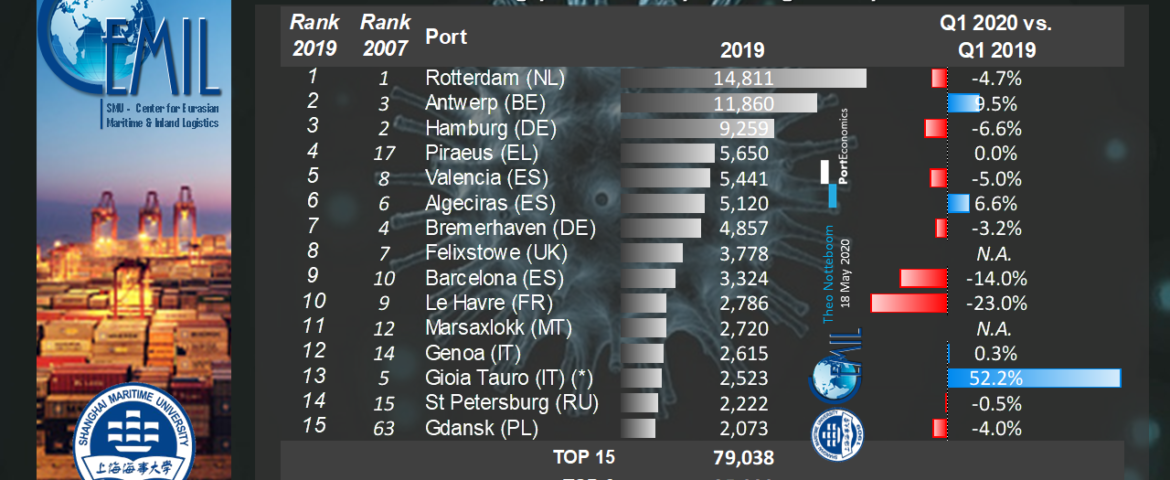
The table shows the container throughput growth for Q1 2020 in the top 15 containers ports in Europe. While the Coronavirus emerged in China in December 2019, its impact on European ports only started to be strongly visible in March 2020. In February 2020, the supply shock in China, where the factories were unable to operate, generated a first wave of blank sailings. Given the sailing time on the Europe-Far East trade, the effect of these blank sailings could only be observed by March 2020. In mid-March, the whole picture turned around: the supply side really built back up nicely in Asia, but a demand shock in Europe emerged due to the full and semi lockdown situations in virtually all European countries. This has led to an additional wave in blank sailings with carriers withdrawing up to 20% of their network capacity on the main trade lanes and idling more than 2.5 million TEU of fleet capacity. For some ports, the blank sailings imply 20% to even up to 50% less vessel calls for April and May 2020, although for most ports the impact is mainly visible on the main trade routes (FE-Europe) and not so much on other trade routes. This second wave of blank sailings will significantly affect Q2 2020 volumes in European ports, but does not show in the Q1 2020 figures.

Gioia Tauro, Antwerp and Algeciras record strong growth

Despite the fact that the COVID-19 crisis only partially affected the Q1 2020 throughput figures, most ports recorded negative growth figures. Mediterranean transhipment hubs Gioia Tauro and Algeciras and the mixed transhipment-gateway port of Antwerp are the only ports posting strong growth figures. In the Summer of 2019, Terminal Investment Limited (TiL) became the full owner of Medcenter Container Terminal (MCT) at Gioia Tauro after it acquired the 50% stake from Contship Italia. This move now starts to have its effects with more MSC container flows being directed via Gioia Tauro. The port of Algeciras handled 6.6% more containers in Q1 2020 compared to the same period last year. This is in line with the 7.3% growth in 2019. The port of Antwerp recorded strong growth on all trade routes except for the Far East (-2.2%). Note that the Belgian coastal port of Zeebrugge (no. 18 in Europe in 2019) also recorded strong growth in Q1 (i.e. plus 11.1%) mainly as a result of the additional volume generated at the terminal of Cosco Shipping Ports. The strong throughput performance of the Belgian container ports of Antwerp and Zeebrugge is in sharp contrast to the moderate to strong volume drops in the other hub ports of the Le Havre-Hamburg range, such as Rotterdam (-4.7%), Hamburg (-6.6%), Bremerhaven (-3.2) and Le Havre (-23%).

Strong performance of Antwerp in sharp contrast to the situation in other hub ports of the Le Havre-Hamburg range

Le Havre and Barcelona were confronted with a steep decline in container volumes in Q1 2020. Le Havre initially was heavily affected by the French national strike during December 2019 and January 2020. In March 2020, the port’s strong exposure to trade with China further affected its first quarter results. The French port is trying to bounce back. In early March an agreement was signed to implement a recovery plan in response to disruptions caused by the strike. Le Havre also announced its intention to merge with its HAROPA partner ports of Rouen and Paris by 21 January 2021. The 14% drop in Barcelona is almost fully attributable to a 27% decline in transit traffic. Import/export containerised cargo flows in the Catalan port only decreased by 3.2%. Valencia had to accept a 5% volume drop.

Abrupt disruption in steep growth curves of Piraeus and Gdansk

Another remarkable result is the moderate TEU decline in Piraeus. The Cosco-owned Greek hub port realized strong growth figures in the past ten years which resulted in a rise to a no. 4 position in the ranking in 2019. Also the port of Gdansk, another fast climber in the European container port ranking, recorded a negative growth figure for the first time for many years. The first quarter TEU throughputs in the Italian port of Genoa and the Russian port of Saint-Petersburg were at the same level as in the same period last year.

Q2 2020 results are expected to be worse than the Q1 2020 results.

The Q2 results are expected to be worse than the Q1 results. As mentioned earlier, the second wave of blank sailings is hitting European hub ports. While more and more countries are relaxing the lockdown measures which were implemented in March, normal flow patterns are still disrupted leading to logistical challenges related to the repositioning of equipment (ships, boxes). Despite the negative volume prospects for Q2 2020, the TEU volumes in some European ports will benefit from the programs implemented by carriers to slow the flow of trade for shippers who are unable to take deliveries amid the crisis (e.g. “suspension of transit” “detention in transit” or “storage in transit” which allow the customer to adapt the delivery date).

Next article Deep adaptation to climate change: a new paradigm in the maritime transport sector
Previous article IAPH-WPSP Port Economic Impact Barometer for Week 20: Latin American ports more impacted by hinterland delays, dockworker shortages & truck driver availability

Theo Notteboom

Dr. Theo Notteboom is co-founder and co-director of PortEconomics. He is a professor in port and maritime economics and management with about 25 years of experience in this area. His work is widely cited. He is a regular speaker at international conferences and a rapporteur/expert to leading organizations in the field. He is Chair Professor at Ghent University in Belgium. He is a visiting Research Professor at China Institute of FTZ Supply Chain of Shanghai Maritime University. He also is part-time Professor at University of Antwerp and the Antwerp Maritime Academy in Belgium. He previously held a full-time position as High-end Foreign Expert / Professor at Dalian Maritime University in China (2014-2016) and an MPA visiting professorship in port management at Nanyang Technological University (NTU) in Singapore. He is immediate past President (2010-2014) and Council Member of International Association of Maritime Economists (IAME). Between October 2006 and October 2014 he was President of ITMMA of the University of Antwerp. Between 2009 and 2014 he was Chairman of the Board of Directors of Belgian Institute of Transport Organizers (BITO), an institute of the Belgian Federal Government.

Related Posts

Rhine-Scheldt delta port system Featured

Rhine-Scheldt delta port system

Commission unveils new EU Ports Strategy European Port Policy

Commission unveils new EU Ports Strategy

PortGraphic: Container port dynamics near Gibraltar Containers

PortGraphic: Container port dynamics near Gibraltar

Weekly Timeline
Mar 9th 4:35 PM
Featured

Rhine-Scheldt delta port system

Mar 6th 1:23 PM
Thematic Area

Commission unveils new EU Ports Strategy

Feb 18th 1:46 PM
Thematic Area

PortGraphic: Container port dynamics near Gibraltar

Feb 12th 12:25 PM
Featured

A metric of global maritime supply chain disruptions: The global supply chain stress index – maritime (GSCSI-M)

Jan 14th 12:56 PM
Noticeboard

Call for papers: Contemporary Maritime Economics: Transformations and Emerging Perspectives

Tweets by @PortEconomics
  • Containers
  • Cruise
  • EPP
  • Ports & COVID-19
  • Back to top
About PortEconomics

PortEconomics is a web-based initiative aiming to advance knowledge exchange on seaport studies. Established by maritime economists affiliated to academic institutions in Belgium, Greece and the Netherlands. It provides freely accessible research, education, information, and network-building material on critical issues of port economics, management and policies.

Additional Information
  • About
  • Login
  • Register
  • Edit Profile
  • Contact us
  • PortProfessionals
  • PortReport Series
  • Terms and Conditions
  • Cookie Policy
© PortEconomics 2025. All rights reserved.
Produced by PortEconomics
Manage Consent
To provide the best experiences, we use technologies like cookies to store and/or access device information. Consenting to these technologies will allow us to process data such as browsing behavior or unique IDs on this site. Not consenting or withdrawing consent, may adversely affect certain features and functions.
Functional Always active
The technical storage or access is strictly necessary for the legitimate purpose of enabling the use of a specific service explicitly requested by the subscriber or user, or for the sole purpose of carrying out the transmission of a communication over an electronic communications network.
Preferences
The technical storage or access is necessary for the legitimate purpose of storing preferences that are not requested by the subscriber or user.
Statistics
The technical storage or access that is used exclusively for statistical purposes. The technical storage or access that is used exclusively for anonymous statistical purposes. Without a subpoena, voluntary compliance on the part of your Internet Service Provider, or additional records from a third party, information stored or retrieved for this purpose alone cannot usually be used to identify you.
Marketing
The technical storage or access is required to create user profiles to send advertising, or to track the user on a website or across several websites for similar marketing purposes.
  • Manage options
  • Manage services
  • Manage {vendor_count} vendors
  • Read more about these purposes
View preferences
  • {title}
  • {title}
  • {title}