
By Theo Notteboom
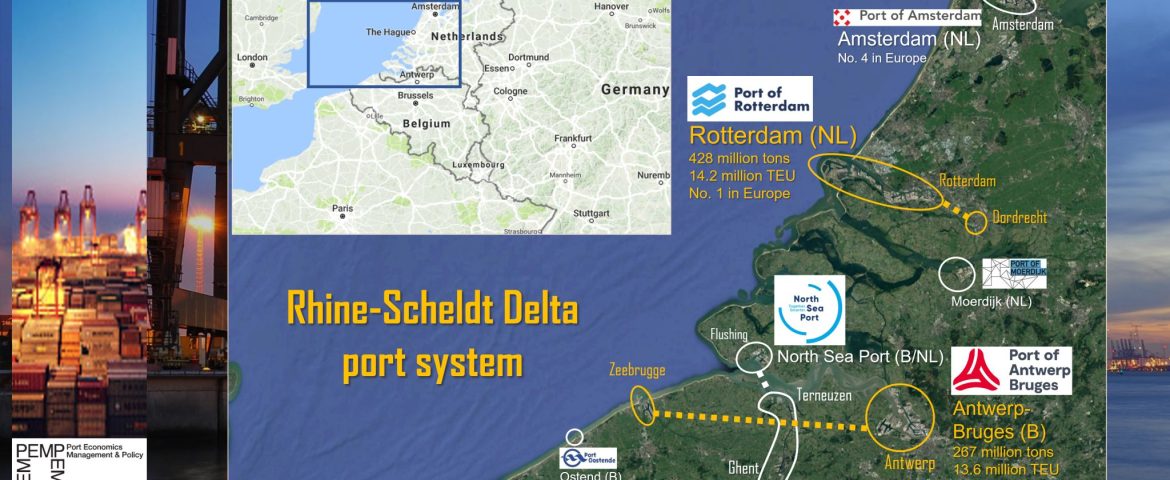
The Port of Rotterdam and Port of Antwerp-Bruges are Europe’s two largest seaports in terms of cargo volume. Together with other major hubs in the Rhine–Scheldt Delta, such as the cross‑border North Sea Port and the North Sea Canal port cluster near Amsterdam, they form an integrated logistics and industrial ecosystem that handles more than a quarter of all maritime cargo in the European Union.
These port complexes face comparable strategic challenges, including digital transformation, the energy transition, circular-economy development, and enhanced safety and security requirements. This shared agenda has driven a marked increase in inter‑port collaboration over the past decade. Recent joint initiatives include efforts to strengthen the competitiveness of energy‑intensive industries located in the port areas, improve military mobility, and combat drug trafficking.
Recent port authority mergers have reshaped the regional port landscape. The creation of Port of Antwerp-Bruges in 2022 (merging Antwerp and Zeebrugge) and North Sea Port in 2018 (uniting Terneuzen, Flushing, and Ghent) illustrate a broader trend toward consolidation to improve efficiency and strategic positioning. Against this backdrop, the Belgian prime minister has recently called for deeper cooperation—potentially even a merger—between Port of Antwerp-Bruges and Port of Rotterdam to address mounting competitive and sustainability pressures.
In our handbook “Port Economics, Management and Policy”, Chapter 8.3 on port coordination and cooperation, highlights the diverse drivers behind port authority mergers. These include reducing infrastructure duplication, avoiding destructive competition, and responding to market and financial pressures or opportunities. At the same time, we identify several barriers that often complicate merger processes: administrative and cultural boundaries, unclear or uneven distribution of costs and benefits, interpersonal dynamics, the absence of a compelling business case, or a belief that enhanced cooperation and coordination may be sufficient without full institutional integration.
More detailed analysis here.
Port Economics Management Policy (by Theo Notteboom, Thanos Pallis & Jean-Paul Rodrigue) is a book and online reference project available:
– in English by Routledge Taylor & Francis Group (here)
– in Greek by Broken Hill Publishers Ltd (here)
– Webcompanion (in English; regularly updated) (here)
Update: The 2nd fully revised edition will be available for pre-order on May 7, 2026! Order your copy here.