



• Home
  • About
    • Members
    • Associate Members
    • Former members
  • Thematic Areas
    • Containers
    • Cruise
    • European Port Policy
    • Ports & COVID-19
  • PortStudies
  • Presentations
  • Noticeboard
  • Viewpoints
  • PortLibrary
  • PortReport
PortEconomics
  • February 18th, 2026
PortEconomics
  • Home
  • About
    • Members
    • Associate Members
    • Former members
  • Thematic Areas
    • Containers
    • Cruise
    • European Port Policy
    • Ports & COVID-19
  • PortStudies
    A metric of global maritime supply chain disruptions: The global supply chain stress index - maritime (GSCSI-M)

    A metric of global maritime supply chain disruptions: The global supply chain stress index - maritime (GSCSI-M)

    ESG disclosure as a proxy of port corporate communication and sustainable management strategy: An LDA approach

    ESG disclosure as a proxy of port corporate communication and sustainable management strategy: An LDA approach

    From coal exports to green steel production? The role of circular economy precincts for sustainable port diversification

    From coal exports to green steel production? The role of circular economy precincts for sustainable port diversification

    Maritime transport in net zero

    Maritime transport in net zero

    Onboard carbon capture, utilisation and storage (CCUS) supply chain optimisation: an application to vessels active in the offshore wind industry

    Onboard carbon capture, utilisation and storage (CCUS) supply chain optimisation: an application to vessels active in the offshore wind industry

  • Presentations
    PortGraphic: Container port dynamics near Gibraltar

    PortGraphic: Container port dynamics near Gibraltar

    Top-10 PortReads in 2025

    Top-10 PortReads in 2025

    Port reform: World Bank publishes the third edition of its port reform toolkit

    Port reform: World Bank publishes the third edition of its port reform toolkit

    When will we admit that maritime transport will not be decarbonised by 2050?

    When will we admit that maritime transport will not be decarbonised by 2050?

    Digital technologies for efficient and resilient sea-land logistics

    Digital technologies for efficient and resilient sea-land logistics

  • Noticeboard
    Call for papers: Contemporary Maritime Economics: Transformations and Emerging Perspectives

    Call for papers: Contemporary Maritime Economics: Transformations and Emerging Perspectives

    ECONSHIP2026: Call for papers

    ECONSHIP2026: Call for papers

    Call for papers: 1st Florence Maritime Regulation Conference

    Call for papers: 1st Florence Maritime Regulation Conference

    PortEconomics co-director appointed Senior Scientific Advisor to the Florence School of Regulation

    PortEconomics co-director appointed Senior Scientific Advisor to the Florence School of Regulation

    Jean Monnet Chair in European Port Policy

    Jean Monnet Chair in European Port Policy

  • Viewpoints
    PortGraphic: Top-15 EU container ports in Q3 2025

    PortGraphic: Top-15 EU container ports in Q3 2025

    Maritime transport in net zero

    Maritime transport in net zero

    Portgraphic: Top-15 EU container ports in H1 2025

    Portgraphic: Top-15 EU container ports in H1 2025

    Portgraphic: fleet capacity (owned/chartered) of container shipping lines

    Portgraphic: fleet capacity (owned/chartered) of container shipping lines

    In a tight spot: American ports in global supply chains

    In a tight spot: American ports in global supply chains

  • PortLibrary
  • PortReport
Special issue on port strategy for sustainable development: circularization and value creationNoticeboard

Special issue on port strategy for sustainable development: circularization and value creation

June 21st, 2019 Noticeboard, Viewpoints

READ ALSO

Call for papers: Contemporary Maritime Economics: Transformations and Emerging Perspectives
ECONSHIP2026: Call for papers
Call for papers: 1st Florence Maritime Regulation Conference
Call for papers: Contemporary Maritime Economics: Transformations and Emerging Perspectives

Sustainability journal: Call for contributions

Today, most large port hubs include the circular economy transformation challenge, together with smart digitalization and Internet of Things (IoT), in their strategic priorities. Some port authorities even express the ambition for their port to become a maritime circular hotspot. However, many ports do not seem to have progressed beyond incremental, small-scale sustainable innovations, or the support of rather fragmented sustainability initiatives. However, what really takes ports to the next level in terms of preparing for and implementing circular business has hardly been addressed in research so far.

Challenges are complex, since ports do not only have to reconsider their own core activities but also their role in the supply chain of shippers, to lift themselves out of the linear lock-in. Opportunities are also created, as Fusco Girard (2013) argued: “Economic circuits are shortened and the local economy is strengthened through integration” (Fusco Girard, L., 2013, Toward a smart sustainable development of port cities/areas: The role of the “Historic Urban Landscape” approach. Sustainability, 5(10), 4329-4348.). This author put forward that a port’s circularization process consists of an industrial, urban, and city-territorial or regional symbiosis (Fusco Girard, 2013).

However, non-business (government, cluster organizations, etc.) initiatives or support are often behind circular pilot projects, and as much as it can serve as an engine for innovation towards sustainable port development, port authorities and businesses finally need to embrace circular learning and turn these projects into sustainable business models, i.e., with the design of the value creation, delivery, and capture mechanisms employed (Teece, 2010). This strategic change or refocus requires new insights into innovative governance and business frameworks, the link between strategy and commercially viable business models, systems innovation, intensified stakeholder collaboration and co-creation, altered traffic segments and hinterland focus, etc.

PortEconomics member Elvira Haezendonck is co-editing this Special Issue in Sustainability and is calling for papers on research into circular strategies and sustainable (business) models for ports. Theoretical as well as empirical, and quantitative as well as qualitative contributions are welcomed. Ultimately, proposed papers for this Special Issue may cover a broad range of strategies and policies, as long as the focus is on supporting ports and port authorities in their circular transition.

Manuscript Submission Information

Manuscripts should be submitted online at www.mdpi.com by registering and logging in to this website. Once you are registered, click here to go to the submission form. Manuscripts can be submitted until the deadline. All papers will be peer-reviewed. Accepted papers will be published continuously in the journal (as soon as accepted) and will be listed together on the special issue website. Research articles, review articles as well as short communications are invited. For planned papers, a title and short abstract (about 100 words) can be sent to the Editorial Office for announcement on this website.

Submitted manuscripts should not have been published previously, nor be under consideration for publication elsewhere (except conference proceedings papers). All manuscripts are thoroughly refereed through a single-blind peer-review process. A guide for authors and other relevant information for submission of manuscripts is available on the Instructions for Authors page. Sustainability is an international peer-reviewed open access semimonthly journal published by MDPI.

Please visit the Instructions for Authors page before submitting a manuscript. The Article Processing Charge (APC) for publication in this open access journal is 1700 CHF (Swiss Francs). Submitted papers should be well formatted and use good English. Authors may use MDPI’s English editing service prior to publication or during author revisions.
Next article The Analyst: from fuel to food
Previous article Measurement of port performance from users’ perspective

Related Posts

Noticeboard

Call for papers: Contemporary Maritime Economics: Transformations and Emerging Perspectives

Guest Editors Assoc. Prof. Kum Fai Yuen, Nanyang Technological University, SingaporeProf. Theo Notteboom,...
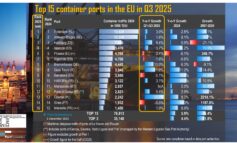
PortGraphic: Top-15 EU container ports in Q3 2025 Containers

PortGraphic: Top-15 EU container ports in Q3 2025

ECONSHIP2026: Call for papers European Port Policy

ECONSHIP2026: Call for papers

Weekly Timeline
Feb 18th 1:46 PM
Thematic Area

PortGraphic: Container port dynamics near Gibraltar

Feb 12th 12:25 PM
Featured

A metric of global maritime supply chain disruptions: The global supply chain stress index – maritime (GSCSI-M)

Jan 14th 12:56 PM
Noticeboard

Call for papers: Contemporary Maritime Economics: Transformations and Emerging Perspectives

Jan 4th 12:46 PM
Thematic Area

PortGraphic: Top-15 EU container ports in Q3 2025

Dec 16th 1:12 PM
Featured

Top-10 PortReads in 2025

Tweets by @PortEconomics
  • Containers
  • Cruise
  • EPP
  • Ports & COVID-19
  • Back to top
About PortEconomics

PortEconomics is a web-based initiative aiming to advance knowledge exchange on seaport studies. Established by maritime economists affiliated to academic institutions in Belgium, Greece and the Netherlands. It provides freely accessible research, education, information, and network-building material on critical issues of port economics, management and policies.

Additional Information
  • About
  • Login
  • Register
  • Edit Profile
  • Contact us
  • PortProfessionals
  • PortReport Series
  • Terms and Conditions
  • Cookie Policy
© PortEconomics 2025. All rights reserved.
Produced by PortEconomics
Manage Consent
To provide the best experiences, we use technologies like cookies to store and/or access device information. Consenting to these technologies will allow us to process data such as browsing behavior or unique IDs on this site. Not consenting or withdrawing consent, may adversely affect certain features and functions.
Functional Always active
The technical storage or access is strictly necessary for the legitimate purpose of enabling the use of a specific service explicitly requested by the subscriber or user, or for the sole purpose of carrying out the transmission of a communication over an electronic communications network.
Preferences
The technical storage or access is necessary for the legitimate purpose of storing preferences that are not requested by the subscriber or user.
Statistics
The technical storage or access that is used exclusively for statistical purposes. The technical storage or access that is used exclusively for anonymous statistical purposes. Without a subpoena, voluntary compliance on the part of your Internet Service Provider, or additional records from a third party, information stored or retrieved for this purpose alone cannot usually be used to identify you.
Marketing
The technical storage or access is required to create user profiles to send advertising, or to track the user on a website or across several websites for similar marketing purposes.
  • Manage options
  • Manage services
  • Manage {vendor_count} vendors
  • Read more about these purposes
View preferences
  • {title}
  • {title}
  • {title}