

• Home
  • About
    • Members
    • Associate Members
    • Former members
  • Thematic Areas
    • Containers
    • Cruise
    • European Port Policy
    • Ports & COVID-19
  • PortStudies
  • Presentations
  • Noticeboard
  • Viewpoints
  • PortLibrary
  • PortReport
PortEconomics
  • May 3rd, 2026
PortEconomics
  • Home
  • About
    • Members
    • Associate Members
    • Former members
  • Thematic Areas
    • Containers
    • Cruise
    • European Port Policy
    • Ports & COVID-19
  • PortStudies
    Risk-driven supply chain designs – a re-assessment with geopolitical and geoeconomic considerations

    Risk-driven supply chain designs – a re-assessment with geopolitical and geoeconomic considerations

    Rhine-Scheldt delta port system

    Rhine-Scheldt delta port system

    A metric of global maritime supply chain disruptions: The global supply chain stress index - maritime (GSCSI-M)

    A metric of global maritime supply chain disruptions: The global supply chain stress index - maritime (GSCSI-M)

    ESG disclosure as a proxy of port corporate communication and sustainable management strategy: An LDA approach

    ESG disclosure as a proxy of port corporate communication and sustainable management strategy: An LDA approach

    From coal exports to green steel production? The role of circular economy precincts for sustainable port diversification

    From coal exports to green steel production? The role of circular economy precincts for sustainable port diversification

  • Presentations
    European Ports: Reflection on policies and strategies for the energy transition

    European Ports: Reflection on policies and strategies for the energy transition

    IAPH World Ports Tracker 2026 reveals state of global port sustainability

    IAPH World Ports Tracker 2026 reveals state of global port sustainability

    PortGraphic: Container port dynamics near Gibraltar

    PortGraphic: Container port dynamics near Gibraltar

    Top-10 PortReads in 2025

    Top-10 PortReads in 2025

    Port reform: World Bank publishes the third edition of its port reform toolkit

    Port reform: World Bank publishes the third edition of its port reform toolkit

  • Noticeboard
    Call for papers: Contemporary Maritime Economics: Transformations and Emerging Perspectives

    Call for papers: Contemporary Maritime Economics: Transformations and Emerging Perspectives

    ECONSHIP2026: Call for papers

    ECONSHIP2026: Call for papers

    Call for papers: 1st Florence Maritime Regulation Conference

    Call for papers: 1st Florence Maritime Regulation Conference

    PortEconomics co-director appointed Senior Scientific Advisor to the Florence School of Regulation

    PortEconomics co-director appointed Senior Scientific Advisor to the Florence School of Regulation

    Jean Monnet Chair in European Port Policy

    Jean Monnet Chair in European Port Policy

  • Viewpoints
    European Ports: Reflection on policies and strategies for the energy transition

    European Ports: Reflection on policies and strategies for the energy transition

    Port-city integration

    Port-city integration

    Commission unveils new EU Ports Strategy

    Commission unveils new EU Ports Strategy

    PortGraphic: Top-15 EU container ports in Q3 2025

    PortGraphic: Top-15 EU container ports in Q3 2025

    Maritime transport in net zero

    Maritime transport in net zero

  • PortLibrary
  • PortReport
Energy consumption in LAC container terminalsContainers

Energy consumption in LAC container terminals

July 28th, 2014 Containers, PortStudies

READ ALSO

European Ports: Reflection on policies and strategies for the energy transition
Risk-driven supply chain designs – a re-assessment with geopolitical and geoeconomic considerations
Stakeholders’ attitudes toward container terminal automation
Risk-driven supply chain designs – a re-assessment with geopolitical and geoeconomic considerations

PortEconomics associate member Gordon Wilmsmeier (UNECLAC, Chile) along with Ann-Kathrin Zotz (UNECLAC, Chile), Jens Froese (Jacobs University, Bremen, Germany) and Andreas Meyer (Independent Consultant) presented their latest research on “Social and instrumental antecedents of clique survival in the port industry network: A longitudinal perspective” during the the annual conference of the International Association of Maritime Economists – IAME 2014, that was held in Norfolk, Virginia, USA.

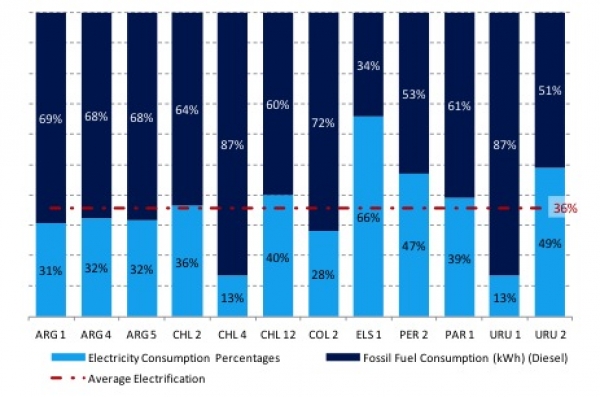
Τhe study presents a detailed comparative analysis of energy consumption patterns in container terminals in order to identify main energy consumption sources and to benchmark a set of terminals. The study provides detailed insight to the different energy consumption sources and costs and relates them to the terminals container handling processes. Thus the work allows a differentiated calculation of energy consumption per container type as the basis for future energy efficiency measures and of potential solutions to reduce emissions at the terminals.

The objective is threefold: Firstly, the development of a detailed mapping of energy consumption sources in container terminals; secondly, the presentation of a first benchmark of energy consumption in Latin American container terminals; thirdly to calculate the differences between reefer and standard containers in the terminals energy consumption matrix.

The results of this work are to obtain theoretical insights into the current energy consumption pattern which is inspired by the emergence of new trade pattern on the one hand and the search to improve the sustainability of logistics chains in the other. This makes the study highly relevant, not only in terms of academic research, but also from an industrial and policy makers’ perspective, given the urgent need to address energy security and climate change.

You may freely download the paper and presentation @PortEconomics.

Next article Incentives in cruise terminal concession contracts
Previous article How can cruise ports associations represent the sector best?

Gordon Wilmsmeier

Gordon Wilmsmeier holds the Kühne Professorial Chair in Logistics at the Universidad de los Andes in Bogota, Colombia. From 2011 to 2017, he worked as Economic Affairs Officer in the Infrastructure Services Unit at the Economic Commission for Latin America and the Caribbean. Previously he worked at Edinburgh Napier University’s Transport Research Institute (TRI), and as consultant for UN-ECLAC, UNCTAD, UN-OHRLLS, World Bank, JICA, IDB, CAF, and the OAS. Gordon is honorary professor for Maritime Geography at the University of Applied Sciences in Bremen, Germany, visiting lecturer at Göteborg University, Sweden and Universidad Nacional de San Martín, Argentina. He has published over 100 book chapters, journal papers, institutional publications and working papers. His research focuses on transport and economic geography, maritime economics and energy efficiency with particular interests in international trade and transport geography and transport costs, sustainable mobility strategies, maritime transport networks and connectivity , inland waterways and inland shipping policy. In the area of port economics his research concentrates on devolution and privatization, and organizational performance and efficiency, as well as sustainable performance analysis. Currently, a specific focus is related to measuring energy, emissions and water footprints in ports. He is chair of the global Port Performance Research Network (PPRN), IAME member, the Sustainability Working Group of the European Freight & Logistics Leaders Forum, and associate member of PortEconomics.

Related Posts

Risk-driven supply chain designs – a re-assessment with geopolitical and geoeconomic considerations Featured

Risk-driven supply chain designs – a re-assessment with geopolitical and geoeconomic considerations

Rhine-Scheldt delta port system Featured

Rhine-Scheldt delta port system

PortGraphic: Container port dynamics near Gibraltar Containers

PortGraphic: Container port dynamics near Gibraltar

Weekly Timeline
Apr 29th 11:39 AM
Thematic Area

European Ports: Reflection on policies and strategies for the energy transition

Apr 23rd 4:58 PM
Featured

IAPH World Ports Tracker 2026 reveals state of global port sustainability

Apr 8th 1:36 PM
Featured

Risk-driven supply chain designs – a re-assessment with geopolitical and geoeconomic considerations

Mar 27th 5:31 PM
Thematic Area

Port-city integration

Mar 9th 4:35 PM
Featured

Rhine-Scheldt delta port system

Tweets by @PortEconomics
  • Containers
  • Cruise
  • EPP
  • Ports & COVID-19
  • Back to top
About PortEconomics

PortEconomics is a web-based initiative aiming to advance knowledge exchange on seaport studies. Established by maritime economists affiliated to academic institutions in Belgium, Greece and the Netherlands. It provides freely accessible research, education, information, and network-building material on critical issues of port economics, management and policies.

Additional Information
  • About
  • Login
  • Register
  • Edit Profile
  • Contact us
  • PortProfessionals
  • PortReport Series
  • Terms and Conditions
  • Cookie Policy
© PortEconomics 2025. All rights reserved.
Produced by PortEconomics
Manage Consent
To provide the best experiences, we use technologies like cookies to store and/or access device information. Consenting to these technologies will allow us to process data such as browsing behavior or unique IDs on this site. Not consenting or withdrawing consent, may adversely affect certain features and functions.
Functional Always active
The technical storage or access is strictly necessary for the legitimate purpose of enabling the use of a specific service explicitly requested by the subscriber or user, or for the sole purpose of carrying out the transmission of a communication over an electronic communications network.
Preferences
The technical storage or access is necessary for the legitimate purpose of storing preferences that are not requested by the subscriber or user.
Statistics
The technical storage or access that is used exclusively for statistical purposes. The technical storage or access that is used exclusively for anonymous statistical purposes. Without a subpoena, voluntary compliance on the part of your Internet Service Provider, or additional records from a third party, information stored or retrieved for this purpose alone cannot usually be used to identify you.
Marketing
The technical storage or access is required to create user profiles to send advertising, or to track the user on a website or across several websites for similar marketing purposes.
  • Manage options
  • Manage services
  • Manage {vendor_count} vendors
  • Read more about these purposes
View preferences
  • {title}
  • {title}
  • {title}