


• Home
  • About
    • Members
    • Associate Members
    • Former members
  • Thematic Areas
    • Containers
    • Cruise
    • European Port Policy
    • Ports & COVID-19
  • PortStudies
  • Presentations
  • Noticeboard
  • Viewpoints
  • PortLibrary
  • PortReport
PortEconomics
  • July 23rd, 2026
PortEconomics
  • Home
  • About
    • Members
    • Associate Members
    • Former members
  • Thematic Areas
    • Containers
    • Cruise
    • European Port Policy
    • Ports & COVID-19
  • PortStudies
    Risk-driven supply chain designs – a re-assessment with geopolitical and geoeconomic considerations

    Risk-driven supply chain designs – a re-assessment with geopolitical and geoeconomic considerations

    Rhine-Scheldt delta port system

    Rhine-Scheldt delta port system

    A metric of global maritime supply chain disruptions: The global supply chain stress index - maritime (GSCSI-M)

    A metric of global maritime supply chain disruptions: The global supply chain stress index - maritime (GSCSI-M)

    ESG disclosure as a proxy of port corporate communication and sustainable management strategy: An LDA approach

    ESG disclosure as a proxy of port corporate communication and sustainable management strategy: An LDA approach

    From coal exports to green steel production? The role of circular economy precincts for sustainable port diversification

    From coal exports to green steel production? The role of circular economy precincts for sustainable port diversification

  • Presentations
    European ports: The need to avoid the great divide

    European ports: The need to avoid the great divide

    Florence maritime regulation conference: PortEconomics members shape maritime regulation

    Florence maritime regulation conference: PortEconomics members shape maritime regulation

    New edition: Developing ports as business ecosystems

    New edition: Developing ports as business ecosystems

    European Ports: Reflection on policies and strategies for the energy transition

    European Ports: Reflection on policies and strategies for the energy transition

    IAPH World Ports Tracker 2026 reveals state of global port sustainability

    IAPH World Ports Tracker 2026 reveals state of global port sustainability

  • Noticeboard
    Call for papers: Contemporary Maritime Economics: Transformations and Emerging Perspectives

    Call for papers: Contemporary Maritime Economics: Transformations and Emerging Perspectives

    ECONSHIP2026: Call for papers

    ECONSHIP2026: Call for papers

    Call for papers: 1st Florence Maritime Regulation Conference

    Call for papers: 1st Florence Maritime Regulation Conference

    PortEconomics co-director appointed Senior Scientific Advisor to the Florence School of Regulation

    PortEconomics co-director appointed Senior Scientific Advisor to the Florence School of Regulation

    Jean Monnet Chair in European Port Policy

    Jean Monnet Chair in European Port Policy

  • Viewpoints
    European ports: The need to avoid the great divide

    European ports: The need to avoid the great divide

    New edition: Developing ports as business ecosystems

    New edition: Developing ports as business ecosystems

    Maritime and port strategies as state policies: an introductory approach

    Maritime and port strategies as state policies: an introductory approach

    European Ports: Reflection on policies and strategies for the energy transition

    European Ports: Reflection on policies and strategies for the energy transition

    Port-city integration

    Port-city integration

  • PortLibrary
  • PortReport
New book: Port of Los Angeles: conflict, commerce and the fight for controlFeatured

New book: Port of Los Angeles: conflict, commerce and the fight for control

April 11th, 2019 Featured, Noticeboard

READ ALSO

Stakeholders’ attitudes toward container terminal automation
Container terminal automation: a global analysis on decision-making drivers, benefits realized, and stakeholder support
Container terminal automation: assessment of drivers and benefits
European ports: The need to avoid the great divide

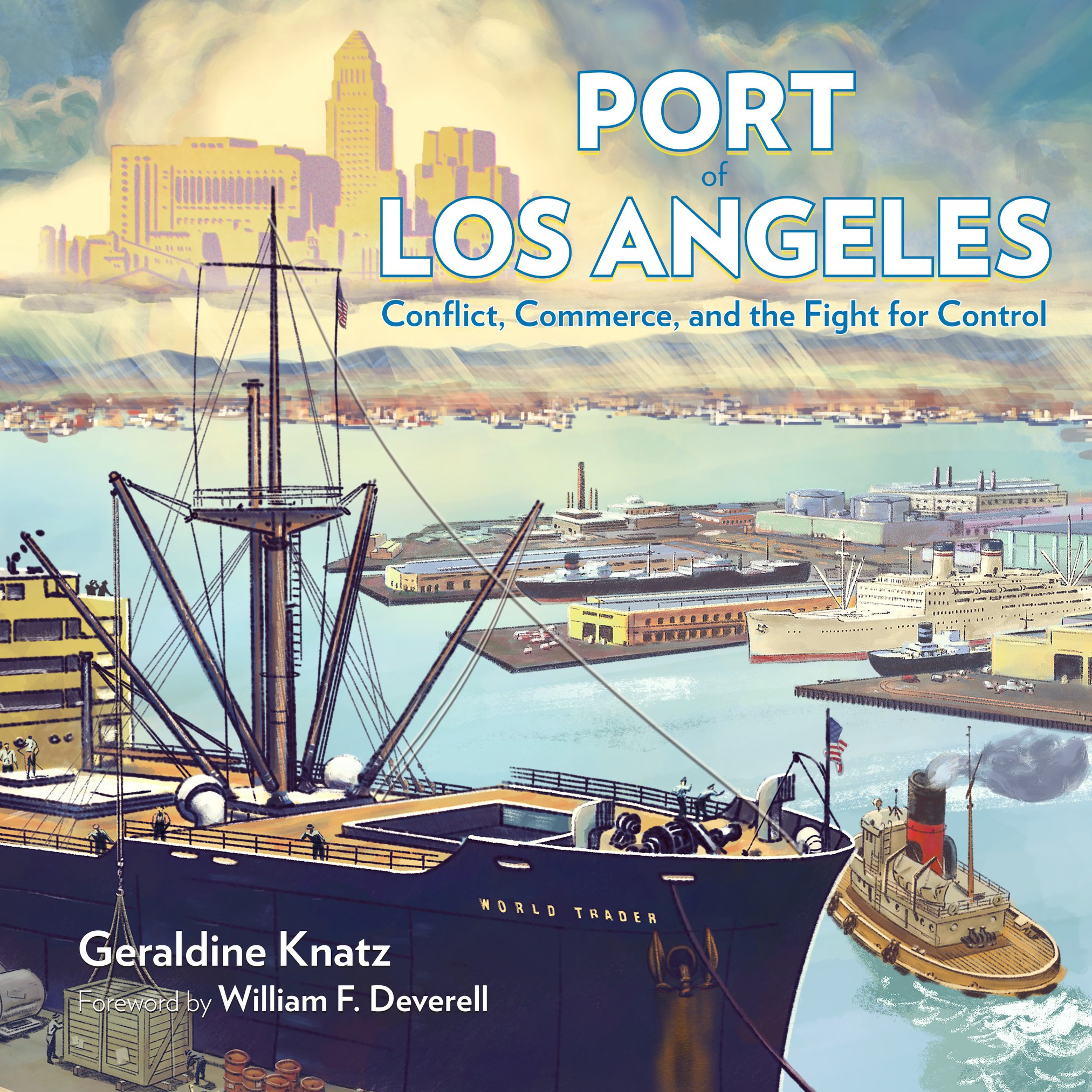
With years of research and more than 200 maps and images, PortEconomics member Geraldine Knatz shapes an insightful story of the Port of Los Angeles, from its early entrepreneurs to the city’s business and political leadership, and the inevitable conflicts that arose between them. Knatz digs into the back stories of the key players in a hardcore, well-documented piece of storytelling at its best. 

 Port of Los Angeles matches a topic—the history of Los Angeles Harbor—with someone of unquestionable authority to tackle the subject. Knatz worked nearly four decades at the Ports of Los Angeles and Long Beach, her last eight years as Executive Director at Los Angeles. At the heart of this work is the City-Harbor relationship, that challenging and frequently strained governance dance that formally began in 1907, the year the Los Angeles City Council created its first Board of Harbor Commissioners.    The major themes that have shaped—and continue to determine—the Port of L.A.’s history began with the struggle over who governs the harbor and how it was governed. The result was a different kind of municipal operation than the progressives of early twentieth-century Los Angeles envisioned—one that had to be nimble enough to compete on a global basis. Politics, rate wars, duplicate facilities, and Los Angeles’s desire to control Long Beach oil money triggered numerous attempts to merge the two ports—an effort that persists today and probably always will. The Port of L.A.’s formative period shaped its history in the late twentieth century—and continues to impact the still-unfolding twenty-first.  Personalities, crimes, power moves disguised as bureaucratic banalities, jurisdictional feuds, and outright warfare—it is all here. So, too, is the way that the port has remained umbilical to Los Angeles: feeding it, for sure, but also tethering it to worlds an ocean away.   

 A collaboration of an academic institution, the Huntington-USC Institute for California and the West and a commercial publisher, Angel City Press,  has produced an authoritative work that reads like a script for another Chinatown, only this time it’s about saltwater and controlling the waterfront, not drinking water and controlling the land.  The book takes readers on a journey that will educate and inspire, filling these pages with real-life intrigue, masterminds, and politics extraordinaire.

“The Port of Los Angeles made this city. This very well might be “The Study” of what made modern Los Angeles.” William Deverell, Director, Huntington-USC Institute on California and the West.

You can order the book via Amazon: Link

Next article The Analyst: circular space opportunities
Previous article Report on port activity of Latin America and the Caribbean 2018

gknatz

Geraldine Knatz is a Professor of the Practice of Policy and Engineering, holding joint appointment in the University of Southern California's School of Engineering and School of Public policy where she teaches courses on seaport policy, marine transportation and environmental policy and conducts research in affiliation with the METRANS Transportation Center. Knatz has worked for the Ports of Los Angeles and Long Beach for over thirty years and spend eight years as CEO of the Port of Los Angeles before her retirement in January, 2014.

Related Posts

European ports: The need to avoid the great divide European Port Policy

European ports: The need to avoid the great divide

Florence maritime regulation conference: PortEconomics members shape maritime regulation European Port Policy

Florence maritime regulation conference: PortEconomics members shape maritime regulation

Maritime and port strategies as state policies: an introductory approach Featured

Maritime and port strategies as state policies: an introductory approach

Weekly Timeline
Jul 22nd 3:50 PM
Thematic Area

European ports: The need to avoid the great divide

Jul 21st 1:41 PM
Thematic Area

Florence maritime regulation conference: PortEconomics members shape maritime regulation

Jul 2nd 2:45 PM
Presentations

New edition: Developing ports as business ecosystems

Jun 23rd 11:51 AM
Featured

Maritime and port strategies as state policies: an introductory approach

Jun 11th 4:40 PM
Featured

Global port integrity platform: A data-driven Assessment of Port Integrity Worldwide

Tweets by @PortEconomics
  • Containers
  • Cruise
  • EPP
  • Ports & COVID-19
  • Back to top
About PortEconomics

PortEconomics is a web-based initiative aiming to advance knowledge exchange on seaport studies. Established by maritime economists affiliated to academic institutions in Belgium, Greece and the Netherlands. It provides freely accessible research, education, information, and network-building material on critical issues of port economics, management and policies.

Additional Information
  • About
  • Login
  • Register
  • Edit Profile
  • Contact us
  • PortProfessionals
  • PortReport Series
  • Terms and Conditions
  • Cookie Policy
© PortEconomics 2025. All rights reserved.
Produced by PortEconomics
Manage Consent
To provide the best experiences, we use technologies like cookies to store and/or access device information. Consenting to these technologies will allow us to process data such as browsing behavior or unique IDs on this site. Not consenting or withdrawing consent, may adversely affect certain features and functions.
Functional Always active
The technical storage or access is strictly necessary for the legitimate purpose of enabling the use of a specific service explicitly requested by the subscriber or user, or for the sole purpose of carrying out the transmission of a communication over an electronic communications network.
Preferences
The technical storage or access is necessary for the legitimate purpose of storing preferences that are not requested by the subscriber or user.
Statistics
The technical storage or access that is used exclusively for statistical purposes. The technical storage or access that is used exclusively for anonymous statistical purposes. Without a subpoena, voluntary compliance on the part of your Internet Service Provider, or additional records from a third party, information stored or retrieved for this purpose alone cannot usually be used to identify you.
Marketing
The technical storage or access is required to create user profiles to send advertising, or to track the user on a website or across several websites for similar marketing purposes.
  • Manage options
  • Manage services
  • Manage {vendor_count} vendors
  • Read more about these purposes
View preferences
  • {title}
  • {title}
  • {title}