


• Home
  • About
    • Members
    • Associate Members
    • Former members
  • Thematic Areas
    • Containers
    • Cruise
    • European Port Policy
    • Ports & COVID-19
  • PortStudies
  • Presentations
  • Noticeboard
  • Viewpoints
  • PortLibrary
  • PortReport
PortEconomics
  • September 22nd, 2026
PortEconomics
  • Home
  • About
    • Members
    • Associate Members
    • Former members
  • Thematic Areas
    • Containers
    • Cruise
    • European Port Policy
    • Ports & COVID-19
  • PortStudies
    Geopolitical leverage through the international activities of State-Owned Enterprises (SOEs) in ports and maritime logistics

    Geopolitical leverage through the international activities of State-Owned Enterprises (SOEs) in ports and maritime logistics

    Risk-driven supply chain designs – a re-assessment with geopolitical and geoeconomic considerations

    Risk-driven supply chain designs – a re-assessment with geopolitical and geoeconomic considerations

    Rhine-Scheldt delta port system

    Rhine-Scheldt delta port system

    A metric of global maritime supply chain disruptions: The global supply chain stress index - maritime (GSCSI-M)

    A metric of global maritime supply chain disruptions: The global supply chain stress index - maritime (GSCSI-M)

    ESG disclosure as a proxy of port corporate communication and sustainable management strategy: An LDA approach

    ESG disclosure as a proxy of port corporate communication and sustainable management strategy: An LDA approach

  • Presentations
    Top-15 EU container ports in H1 2026

    Top-15 EU container ports in H1 2026

    European ports: The need to avoid the great divide

    European ports: The need to avoid the great divide

    Florence maritime regulation conference: PortEconomics members shape maritime regulation

    Florence maritime regulation conference: PortEconomics members shape maritime regulation

    New edition: Developing ports as business ecosystems

    New edition: Developing ports as business ecosystems

    European Ports: Reflection on policies and strategies for the energy transition

    European Ports: Reflection on policies and strategies for the energy transition

  • Noticeboard
    Call for papers: Contemporary Maritime Economics: Transformations and Emerging Perspectives

    Call for papers: Contemporary Maritime Economics: Transformations and Emerging Perspectives

    ECONSHIP2026: Call for papers

    ECONSHIP2026: Call for papers

    Call for papers: 1st Florence Maritime Regulation Conference

    Call for papers: 1st Florence Maritime Regulation Conference

    PortEconomics co-director appointed Senior Scientific Advisor to the Florence School of Regulation

    PortEconomics co-director appointed Senior Scientific Advisor to the Florence School of Regulation

    Jean Monnet Chair in European Port Policy

    Jean Monnet Chair in European Port Policy

  • Viewpoints
    Top-15 EU container ports in H1 2026

    Top-15 EU container ports in H1 2026

    European ports: The need to avoid the great divide

    European ports: The need to avoid the great divide

    New edition: Developing ports as business ecosystems

    New edition: Developing ports as business ecosystems

    Maritime and port strategies as state policies: an introductory approach

    Maritime and port strategies as state policies: an introductory approach

    European Ports: Reflection on policies and strategies for the energy transition

    European Ports: Reflection on policies and strategies for the energy transition

  • PortLibrary
  • PortReport
Stakeholders’ attitudes toward container terminal automationContainers

Stakeholders’ attitudes toward container terminal automation

June 30th, 2025 Containers, Featured, PortStudies

READ ALSO

Top-15 EU container ports in H1 2026
Geopolitical leverage through the international activities of State-Owned Enterprises (SOEs) in ports and maritime logistics
European ports: The need to avoid the great divide
Top-15 EU container ports in H1 2026

Do you want to understand better why fewer than 80 container terminals are automated?

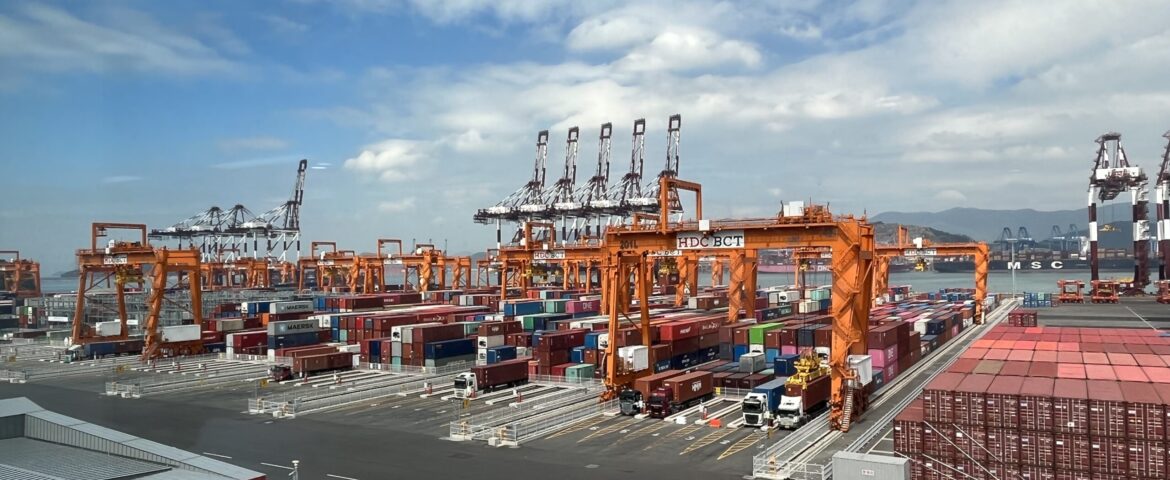
PortEconomics members Theo Notteboom, Thanos Pallis & Geraldine Knatz examine stakeholders’ attitudes toward container terminal automation, aiming to place terminal automation as an innovation trajectory in the broader context of stakeholder relations management.

More specifically, their port study:

  • Position terminal automation as an innovation trajectory within the broader context of stakeholder relations management.
  • Details how the stakeholder environment plays a crucial role in shaping the path toward adopting innovation
  • Focuses on key stakeholders, including governments, port management entities, dockworkers, local communities, ocean carriers, and supply chain actors, such as logistics service providers.
  • Employes a survey-based approach, the descriptive statistical results capture these attitudes as perceived by terminal operators who have implemented automation.
  • Statistical analysis techniques are used to investigate the potential relationships between the factors driving automation and stakeholder views, the shifting of stakeholder attitudes over time, and their regional variations.

The research provides valuable insights into the challenges and strategies for fostering innovation in port operations. Furthermore, this portstudy positions terminal automation as an innovation pathway within the broader framework of stakeholder relationship management, offering a comprehensive understanding of the dynamics that shape its adoption.

The portsudy has been published in the scientific journal Maritime Economics and Logistics and can be freely downloaded here.


The Open Access publication has been generously funded by HEAL-Link (Hellenic Academic Libraries Link). The study has been funded by METRANS & the VREF Volvo Research and Educational Foundations.
Next article Digital technologies for efficient and resilient sea-land logistics
Previous article The World Ports Tracker in TOC Europe

Related Posts

Top-15 EU container ports in H1 2026 Containers

Top-15 EU container ports in H1 2026

Geopolitical leverage through the international activities of State-Owned Enterprises (SOEs) in ports and maritime logistics Category

Geopolitical leverage through the international activities of State-Owned Enterprises (SOEs) in ports and maritime logistics

European ports: The need to avoid the great divide European Port Policy

European ports: The need to avoid the great divide

Weekly Timeline
Sep 22nd 10:21 AM
Thematic Area

Top-15 EU container ports in H1 2026

Sep 17th 12:11 PM
Category

Geopolitical leverage through the international activities of State-Owned Enterprises (SOEs) in ports and maritime logistics

Jul 22nd 3:50 PM
Thematic Area

European ports: The need to avoid the great divide

Jul 21st 1:41 PM
Thematic Area

Florence maritime regulation conference: PortEconomics members shape maritime regulation

Jul 2nd 2:45 PM
Presentations

New edition: Developing ports as business ecosystems

Tweets by @PortEconomics
  • Containers
  • Cruise
  • EPP
  • Ports & COVID-19
  • Back to top
About PortEconomics

PortEconomics is a web-based initiative aiming to advance knowledge exchange on seaport studies. Established by maritime economists affiliated to academic institutions in Belgium, Greece and the Netherlands. It provides freely accessible research, education, information, and network-building material on critical issues of port economics, management and policies.

Additional Information
  • About
  • Login
  • Register
  • Edit Profile
  • Contact us
  • PortProfessionals
  • PortReport Series
  • Terms and Conditions
  • Cookie Policy
© PortEconomics 2025. All rights reserved.
Produced by PortEconomics
Manage Consent
To provide the best experiences, we use technologies like cookies to store and/or access device information. Consenting to these technologies will allow us to process data such as browsing behavior or unique IDs on this site. Not consenting or withdrawing consent, may adversely affect certain features and functions.
Functional Always active
The technical storage or access is strictly necessary for the legitimate purpose of enabling the use of a specific service explicitly requested by the subscriber or user, or for the sole purpose of carrying out the transmission of a communication over an electronic communications network.
Preferences
The technical storage or access is necessary for the legitimate purpose of storing preferences that are not requested by the subscriber or user.
Statistics
The technical storage or access that is used exclusively for statistical purposes. The technical storage or access that is used exclusively for anonymous statistical purposes. Without a subpoena, voluntary compliance on the part of your Internet Service Provider, or additional records from a third party, information stored or retrieved for this purpose alone cannot usually be used to identify you.
Marketing
The technical storage or access is required to create user profiles to send advertising, or to track the user on a website or across several websites for similar marketing purposes.
  • Manage options
  • Manage services
  • Manage {vendor_count} vendors
  • Read more about these purposes
View preferences
  • {title}
  • {title}
  • {title}