

• Home
  • About
    • Members
    • Associate Members
    • Former members
  • Thematic Areas
    • Containers
    • Cruise
    • European Port Policy
    • Ports & COVID-19
  • PortStudies
  • Presentations
  • Noticeboard
  • Viewpoints
  • PortLibrary
  • PortReport
PortEconomics
  • September 17th, 2026
PortEconomics
  • Home
  • About
    • Members
    • Associate Members
    • Former members
  • Thematic Areas
    • Containers
    • Cruise
    • European Port Policy
    • Ports & COVID-19
  • PortStudies
    Geopolitical leverage through the international activities of State-Owned Enterprises (SOEs) in ports and maritime logistics

    Geopolitical leverage through the international activities of State-Owned Enterprises (SOEs) in ports and maritime logistics

    Risk-driven supply chain designs – a re-assessment with geopolitical and geoeconomic considerations

    Risk-driven supply chain designs – a re-assessment with geopolitical and geoeconomic considerations

    Rhine-Scheldt delta port system

    Rhine-Scheldt delta port system

    A metric of global maritime supply chain disruptions: The global supply chain stress index - maritime (GSCSI-M)

    A metric of global maritime supply chain disruptions: The global supply chain stress index - maritime (GSCSI-M)

    ESG disclosure as a proxy of port corporate communication and sustainable management strategy: An LDA approach

    ESG disclosure as a proxy of port corporate communication and sustainable management strategy: An LDA approach

  • Presentations
    European ports: The need to avoid the great divide

    European ports: The need to avoid the great divide

    Florence maritime regulation conference: PortEconomics members shape maritime regulation

    Florence maritime regulation conference: PortEconomics members shape maritime regulation

    New edition: Developing ports as business ecosystems

    New edition: Developing ports as business ecosystems

    European Ports: Reflection on policies and strategies for the energy transition

    European Ports: Reflection on policies and strategies for the energy transition

    IAPH World Ports Tracker 2026 reveals state of global port sustainability

    IAPH World Ports Tracker 2026 reveals state of global port sustainability

  • Noticeboard
    Call for papers: Contemporary Maritime Economics: Transformations and Emerging Perspectives

    Call for papers: Contemporary Maritime Economics: Transformations and Emerging Perspectives

    ECONSHIP2026: Call for papers

    ECONSHIP2026: Call for papers

    Call for papers: 1st Florence Maritime Regulation Conference

    Call for papers: 1st Florence Maritime Regulation Conference

    PortEconomics co-director appointed Senior Scientific Advisor to the Florence School of Regulation

    PortEconomics co-director appointed Senior Scientific Advisor to the Florence School of Regulation

    Jean Monnet Chair in European Port Policy

    Jean Monnet Chair in European Port Policy

  • Viewpoints
    European ports: The need to avoid the great divide

    European ports: The need to avoid the great divide

    New edition: Developing ports as business ecosystems

    New edition: Developing ports as business ecosystems

    Maritime and port strategies as state policies: an introductory approach

    Maritime and port strategies as state policies: an introductory approach

    European Ports: Reflection on policies and strategies for the energy transition

    European Ports: Reflection on policies and strategies for the energy transition

    Port-city integration

    Port-city integration

  • PortLibrary
  • PortReport
Geopolitical leverage through the international activities of State-Owned Enterprises (SOEs) in ports and maritime logisticsCategory

Geopolitical leverage through the international activities of State-Owned Enterprises (SOEs) in ports and maritime logistics

September 17th, 2026 Category, Containers, Featured, PortStudies, Thematic Area

READ ALSO

European ports: The need to avoid the great divide
Florence maritime regulation conference: PortEconomics members shape maritime regulation
Global port integrity platform: A data-driven Assessment of Port Integrity Worldwide
European ports: The need to avoid the great divide

In their latest port study, PortEconomics co-directors Peter de Langen and Thanos Pallis examine the leverage [defined as ‘capacity to influence’] that countries develop over others through international investments of their State-Owned Enterprises (SOEs) in ports and maritime logistics.

Seaports serving international trade are pivotal connections between national economies and the world, and critical nodes in global logistics networks. Influence in a foreign port is a potential source of geopolitical leverage. SOEs have long been active in ports, shipping, and logistics, and attention to their impact has increased due to the accelerated involvement of SOEs, in particular Chinese ones, in ports worldwide.

▶️ The study details the roles of internationally active SOEs in three relevant activities: shipping, terminal operations, and port management and development and constructs a framework for assessing the conditions under which SOE activities in a host country create leverage for the home country of the SOE. 

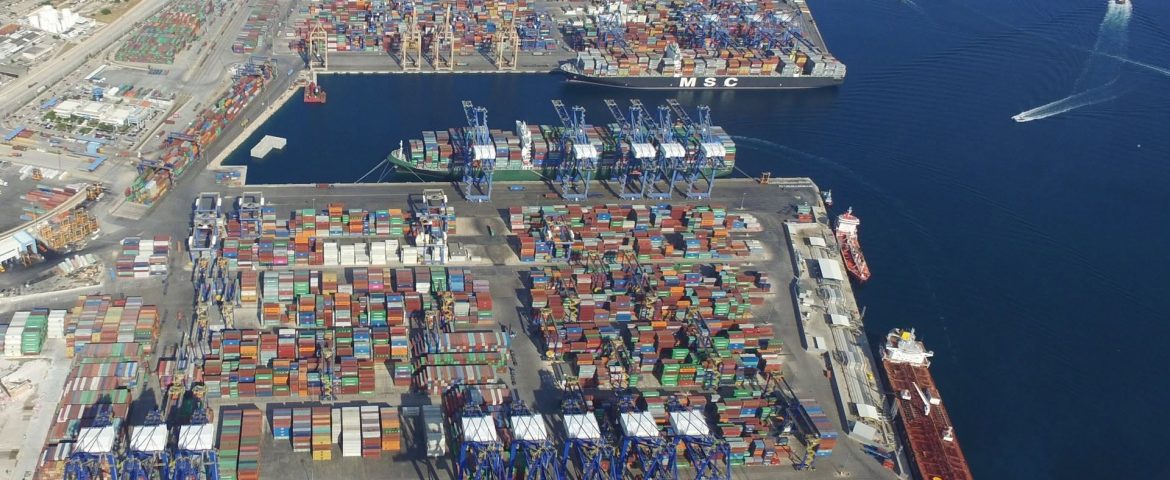
▶️ It then applies this analytical framework in a case study of the presence of a Chinese SOE (COSCO) in Piraeus, Greece. The case study concludes that COSCO’s activities in Piraeus do give China leverage over Greece. The findings call for further assessments of whether, and if so, how home countries of SOEs develop and exercise leverage to achieve their geopolitical objectives. 

▶️ The full study is published in the esteemed scholarly journal Journal of Transport Geography and is freely available (Open Access thanks to HEAL-Link Greece) – Enjoy the reading:

Peter W. de Langen, Athanasios A. Pallis, (2026). Do States develop geopolitical leverage through the international activities of State-Owned Enterprises (SOEs) in ports and maritime logistics?, Journal of Transport Geography, Volume 136,104783,

More about the study 

Better ports improve logistics performance, driving growth of seaborne trade and contributing to economic growth. This impact is especially substantial for developing countries (Munim & Schramm, 2018). Ports, as critical nodes in global logistics, are also potential sources of geopolitical power. Several countries actively shape port development in overseas countries to enhance their role in international trade or status as economic powers.  Thus, studies examining ports from a geopolitical perspective are steadily expanding, with expansive infrastructure projects regarded as forms of geopolitical activity that transform the context for geopolitical decisions. Some even argue that ‘port power’ influences the world order.

State-Owned Enterprises (SOEs) play an increasing role in ports, as shipping lines, container terminal operators or port management bodies (PMBs). Foreign state ownership of container terminal operators is common. SOEs account for approximately 35-40% of global throughput. The largest SOEs in port logistics are COSCO (China; the largest terminal operator by TEU volume), PSA International (Singapore; 3rd), DP World (Dubai; 4th), and China Merchants Port (CMP) (China; 7th). States with majority shares in terminal operating companies also include South Africa, Germany and Indonesia. The expanding global presence of state-owned terminal operators from the Middle East (i.e., Abu Dhabi Ports, DP World, ASYAD-Oman, Q Terminals – Qatar) also points to a reversal of the convergence towards a ports and shipping industry dominated by private enterprises. 

Port management bodies (PMBs) are often embedded in the public sector or domestic SOEs. However, some national governments have delegated port management and development to private port companies, including foreign SOEs investing overseas. Examples include the UK, Greece, India, and Mozambique. 

The extended involvement of SOEs increases the relevance of geopolitics in the evolution of the global port system. It raises critical regulatory questions, specifically whether – and under what circumstances – overseas SOEs should be treated differently from private companies. 

Attention to ports in foreign policy has further increased due to China’s Belt and Road Initiative (BRI), which has accelerated the country’s involvement in ports and terminals worldwide. This involvement in foreign ports is primarily taking shape through SOEs activities. COSCO has invested in ports in 16 countries, and CMP in nine countries. These two SOEs handle approximately 24% of the global annual TEUs throughput. Liu’s (2024) list of 129 international port projects with deep Chinese involvement had increased to 138 by May 2025, of which 113 were part of the BRI. BRI aims to strengthen China’s global connectivity and has triggered ‘global connectivity’ initiatives from the European Union (EU) and the US – the Global Gateway and the Partnership for Global Infrastructure and Investment, respectively. 

There is growing consensus that the ‘naïve’ argument asserting that the foreign activities of SOEs are no different from those of fully private companies needs to be reconsidered. This is because the overseas activities of SOEs may advance the geopolitical goals of their home countries, thereby expanding the influence those home countries can exert over the host country’s economy,

This study provides a framework for assessing the conditions under which States can create geopolitical leverage [defined as ‘the capacity to influence another party to achieve particular results through the threat of or the imposition of consequences on that party’] through SOE activities in foreign ports. Attention to leverage is necessary to fully understand the implications of the growing international presence of SOEs in ports and maritime supply chains. 

This analysis focuses on the home State’s ability to use SOEs to influence the host country to advance its own interests. No attempt is made to assess whether home States have exercised this leverage. Furthermore, the likelihood that a home Country would use its leverage is also not addressed. The objective is to clarify the conditions under which a home country gains leverage vis-à-vis the host country through SOE activities in ports and maritime logistics.

This framework offers a construct for a broader understanding of the geopolitical impact of international investments by SOEs.

The sudy then applies this framework to one of the most illustrative cases of Chinese investments in European ports: the port of Piraeus, Greece, where a Chinese SOE (COSCO) has been the leading container terminal operator since 2008 and the owner of the port managing entity (PPA SA) since 2016. 

Previous article European ports: The need to avoid the great divide

Related Posts

European ports: The need to avoid the great divide European Port Policy

European ports: The need to avoid the great divide

Florence maritime regulation conference: PortEconomics members shape maritime regulation European Port Policy

Florence maritime regulation conference: PortEconomics members shape maritime regulation

Maritime and port strategies as state policies: an introductory approach Featured

Maritime and port strategies as state policies: an introductory approach

Weekly Timeline
Sep 17th 12:11 PM
Category

Geopolitical leverage through the international activities of State-Owned Enterprises (SOEs) in ports and maritime logistics

Jul 22nd 3:50 PM
Thematic Area

European ports: The need to avoid the great divide

Jul 21st 1:41 PM
Thematic Area

Florence maritime regulation conference: PortEconomics members shape maritime regulation

Jul 2nd 2:45 PM
Presentations

New edition: Developing ports as business ecosystems

Jun 23rd 11:51 AM
Featured

Maritime and port strategies as state policies: an introductory approach

Tweets by @PortEconomics
  • Containers
  • Cruise
  • EPP
  • Ports & COVID-19
  • Back to top
About PortEconomics

PortEconomics is a web-based initiative aiming to advance knowledge exchange on seaport studies. Established by maritime economists affiliated to academic institutions in Belgium, Greece and the Netherlands. It provides freely accessible research, education, information, and network-building material on critical issues of port economics, management and policies.

Additional Information
  • About
  • Login
  • Register
  • Edit Profile
  • Contact us
  • PortProfessionals
  • PortReport Series
  • Terms and Conditions
  • Cookie Policy
© PortEconomics 2025. All rights reserved.
Produced by PortEconomics
Manage Consent
To provide the best experiences, we use technologies like cookies to store and/or access device information. Consenting to these technologies will allow us to process data such as browsing behavior or unique IDs on this site. Not consenting or withdrawing consent, may adversely affect certain features and functions.
Functional Always active
The technical storage or access is strictly necessary for the legitimate purpose of enabling the use of a specific service explicitly requested by the subscriber or user, or for the sole purpose of carrying out the transmission of a communication over an electronic communications network.
Preferences
The technical storage or access is necessary for the legitimate purpose of storing preferences that are not requested by the subscriber or user.
Statistics
The technical storage or access that is used exclusively for statistical purposes. The technical storage or access that is used exclusively for anonymous statistical purposes. Without a subpoena, voluntary compliance on the part of your Internet Service Provider, or additional records from a third party, information stored or retrieved for this purpose alone cannot usually be used to identify you.
Marketing
The technical storage or access is required to create user profiles to send advertising, or to track the user on a website or across several websites for similar marketing purposes.
  • Manage options
  • Manage services
  • Manage {vendor_count} vendors
  • Read more about these purposes
View preferences
  • {title}
  • {title}
  • {title}