

• Home
  • About
    • Members
    • Associate Members
    • Former members
  • Thematic Areas
    • Containers
    • Cruise
    • European Port Policy
    • Ports & COVID-19
  • PortStudies
  • Presentations
  • Noticeboard
  • Viewpoints
  • PortLibrary
  • PortReport
PortEconomics
  • March 21st, 2026
PortEconomics
  • Home
  • About
    • Members
    • Associate Members
    • Former members
  • Thematic Areas
    • Containers
    • Cruise
    • European Port Policy
    • Ports & COVID-19
  • PortStudies
    Rhine-Scheldt delta port system

    Rhine-Scheldt delta port system

    A metric of global maritime supply chain disruptions: The global supply chain stress index - maritime (GSCSI-M)

    A metric of global maritime supply chain disruptions: The global supply chain stress index - maritime (GSCSI-M)

    ESG disclosure as a proxy of port corporate communication and sustainable management strategy: An LDA approach

    ESG disclosure as a proxy of port corporate communication and sustainable management strategy: An LDA approach

    From coal exports to green steel production? The role of circular economy precincts for sustainable port diversification

    From coal exports to green steel production? The role of circular economy precincts for sustainable port diversification

    Maritime transport in net zero

    Maritime transport in net zero

  • Presentations
    PortGraphic: Container port dynamics near Gibraltar

    PortGraphic: Container port dynamics near Gibraltar

    Top-10 PortReads in 2025

    Top-10 PortReads in 2025

    Port reform: World Bank publishes the third edition of its port reform toolkit

    Port reform: World Bank publishes the third edition of its port reform toolkit

    When will we admit that maritime transport will not be decarbonised by 2050?

    When will we admit that maritime transport will not be decarbonised by 2050?

    Digital technologies for efficient and resilient sea-land logistics

    Digital technologies for efficient and resilient sea-land logistics

  • Noticeboard
    Call for papers: Contemporary Maritime Economics: Transformations and Emerging Perspectives

    Call for papers: Contemporary Maritime Economics: Transformations and Emerging Perspectives

    ECONSHIP2026: Call for papers

    ECONSHIP2026: Call for papers

    Call for papers: 1st Florence Maritime Regulation Conference

    Call for papers: 1st Florence Maritime Regulation Conference

    PortEconomics co-director appointed Senior Scientific Advisor to the Florence School of Regulation

    PortEconomics co-director appointed Senior Scientific Advisor to the Florence School of Regulation

    Jean Monnet Chair in European Port Policy

    Jean Monnet Chair in European Port Policy

  • Viewpoints
    Commission unveils new EU Ports Strategy

    Commission unveils new EU Ports Strategy

    PortGraphic: Top-15 EU container ports in Q3 2025

    PortGraphic: Top-15 EU container ports in Q3 2025

    Maritime transport in net zero

    Maritime transport in net zero

    Portgraphic: Top-15 EU container ports in H1 2025

    Portgraphic: Top-15 EU container ports in H1 2025

    Portgraphic: fleet capacity (owned/chartered) of container shipping lines

    Portgraphic: fleet capacity (owned/chartered) of container shipping lines

  • PortLibrary
  • PortReport
Improving cruise port infrastructure in the MedCruise

Improving cruise port infrastructure in the Med

February 28th, 2017 Cruise, Featured, Viewpoints

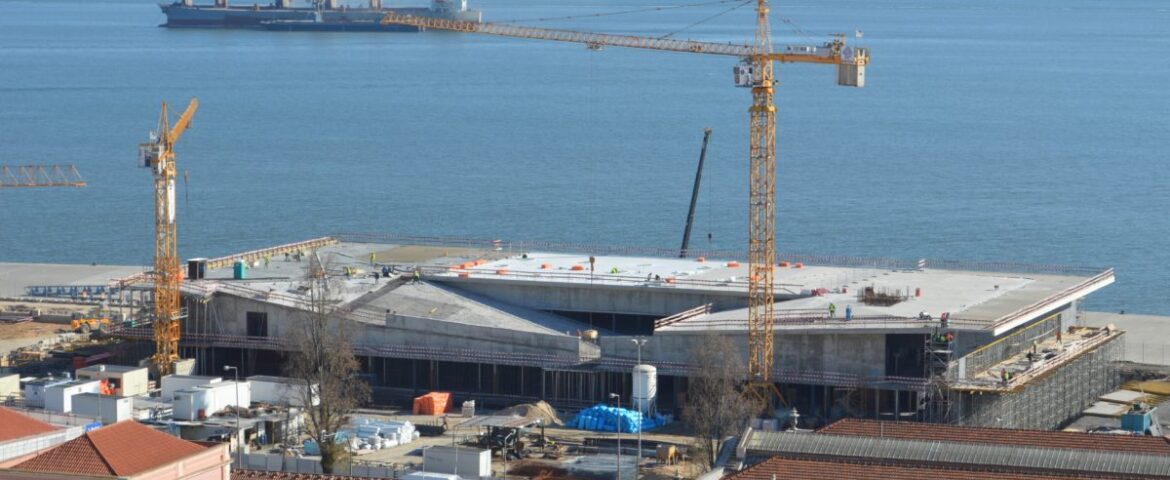
Port of Lisbon under construction terminal

READ ALSO

Call for papers: 1st Florence Maritime Regulation Conference
Jean Monnet Chair in European Port Policy
Port reform: World Bank publishes the third edition of its port reform toolkit
Rhine-Scheldt delta port system

pallisBy Thanos Pallis

Cruise activities in the Mediterranean and its adjoining seas experienced remarkable growth in 2016. Annual statistics from the MedCruise association reveal that member ports handled a total of 27.4 million cruise passenger movements and 13,500 cruise calls last year, a significant rise from 2001, when they welcomed 8.6 million passengers and 10,100 cruise visits.

MedCruise ports have upgraded their cruise terminal infrastructure to meet this demand for more berthing capacity and to accommodate bigger ships. Providing first-class infrastructure for modern cruise vessels remains a top priority for port operators, particularly because the port is the first ‘face’ of a destination.

Cruise ports also aim to develop infrastructure to meet new environmental requirements

Cruise ports also aim to develop infrastructure to meet new environmental requirements. To help members achieve this, MedCruise has partnered with the World Association for Waterborne Transport Infrastructure (PIANC). Together, the organisations plan to advance guidelines on the development of cruise port infrastructure and help MedCruise members benefit from the growth of the industry. The first discussions were held at the MedCruise General Assembly in Tenerife last September. Architects often design port facilities according to the type of operations they will carry out, considering whether cruise lines will use the port for turnaround or transit calls – or both. Transit ports must provide berths of a minimum depth, quays of a certain length, and a wide apron for handling passengers, International Ship and Port Facility Security rules implementation, immigration and customs. A high-quality connection to the local tourist attractions is also essential.

Turnaround ports must be easily connected to passengers’ possible arrival or departure points, such as airports, railway station or bus stations. It is particularly important to offer international connections at airports so passengers worldwide can easily reach their departure port. It is also critical for turnaround ports to provide vast parking areas near the terminal.

Some ports in the Mediterranean and its adjoining seas are currently working on infrastructure development projects that take into account minimum requirements for draughts, berthing lines and navigation channels. Others are collaborating with destination representatives and stakeholders to improve the accessibility from the cruise terminal to the city, minimise road disruption, and to provide better car parking and public transport facilities. In addition, several port authorities and decision makers are upgrading the various spaces inside the cruise terminal, as well as the ground transportation area.

Upgrading infrastructure takes long-term planning because port authorities must secure financing, complete environmental and other technical studies, and consult with multiple institutions before and during work

Upgrading infrastructure takes long-term planning because port authorities must secure financing, complete environmental and other technical studies, and consult with multiple institutions before and during work. All of this adds to the initial high cost of the infrastructure investment.

The cruise industry is constantly evolving, and vessels have continued to grow in all dimensions for more than 40 years. For example, two of today’s biggest cruise vessels are Royal Caribbean International’s 360-metre long, 47-metre wide Allure of the Seas and Oasis of the Seas, which were built in 2009 to accommodate 5,400 passengers. Their size differs significantly from the cruise line’s former Song of Norway, which was built in 1970 and with a length of 168.5 metres, a beam of 24.1 metres and capacity for around 724 passengers.

Higher manoeuvrability, design changes and the use of technology are also key aspects that port authorities and architects must consider when developing infrastructure for particular vessels.

Needs also change when it comes to greener port infrastructure. Decisions on green infrastructure investments should be made in cooperation with the port users and stakeholders, as there is not a one-size-fits-all solution. For example, cruise ports provide waste and cargo residue reception facilities that comply with existing regulatory requirements. However, to get the best results, the facilities and waste delivery and handling plans must be designed after an extensive consultation with all port users.

As ship sizes increase and more people choose to cruise, ports must improve their infrastructure. However, this does not mean that cruise infrastructure will pay off automatically, nor that it will ensure ports secure cruise traffic

As ship sizes increase and more people choose to cruise, ports must improve their infrastructure. However, this does not mean that cruise infrastructure will pay off automatically, nor that it will ensure ports secure cruise traffic. Certainly, investing in upgrades and construction activities is susceptible to several risks. It is difficult to secure funding and there is a long return on investment period, especially because cruising is seasonal and terminals may not be fully used all year round.

Long-term engagement would involve cruise lines committing to calling at the ports for longer periods of time, and ports becoming more actively engaged with itinerary planners and cruise and destination marketers

Ports in the Mediterranean and its adjoining seas continue to take these risks into account, frequently preparing for the worst when making their business cases for the intended infrastructure investments. However, they need more long-term engagement from cruise lines to help them to streamline investments and timelines, avoiding potential mismatches between their long-term port improvement vision and the cruise lines’ short-term itinerary planning decisions. Long-term engagement would involve cruise lines committing to calling at the ports for longer periods of time, and ports becoming more actively engaged with itinerary planners and cruise and destination marketers.

MedCruise will continue to create platforms that enable cruise ports and cruise lines to ensure their strategies are aligned and that ports can provide the infrastructure cruise lines need.

The viewpoint first published @International Cruise & Ferry Review, Issue 50, Spring 2017.
 

Next article PortGraphic: the spectacular rise of Shanghai as a container port
Previous article The impacts of e-commerce on freight distribution

Thanos Pallis

Dr. Thanos Pallis is Professor of Port Economics & Policy & the scientific coordinator of the Jean Monnet Action on European Port Policy at the Department of Shipping, Trade and Transport (STT), University of the Aegean, Greece. He is currently the President of the International Association of Maritime Economists (IAME), and has served as secretary general of MedCruise, the association of cruise ports in the Med. The author of the acclaimed book "European Port Policy", he has an extensive international experience in port policy and economics. Thanos co-directs PortEconomics and is a regular contributor at the work of national governments and international organisation (UNCTAD, OECD, and ESPO, IAPH, and AVIP) shaping the port sector.

Related Posts

Rhine-Scheldt delta port system Featured

Rhine-Scheldt delta port system

Commission unveils new EU Ports Strategy European Port Policy

Commission unveils new EU Ports Strategy

PortGraphic: Container port dynamics near Gibraltar Containers

PortGraphic: Container port dynamics near Gibraltar

Weekly Timeline
Mar 9th 4:35 PM
Featured

Rhine-Scheldt delta port system

Mar 6th 1:23 PM
Thematic Area

Commission unveils new EU Ports Strategy

Feb 18th 1:46 PM
Thematic Area

PortGraphic: Container port dynamics near Gibraltar

Feb 12th 12:25 PM
Featured

A metric of global maritime supply chain disruptions: The global supply chain stress index – maritime (GSCSI-M)

Jan 14th 12:56 PM
Noticeboard

Call for papers: Contemporary Maritime Economics: Transformations and Emerging Perspectives

Tweets by @PortEconomics
  • Containers
  • Cruise
  • EPP
  • Ports & COVID-19
  • Back to top
About PortEconomics

PortEconomics is a web-based initiative aiming to advance knowledge exchange on seaport studies. Established by maritime economists affiliated to academic institutions in Belgium, Greece and the Netherlands. It provides freely accessible research, education, information, and network-building material on critical issues of port economics, management and policies.

Additional Information
  • About
  • Login
  • Register
  • Edit Profile
  • Contact us
  • PortProfessionals
  • PortReport Series
  • Terms and Conditions
  • Cookie Policy
© PortEconomics 2025. All rights reserved.
Produced by PortEconomics
Manage Consent
To provide the best experiences, we use technologies like cookies to store and/or access device information. Consenting to these technologies will allow us to process data such as browsing behavior or unique IDs on this site. Not consenting or withdrawing consent, may adversely affect certain features and functions.
Functional Always active
The technical storage or access is strictly necessary for the legitimate purpose of enabling the use of a specific service explicitly requested by the subscriber or user, or for the sole purpose of carrying out the transmission of a communication over an electronic communications network.
Preferences
The technical storage or access is necessary for the legitimate purpose of storing preferences that are not requested by the subscriber or user.
Statistics
The technical storage or access that is used exclusively for statistical purposes. The technical storage or access that is used exclusively for anonymous statistical purposes. Without a subpoena, voluntary compliance on the part of your Internet Service Provider, or additional records from a third party, information stored or retrieved for this purpose alone cannot usually be used to identify you.
Marketing
The technical storage or access is required to create user profiles to send advertising, or to track the user on a website or across several websites for similar marketing purposes.
  • Manage options
  • Manage services
  • Manage {vendor_count} vendors
  • Read more about these purposes
View preferences
  • {title}
  • {title}
  • {title}