

• Home
  • About
    • Members
    • Associate Members
    • Former members
  • Thematic Areas
    • Containers
    • Cruise
    • European Port Policy
    • Ports & COVID-19
  • PortStudies
  • Presentations
  • Noticeboard
  • Viewpoints
  • PortLibrary
  • PortReport
PortEconomics
  • February 20th, 2026
PortEconomics
  • Home
  • About
    • Members
    • Associate Members
    • Former members
  • Thematic Areas
    • Containers
    • Cruise
    • European Port Policy
    • Ports & COVID-19
  • PortStudies
    A metric of global maritime supply chain disruptions: The global supply chain stress index - maritime (GSCSI-M)

    A metric of global maritime supply chain disruptions: The global supply chain stress index - maritime (GSCSI-M)

    ESG disclosure as a proxy of port corporate communication and sustainable management strategy: An LDA approach

    ESG disclosure as a proxy of port corporate communication and sustainable management strategy: An LDA approach

    From coal exports to green steel production? The role of circular economy precincts for sustainable port diversification

    From coal exports to green steel production? The role of circular economy precincts for sustainable port diversification

    Maritime transport in net zero

    Maritime transport in net zero

    Onboard carbon capture, utilisation and storage (CCUS) supply chain optimisation: an application to vessels active in the offshore wind industry

    Onboard carbon capture, utilisation and storage (CCUS) supply chain optimisation: an application to vessels active in the offshore wind industry

  • Presentations
    PortGraphic: Container port dynamics near Gibraltar

    PortGraphic: Container port dynamics near Gibraltar

    Top-10 PortReads in 2025

    Top-10 PortReads in 2025

    Port reform: World Bank publishes the third edition of its port reform toolkit

    Port reform: World Bank publishes the third edition of its port reform toolkit

    When will we admit that maritime transport will not be decarbonised by 2050?

    When will we admit that maritime transport will not be decarbonised by 2050?

    Digital technologies for efficient and resilient sea-land logistics

    Digital technologies for efficient and resilient sea-land logistics

  • Noticeboard
    Call for papers: Contemporary Maritime Economics: Transformations and Emerging Perspectives

    Call for papers: Contemporary Maritime Economics: Transformations and Emerging Perspectives

    ECONSHIP2026: Call for papers

    ECONSHIP2026: Call for papers

    Call for papers: 1st Florence Maritime Regulation Conference

    Call for papers: 1st Florence Maritime Regulation Conference

    PortEconomics co-director appointed Senior Scientific Advisor to the Florence School of Regulation

    PortEconomics co-director appointed Senior Scientific Advisor to the Florence School of Regulation

    Jean Monnet Chair in European Port Policy

    Jean Monnet Chair in European Port Policy

  • Viewpoints
    PortGraphic: Top-15 EU container ports in Q3 2025

    PortGraphic: Top-15 EU container ports in Q3 2025

    Maritime transport in net zero

    Maritime transport in net zero

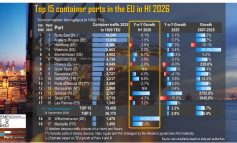
    Portgraphic: Top-15 EU container ports in H1 2025

    Portgraphic: Top-15 EU container ports in H1 2025

    Portgraphic: fleet capacity (owned/chartered) of container shipping lines

    Portgraphic: fleet capacity (owned/chartered) of container shipping lines

    In a tight spot: American ports in global supply chains

    In a tight spot: American ports in global supply chains

  • PortLibrary
  • PortReport
PortReport 3 | Reflections on the future of container ports in view of the new containerization behaviorContainers

PortReport 3 | Reflections on the future of container ports in view of the new containerization behavior

January 14th, 2019 Containers, Featured, PortReport, PortStudies

READ ALSO

Portgraphic: Top-15 EU container ports in H1 2025
The box that makes the world go around: container terminals and global trade
Hierarchy and mobility of Latin America and Caribbean container ports
PortGraphic: Container port dynamics near Gibraltar

Download PortReport No 3 – Reflections on the future of container ports in view of the new containerization behavior.

Almost from its inception, there has been a clear upward trend in the disruptive force of the container during its use. However, a relative decrease in container movement has been seen in recent years although the explanation of which goes beyond disturbances in the world economy. PortEconomics member Ricardo Sanchez along with Eliana Barleta notice that the inter-annual change in throughput with respect to changes in GDP is declining. To understand this phenomenon, the authors- in their latest PortReport- have examined variations in containerization, notably factors that cause containerization to increase and decrease. With the intent to explain these upward and downward variations, some working hypotheses will be proposed and demonstrated, particularly the reprimarization of the economy, cargo miniaturization, possible decreases in transhipments, and the increasing use of 40-feet containers rather than 20-feet containers. PortReport No 3 outlines the current status of trade and containerization, advances hypotheses to better understand the phenomenon of containerization for the future while considers the factors that could cause the containerization rate to increase, and others that make it decrease.


PortReport is a PortEconomics series designed to disseminate studies on port economics, policy, and management to a wider readership. Studies included in the series contain original, unpublished research and are subject to approval by the editorial team, with authors retaining copyright of the published work. The opinions expressed and arguments employed herein do not necessarily reflect official views of the PortEconomics team.  The content might be reproduced subject to citation of the original source.  PortReport studies are published regularly and are freely available electronically on the PortEconomics webpage under “PortReport”. To read previous issues of PortReport visit: www.porteconomics.eu/portreport.

Next article Are container volumes in transhipment hubs more volatile than in gateway ports?
Previous article Ports and the circular economy

Ricardo JSanchez

Ricardo J Sanchez is an economist, PhD in Economics (Pontificia Universidad Catolica Argentina), BA in Economics at the Universidad del Salvador, Argentina, and postgraduate with a MSc in Economics and Administration of Public Utilities at the Universidad Carlos III in Madrid, Spain / University of Paris X, France. Ricardo is an internationally recognised expert in shipping and port economics, as well as in transport and infrastructure, with special focus on the region of Latin America and the Caribbean. He has worked either professionally or academically in 30 out of the 33 countries of Latin America and the Caribbean along 30 years, as well as in Europe and Asia. Currently he is Head of the Caribbean Research Institute and co-chair to the Kühne Professorial Chair in Logistics at the School of Management, Universidad de los Andes at Bogotá, Colombia. He is advisor, for logistics and maritime issues, to the Association of Caribbean States. For more than 20 years, he was a Senior Economic Affairs Officer at the United Nations Economic Commission for Latin American and the Caribbean, Division of Trade, Integration and Infrastructure. Main duties: to lead a high-level professional team to conduct research and to provide technical assistance and training to governments and public and private organisations, on the matters of infrastructure, maritime, ports and logistics affairs. His main research interests are shipping and port economics, including industrial organization applied to shipping markets, port devolution and the maritime cycle. He holds more than 215 publications among books, chapters in books, peer reviewed articles, working papers, etc., in Spanish, English and Portuguese.

Related Posts

PortGraphic: Container port dynamics near Gibraltar Containers

PortGraphic: Container port dynamics near Gibraltar

A metric of global maritime supply chain disruptions: The global supply chain stress index - maritime (GSCSI-M) Featured

A metric of global maritime supply chain disruptions: The global supply chain stress index - maritime (GSCSI-M)

PortGraphic: Top-15 EU container ports in Q3 2025 Containers

PortGraphic: Top-15 EU container ports in Q3 2025

Weekly Timeline
Feb 18th 1:46 PM
Thematic Area

PortGraphic: Container port dynamics near Gibraltar

Feb 12th 12:25 PM
Featured

A metric of global maritime supply chain disruptions: The global supply chain stress index – maritime (GSCSI-M)

Jan 14th 12:56 PM
Noticeboard

Call for papers: Contemporary Maritime Economics: Transformations and Emerging Perspectives

Jan 4th 12:46 PM
Thematic Area

PortGraphic: Top-15 EU container ports in Q3 2025

Dec 16th 1:12 PM
Featured

Top-10 PortReads in 2025

Tweets by @PortEconomics
  • Containers
  • Cruise
  • EPP
  • Ports & COVID-19
  • Back to top
About PortEconomics

PortEconomics is a web-based initiative aiming to advance knowledge exchange on seaport studies. Established by maritime economists affiliated to academic institutions in Belgium, Greece and the Netherlands. It provides freely accessible research, education, information, and network-building material on critical issues of port economics, management and policies.

Additional Information
  • About
  • Login
  • Register
  • Edit Profile
  • Contact us
  • PortProfessionals
  • PortReport Series
  • Terms and Conditions
  • Cookie Policy
© PortEconomics 2025. All rights reserved.
Produced by PortEconomics
Manage Consent
To provide the best experiences, we use technologies like cookies to store and/or access device information. Consenting to these technologies will allow us to process data such as browsing behavior or unique IDs on this site. Not consenting or withdrawing consent, may adversely affect certain features and functions.
Functional Always active
The technical storage or access is strictly necessary for the legitimate purpose of enabling the use of a specific service explicitly requested by the subscriber or user, or for the sole purpose of carrying out the transmission of a communication over an electronic communications network.
Preferences
The technical storage or access is necessary for the legitimate purpose of storing preferences that are not requested by the subscriber or user.
Statistics
The technical storage or access that is used exclusively for statistical purposes. The technical storage or access that is used exclusively for anonymous statistical purposes. Without a subpoena, voluntary compliance on the part of your Internet Service Provider, or additional records from a third party, information stored or retrieved for this purpose alone cannot usually be used to identify you.
Marketing
The technical storage or access is required to create user profiles to send advertising, or to track the user on a website or across several websites for similar marketing purposes.
  • Manage options
  • Manage services
  • Manage {vendor_count} vendors
  • Read more about these purposes
View preferences
  • {title}
  • {title}
  • {title}