

• Home
  • About
    • Members
    • Associate Members
    • Former members
  • Thematic Areas
    • Containers
    • Cruise
    • European Port Policy
    • Ports & COVID-19
  • PortStudies
  • Presentations
  • Noticeboard
  • Viewpoints
  • PortLibrary
  • PortReport
PortEconomics
  • March 19th, 2026
PortEconomics
  • Home
  • About
    • Members
    • Associate Members
    • Former members
  • Thematic Areas
    • Containers
    • Cruise
    • European Port Policy
    • Ports & COVID-19
  • PortStudies
    Rhine-Scheldt delta port system

    Rhine-Scheldt delta port system

    A metric of global maritime supply chain disruptions: The global supply chain stress index - maritime (GSCSI-M)

    A metric of global maritime supply chain disruptions: The global supply chain stress index - maritime (GSCSI-M)

    ESG disclosure as a proxy of port corporate communication and sustainable management strategy: An LDA approach

    ESG disclosure as a proxy of port corporate communication and sustainable management strategy: An LDA approach

    From coal exports to green steel production? The role of circular economy precincts for sustainable port diversification

    From coal exports to green steel production? The role of circular economy precincts for sustainable port diversification

    Maritime transport in net zero

    Maritime transport in net zero

  • Presentations
    PortGraphic: Container port dynamics near Gibraltar

    PortGraphic: Container port dynamics near Gibraltar

    Top-10 PortReads in 2025

    Top-10 PortReads in 2025

    Port reform: World Bank publishes the third edition of its port reform toolkit

    Port reform: World Bank publishes the third edition of its port reform toolkit

    When will we admit that maritime transport will not be decarbonised by 2050?

    When will we admit that maritime transport will not be decarbonised by 2050?

    Digital technologies for efficient and resilient sea-land logistics

    Digital technologies for efficient and resilient sea-land logistics

  • Noticeboard
    Call for papers: Contemporary Maritime Economics: Transformations and Emerging Perspectives

    Call for papers: Contemporary Maritime Economics: Transformations and Emerging Perspectives

    ECONSHIP2026: Call for papers

    ECONSHIP2026: Call for papers

    Call for papers: 1st Florence Maritime Regulation Conference

    Call for papers: 1st Florence Maritime Regulation Conference

    PortEconomics co-director appointed Senior Scientific Advisor to the Florence School of Regulation

    PortEconomics co-director appointed Senior Scientific Advisor to the Florence School of Regulation

    Jean Monnet Chair in European Port Policy

    Jean Monnet Chair in European Port Policy

  • Viewpoints
    Commission unveils new EU Ports Strategy

    Commission unveils new EU Ports Strategy

    PortGraphic: Top-15 EU container ports in Q3 2025

    PortGraphic: Top-15 EU container ports in Q3 2025

    Maritime transport in net zero

    Maritime transport in net zero

    Portgraphic: Top-15 EU container ports in H1 2025

    Portgraphic: Top-15 EU container ports in H1 2025

    Portgraphic: fleet capacity (owned/chartered) of container shipping lines

    Portgraphic: fleet capacity (owned/chartered) of container shipping lines

  • PortLibrary
  • PortReport
PortGraphic: Top15 container ports in Europe in 2018Containers

PortGraphic: Top15 container ports in Europe in 2018

March 2nd, 2019 Containers, European Port Policy, Featured, Viewpoints

READ ALSO

PortGraphic: Container port dynamics near Gibraltar
Call for papers: Contemporary Maritime Economics: Transformations and Emerging Perspectives
PortGraphic: Top-15 EU container ports in Q3 2025
Rhine-Scheldt delta port system

By Theo Notteboom

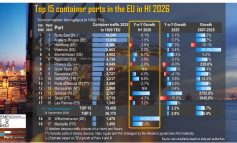
The cargo volume handled remains a key performance indicator for ports. While also other indicators related to logistics performance, sustainability, innovation and economic impact are gaining ground, it remains relevant to observe how cargo volumes have evolved over time. The table shows the top 15 container ports in the European Union in 2018 based on container throughput expressed in TEU. It also includes container growth figures compared to 2017 and pre-crisis year 2007.

What do the figures reveal?

Top 15: y-o-y increase in container traffic of 4.8% in 2018

Last year, the top 15 ports recorded a growth of 4.8%, almost the same as the 4.6% growth in 2017. In 2015 the top 15 ports saw a small traffic decline of 1.6% compared to 2014. In 2016 they recorded a modest growth of 2.1%. The year 2018 brought a double digit growth in Gdansk, Piraeus and Barcelona, while Mediterranean transhipment hub Gioia Tauro saw a 6% decline in box volumes. German ports Hamburg and Bremerhaven recorded a small traffic loss, while container throughput in Le Havre and Genoa stagnated. Both Rotterdam and Antwerp stay on the growth path of the past years with a healthy throughput increase of 5.7% and 6.2% respectively. Valencia, the largest container port in the Mediterranean, can present a similar growth figure.

Top 15: 26% increase in container traffic between 2007 and 2018

The top 15 ports combined saw a 26% increase in container traffic compared to pre-crisis year 2007. Only two of the 15 ports recorded container volumes in 2018 below the 2007 figures: transhipment hub Gioia Tauro and German mainport Hamburg (note that no 2018 figures are available yet for UK ports Felixstowe and Southampton). The performance of Hamburg – Europe’s third largest container port (-11.7% compared to 2007) – sharply deviates from the growth pattern observed in the two largest European ports which both managed to increase TEU volumes by some 35-36% in the period 2007-2018. The gap between Rotterdam and Antwerp now amounts to almost 3.5 million TEU, while Antwerp handles almost 2.5 million TEU more than Hamburg. Recent changes in the liner service schedules of alliances and the Elbe deepening and widening program should help the port of Hamburg to record a healthy growth in 2019. The top 3 ports in Europe handled more than 34 million TEU in 2018 (+4.1%) or 45% of the combined throughput of all top 15 ports.

Baltic port Gdansk enters top 15

Only few changes took place when it comes to the ports that made it to the top 15. Gdansk in Poland entered the top 15 thanks to impressive year-on-year growth figures of more than 23% in 2018 and 21.6% in 2017. It is the first time a Baltic port makes it to the EU top 15 (note that St-Petersburg handled 2.13 million TEU in 2018). With a throughput of 1.75 million TEU, Sines in Portugal is no longer in the top 15 despite a growth rate of 5% in 2018. Sines joined the top 15 only in 2016 filling the spot previously occupied by the Belgian coastal port of Zeebrugge (1.6 million TEU in 2018, +5.2%). In 2007, Constantza in the Black Sea still ranked no. 15 (1.41 million TEU) and Zeebrugge no. 11 (2.02 million TEU).

Fourth position challenged by Med ports

The top 4 remained unchanged in 2018 featuring only ports of the so-called Hamburg-Le Havre range. However, Valencia, Piraeus and Algeciras are closing in fast on Bremerhaven. It is likely that a south European port will enter the top 4 in 2019 or 2020 at the latest. Piraeus continues to climb the rankings by gaining two places to occupy the 6th position in 2018. Piraeus was not even in the top 15 in 2007. Barcelona is now the 9th biggest container port in Europe, while two years ago the port was still at the 13th position. Finally, it is worth mentioning that the Moroccan transhipment port of Tanger Med handled 3.47 million TEU in 2018. With new container terminal capacity becoming operational, Tanger Med continues to be a major competitor for European hubs in the region around the Straits of Gibraltar, such as Algeciras, Valencia and Sines.

Next article Ιnternationalization of port managing bodies
Previous article The Analyst: ships and terminals through Amazon's eyes

Theo Notteboom

Dr. Theo Notteboom is co-founder and co-director of PortEconomics. He is a professor in port and maritime economics and management with about 25 years of experience in this area. His work is widely cited. He is a regular speaker at international conferences and a rapporteur/expert to leading organizations in the field. He is Chair Professor at Ghent University in Belgium. He is a visiting Research Professor at China Institute of FTZ Supply Chain of Shanghai Maritime University. He also is part-time Professor at University of Antwerp and the Antwerp Maritime Academy in Belgium. He previously held a full-time position as High-end Foreign Expert / Professor at Dalian Maritime University in China (2014-2016) and an MPA visiting professorship in port management at Nanyang Technological University (NTU) in Singapore. He is immediate past President (2010-2014) and Council Member of International Association of Maritime Economists (IAME). Between October 2006 and October 2014 he was President of ITMMA of the University of Antwerp. Between 2009 and 2014 he was Chairman of the Board of Directors of Belgian Institute of Transport Organizers (BITO), an institute of the Belgian Federal Government.

Related Posts

Rhine-Scheldt delta port system Featured

Rhine-Scheldt delta port system

Commission unveils new EU Ports Strategy European Port Policy

Commission unveils new EU Ports Strategy

PortGraphic: Container port dynamics near Gibraltar Containers

PortGraphic: Container port dynamics near Gibraltar

Weekly Timeline
Mar 9th 4:35 PM
Featured

Rhine-Scheldt delta port system

Mar 6th 1:23 PM
Thematic Area

Commission unveils new EU Ports Strategy

Feb 18th 1:46 PM
Thematic Area

PortGraphic: Container port dynamics near Gibraltar

Feb 12th 12:25 PM
Featured

A metric of global maritime supply chain disruptions: The global supply chain stress index – maritime (GSCSI-M)

Jan 14th 12:56 PM
Noticeboard

Call for papers: Contemporary Maritime Economics: Transformations and Emerging Perspectives

Tweets by @PortEconomics
  • Containers
  • Cruise
  • EPP
  • Ports & COVID-19
  • Back to top
About PortEconomics

PortEconomics is a web-based initiative aiming to advance knowledge exchange on seaport studies. Established by maritime economists affiliated to academic institutions in Belgium, Greece and the Netherlands. It provides freely accessible research, education, information, and network-building material on critical issues of port economics, management and policies.

Additional Information
  • About
  • Login
  • Register
  • Edit Profile
  • Contact us
  • PortProfessionals
  • PortReport Series
  • Terms and Conditions
  • Cookie Policy
© PortEconomics 2025. All rights reserved.
Produced by PortEconomics
Manage Consent
To provide the best experiences, we use technologies like cookies to store and/or access device information. Consenting to these technologies will allow us to process data such as browsing behavior or unique IDs on this site. Not consenting or withdrawing consent, may adversely affect certain features and functions.
Functional Always active
The technical storage or access is strictly necessary for the legitimate purpose of enabling the use of a specific service explicitly requested by the subscriber or user, or for the sole purpose of carrying out the transmission of a communication over an electronic communications network.
Preferences
The technical storage or access is necessary for the legitimate purpose of storing preferences that are not requested by the subscriber or user.
Statistics
The technical storage or access that is used exclusively for statistical purposes. The technical storage or access that is used exclusively for anonymous statistical purposes. Without a subpoena, voluntary compliance on the part of your Internet Service Provider, or additional records from a third party, information stored or retrieved for this purpose alone cannot usually be used to identify you.
Marketing
The technical storage or access is required to create user profiles to send advertising, or to track the user on a website or across several websites for similar marketing purposes.
  • Manage options
  • Manage services
  • Manage {vendor_count} vendors
  • Read more about these purposes
View preferences
  • {title}
  • {title}
  • {title}