

• Home
  • About
    • Members
    • Associate Members
    • Former members
  • Thematic Areas
    • Containers
    • Cruise
    • European Port Policy
    • Ports & COVID-19
  • PortStudies
  • Presentations
  • Noticeboard
  • Viewpoints
  • PortLibrary
  • PortReport
PortEconomics
  • February 18th, 2026
PortEconomics
  • Home
  • About
    • Members
    • Associate Members
    • Former members
  • Thematic Areas
    • Containers
    • Cruise
    • European Port Policy
    • Ports & COVID-19
  • PortStudies
    A metric of global maritime supply chain disruptions: The global supply chain stress index - maritime (GSCSI-M)

    A metric of global maritime supply chain disruptions: The global supply chain stress index - maritime (GSCSI-M)

    ESG disclosure as a proxy of port corporate communication and sustainable management strategy: An LDA approach

    ESG disclosure as a proxy of port corporate communication and sustainable management strategy: An LDA approach

    From coal exports to green steel production? The role of circular economy precincts for sustainable port diversification

    From coal exports to green steel production? The role of circular economy precincts for sustainable port diversification

    Maritime transport in net zero

    Maritime transport in net zero

    Onboard carbon capture, utilisation and storage (CCUS) supply chain optimisation: an application to vessels active in the offshore wind industry

    Onboard carbon capture, utilisation and storage (CCUS) supply chain optimisation: an application to vessels active in the offshore wind industry

  • Presentations
    PortGraphic: Container port dynamics near Gibraltar

    PortGraphic: Container port dynamics near Gibraltar

    Top-10 PortReads in 2025

    Top-10 PortReads in 2025

    Port reform: World Bank publishes the third edition of its port reform toolkit

    Port reform: World Bank publishes the third edition of its port reform toolkit

    When will we admit that maritime transport will not be decarbonised by 2050?

    When will we admit that maritime transport will not be decarbonised by 2050?

    Digital technologies for efficient and resilient sea-land logistics

    Digital technologies for efficient and resilient sea-land logistics

  • Noticeboard
    Call for papers: Contemporary Maritime Economics: Transformations and Emerging Perspectives

    Call for papers: Contemporary Maritime Economics: Transformations and Emerging Perspectives

    ECONSHIP2026: Call for papers

    ECONSHIP2026: Call for papers

    Call for papers: 1st Florence Maritime Regulation Conference

    Call for papers: 1st Florence Maritime Regulation Conference

    PortEconomics co-director appointed Senior Scientific Advisor to the Florence School of Regulation

    PortEconomics co-director appointed Senior Scientific Advisor to the Florence School of Regulation

    Jean Monnet Chair in European Port Policy

    Jean Monnet Chair in European Port Policy

  • Viewpoints
    PortGraphic: Top-15 EU container ports in Q3 2025

    PortGraphic: Top-15 EU container ports in Q3 2025

    Maritime transport in net zero

    Maritime transport in net zero

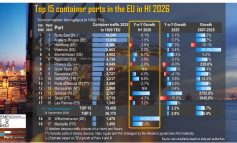
    Portgraphic: Top-15 EU container ports in H1 2025

    Portgraphic: Top-15 EU container ports in H1 2025

    Portgraphic: fleet capacity (owned/chartered) of container shipping lines

    Portgraphic: fleet capacity (owned/chartered) of container shipping lines

    In a tight spot: American ports in global supply chains

    In a tight spot: American ports in global supply chains

  • PortLibrary
  • PortReport
Port and hinterland: the impact of containerisationContainers

Port and hinterland: the impact of containerisation

June 22nd, 2021 Containers, Featured, PortStudies

Photo credit: Hxdyl/Shutterstock

READ ALSO

Digital technologies for efficient and resilient sea-land logistics
Green strategies in ports: stakeholder management perspectives
Operational productivity and financial performance: pure transhipment hubs vs gateway terminals
PortGraphic: Container port dynamics near Gibraltar

The traditional notion of hinterland refers to the inland economic area influenced by the ports. In other words, hinterland represents the set of points of origin/destination of cargo flows, which pass through the port and generates the majority of its business. Following logistics and market transformations, the concept of hinterland has become rather dynamic and the traditional static approach may be misleading. In particular, it appears rather complex to identify hinterland’s boundaries due to the influence of drivers that are constantly evolving. Notably, shipping lines, terminal operators and other logistics players hold a pivotal role in shaping port hinterland development. The ability of Port Authorities (PAs) to cooperate with the actors of the maritime cluster as well as  inland terminals seems to be fundamental to extend the network and enhance port competitiveness. In this perspective, Notteboom and Rodrigue (2005) coined a new concept, defined as “port regionalisation”, capable to explain the new phase of growth of port systems, based on the emergence of broader logistics pole

PortEconomics members Francesco Parola and Giovanni Satta along with Francesco Vitellaro (University of Genoa) co-authored a book chapter on the port and hinterland and its impact of containerisation which included in the International Encyclopedia of Transportation- now available via academic publisher Elsevier.

Encyclopedia of Transportation, a massive academic work edited by Roger Vickerman, consists of seven volumes with contributions by hundreds of scholars with various specializations in transport studies and brings a cross-cutting and integrated approach to all aspects of transportation from a variety of interdisciplinary fields including engineering, operations research, economics, geography and sociology in order to understand the changes taking place.

The authors’ version of the book chapter can be found here.

Next article Improving a congested maritime supply chain with time slot management for port calls
Previous article Underground logistics systems to cope with internal container traffic in the port of Antwerp?

Related Posts

PortGraphic: Container port dynamics near Gibraltar Containers

PortGraphic: Container port dynamics near Gibraltar

A metric of global maritime supply chain disruptions: The global supply chain stress index - maritime (GSCSI-M) Featured

A metric of global maritime supply chain disruptions: The global supply chain stress index - maritime (GSCSI-M)

PortGraphic: Top-15 EU container ports in Q3 2025 Containers

PortGraphic: Top-15 EU container ports in Q3 2025

Weekly Timeline
Feb 18th 1:46 PM
Thematic Area

PortGraphic: Container port dynamics near Gibraltar

Feb 12th 12:25 PM
Featured

A metric of global maritime supply chain disruptions: The global supply chain stress index – maritime (GSCSI-M)

Jan 14th 12:56 PM
Noticeboard

Call for papers: Contemporary Maritime Economics: Transformations and Emerging Perspectives

Jan 4th 12:46 PM
Thematic Area

PortGraphic: Top-15 EU container ports in Q3 2025

Dec 16th 1:12 PM
Featured

Top-10 PortReads in 2025

Tweets by @PortEconomics
  • Containers
  • Cruise
  • EPP
  • Ports & COVID-19
  • Back to top
About PortEconomics

PortEconomics is a web-based initiative aiming to advance knowledge exchange on seaport studies. Established by maritime economists affiliated to academic institutions in Belgium, Greece and the Netherlands. It provides freely accessible research, education, information, and network-building material on critical issues of port economics, management and policies.

Additional Information
  • About
  • Login
  • Register
  • Edit Profile
  • Contact us
  • PortProfessionals
  • PortReport Series
  • Terms and Conditions
  • Cookie Policy
© PortEconomics 2025. All rights reserved.
Produced by PortEconomics
Manage Consent
To provide the best experiences, we use technologies like cookies to store and/or access device information. Consenting to these technologies will allow us to process data such as browsing behavior or unique IDs on this site. Not consenting or withdrawing consent, may adversely affect certain features and functions.
Functional Always active
The technical storage or access is strictly necessary for the legitimate purpose of enabling the use of a specific service explicitly requested by the subscriber or user, or for the sole purpose of carrying out the transmission of a communication over an electronic communications network.
Preferences
The technical storage or access is necessary for the legitimate purpose of storing preferences that are not requested by the subscriber or user.
Statistics
The technical storage or access that is used exclusively for statistical purposes. The technical storage or access that is used exclusively for anonymous statistical purposes. Without a subpoena, voluntary compliance on the part of your Internet Service Provider, or additional records from a third party, information stored or retrieved for this purpose alone cannot usually be used to identify you.
Marketing
The technical storage or access is required to create user profiles to send advertising, or to track the user on a website or across several websites for similar marketing purposes.
  • Manage options
  • Manage services
  • Manage {vendor_count} vendors
  • Read more about these purposes
View preferences
  • {title}
  • {title}
  • {title}