

• Home
  • About
    • Members
    • Associate Members
    • Former members
  • Thematic Areas
    • Containers
    • Cruise
    • European Port Policy
    • Ports & COVID-19
  • PortStudies
  • Presentations
  • Noticeboard
  • Viewpoints
  • PortLibrary
  • PortReport
PortEconomics
  • February 20th, 2026
PortEconomics
  • Home
  • About
    • Members
    • Associate Members
    • Former members
  • Thematic Areas
    • Containers
    • Cruise
    • European Port Policy
    • Ports & COVID-19
  • PortStudies
    A metric of global maritime supply chain disruptions: The global supply chain stress index - maritime (GSCSI-M)

    A metric of global maritime supply chain disruptions: The global supply chain stress index - maritime (GSCSI-M)

    ESG disclosure as a proxy of port corporate communication and sustainable management strategy: An LDA approach

    ESG disclosure as a proxy of port corporate communication and sustainable management strategy: An LDA approach

    From coal exports to green steel production? The role of circular economy precincts for sustainable port diversification

    From coal exports to green steel production? The role of circular economy precincts for sustainable port diversification

    Maritime transport in net zero

    Maritime transport in net zero

    Onboard carbon capture, utilisation and storage (CCUS) supply chain optimisation: an application to vessels active in the offshore wind industry

    Onboard carbon capture, utilisation and storage (CCUS) supply chain optimisation: an application to vessels active in the offshore wind industry

  • Presentations
    PortGraphic: Container port dynamics near Gibraltar

    PortGraphic: Container port dynamics near Gibraltar

    Top-10 PortReads in 2025

    Top-10 PortReads in 2025

    Port reform: World Bank publishes the third edition of its port reform toolkit

    Port reform: World Bank publishes the third edition of its port reform toolkit

    When will we admit that maritime transport will not be decarbonised by 2050?

    When will we admit that maritime transport will not be decarbonised by 2050?

    Digital technologies for efficient and resilient sea-land logistics

    Digital technologies for efficient and resilient sea-land logistics

  • Noticeboard
    Call for papers: Contemporary Maritime Economics: Transformations and Emerging Perspectives

    Call for papers: Contemporary Maritime Economics: Transformations and Emerging Perspectives

    ECONSHIP2026: Call for papers

    ECONSHIP2026: Call for papers

    Call for papers: 1st Florence Maritime Regulation Conference

    Call for papers: 1st Florence Maritime Regulation Conference

    PortEconomics co-director appointed Senior Scientific Advisor to the Florence School of Regulation

    PortEconomics co-director appointed Senior Scientific Advisor to the Florence School of Regulation

    Jean Monnet Chair in European Port Policy

    Jean Monnet Chair in European Port Policy

  • Viewpoints
    PortGraphic: Top-15 EU container ports in Q3 2025

    PortGraphic: Top-15 EU container ports in Q3 2025

    Maritime transport in net zero

    Maritime transport in net zero

    Portgraphic: Top-15 EU container ports in H1 2025

    Portgraphic: Top-15 EU container ports in H1 2025

    Portgraphic: fleet capacity (owned/chartered) of container shipping lines

    Portgraphic: fleet capacity (owned/chartered) of container shipping lines

    In a tight spot: American ports in global supply chains

    In a tight spot: American ports in global supply chains

  • PortLibrary
  • PortReport
Cascading effect, network configuration and optimal transshipment volumesContainers

Cascading effect, network configuration and optimal transshipment volumes

September 18th, 2012 Containers, PortStudies

READ ALSO

Optimizing Asia–Europe container network: The Suez Canal and Cape of Good Hope routes in a changing world
PortEconomics members among best-performing scholars globally
Successful adoption of maritime environmental policy: The Mediterranean emission control area
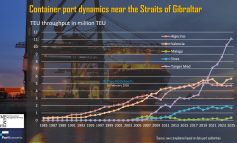
PortGraphic: Container port dynamics near Gibraltar

PortEconomics member Pierre Cariou, in collaboration with Ali Cheaitou, presented their latest research on Cascading Effect, Network Configuration and Optimal Transshipment Volumes during the annual conference of the International Association of Maritime Economists – IAME 2012, that was held in Taipei, Taiwan.

As a consequence of the emergence of large container ships, which have driven freight rates down and left companies struggling with over-capacity, liner shipping companies have faced an unprecedented drop in demand. One of the impacts of this has been the deployment of newly delivered container ships on the main East-West trades market, while medium-sized vessels have been pushed towards smaller sectors, a phenomenon known as the cascading effect.

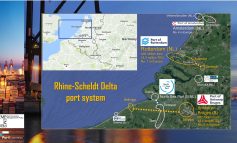
This study investigates how this impact might lead liner companies to modify their services and in particular, to include additional stops at major hubs. To this end, we provide a model which factors in potential changes in network configuration, from direct to indirect services. This is followed by an empirical study of Northern Europe/South America services. In the numerical study, a call at Tangier is added to the schedule and the optimal network configuration depends on the vessel sizes and on transshipment volumes to be collected at the hub.

You might read – and freely download- the full study & its presentation @PortEconomics.

The annual conference of the International Association of Marime Economists – IAME 2012, held in Taipei, Taiwan, provided the PortEconomics team the opportunity to present 16 different port or port related studies that progressed over the course of the most resent months – for more: PortEconomics team@IAME2012.
Next article Strategy concepts for hybrid organizations: port authorities
Previous article IAME 2012: the PortEconomics diary

Pierre Cariou

Pierre Cariou is Senior Professor at Kedge Business School, Visiting Professor at the Shanghai Maritime University and at the World Maritime University (WMU). He is Head of the Maritime Governance, Trade and Logistics Lab of KEDGE Supply chain center of excellence and Associate member of the Hapag-Lloyd/Khüne Logistic University Global Logistics Research Center. He held the French Chair in Maritime Affairs at WMU from 2004 to 2010 and started his academic carrier as Associate Professor in Economics at the University of Nantes (France). He completed his PhD on liner shipping strategies and contributed since 2010 to several reports for various shipping-related companies (French shipowner Association, SKS Tanker, LDA, SOCATRA, CMA CGM…), Port Authorities (Nantes-Saint-Nazaire, Port La Nouvelle, and Marseille), Shippers (Casino/SRS Group…), Banks (NATIXIS)... His main research interests are in shipping/port economics and shipping environmental protection and safety, on which he published more than 80 peer-review articles. He is an associate member of https://www.porteconomics.eu/, and he was the International Association of Maritime Economists’ Vice President (2014-2016) and KEDGE Business School Director of Research (2015-2017).

Related Posts

PortGraphic: Container port dynamics near Gibraltar Containers

PortGraphic: Container port dynamics near Gibraltar

A metric of global maritime supply chain disruptions: The global supply chain stress index - maritime (GSCSI-M) Featured

A metric of global maritime supply chain disruptions: The global supply chain stress index - maritime (GSCSI-M)

PortGraphic: Top-15 EU container ports in Q3 2025 Containers

PortGraphic: Top-15 EU container ports in Q3 2025

Weekly Timeline
Feb 18th 1:46 PM
Thematic Area

PortGraphic: Container port dynamics near Gibraltar

Feb 12th 12:25 PM
Featured

A metric of global maritime supply chain disruptions: The global supply chain stress index – maritime (GSCSI-M)

Jan 14th 12:56 PM
Noticeboard

Call for papers: Contemporary Maritime Economics: Transformations and Emerging Perspectives

Jan 4th 12:46 PM
Thematic Area

PortGraphic: Top-15 EU container ports in Q3 2025

Dec 16th 1:12 PM
Featured

Top-10 PortReads in 2025

Tweets by @PortEconomics
  • Containers
  • Cruise
  • EPP
  • Ports & COVID-19
  • Back to top
About PortEconomics

PortEconomics is a web-based initiative aiming to advance knowledge exchange on seaport studies. Established by maritime economists affiliated to academic institutions in Belgium, Greece and the Netherlands. It provides freely accessible research, education, information, and network-building material on critical issues of port economics, management and policies.

Additional Information
  • About
  • Login
  • Register
  • Edit Profile
  • Contact us
  • PortProfessionals
  • PortReport Series
  • Terms and Conditions
  • Cookie Policy
© PortEconomics 2025. All rights reserved.
Produced by PortEconomics
Manage Consent
To provide the best experiences, we use technologies like cookies to store and/or access device information. Consenting to these technologies will allow us to process data such as browsing behavior or unique IDs on this site. Not consenting or withdrawing consent, may adversely affect certain features and functions.
Functional Always active
The technical storage or access is strictly necessary for the legitimate purpose of enabling the use of a specific service explicitly requested by the subscriber or user, or for the sole purpose of carrying out the transmission of a communication over an electronic communications network.
Preferences
The technical storage or access is necessary for the legitimate purpose of storing preferences that are not requested by the subscriber or user.
Statistics
The technical storage or access that is used exclusively for statistical purposes. The technical storage or access that is used exclusively for anonymous statistical purposes. Without a subpoena, voluntary compliance on the part of your Internet Service Provider, or additional records from a third party, information stored or retrieved for this purpose alone cannot usually be used to identify you.
Marketing
The technical storage or access is required to create user profiles to send advertising, or to track the user on a website or across several websites for similar marketing purposes.
  • Manage options
  • Manage services
  • Manage {vendor_count} vendors
  • Read more about these purposes
View preferences
  • {title}
  • {title}
  • {title}