Featured

December 15th, 2025
Featured

Navigating the Maritime Future: Building Competitive, Sustainable, and Resilient Maritime Supply Chains23-25 September 2026, Chios, Greece Following the successful first editions of 2011 and 2015, ECONSHIP returns, inviting researchers from Europe and around the globe to submit papers on the theme “Navigating the Maritime Future: Building Competitive, Sustainable, and Resilient Maritime Supply Chains”. Proudly supported by PortEconomics, the 3rd edition of the European Conference on Shipping, Intermodalism and Ports –...
December 1st, 2025
Featured

The contemporary port industry faces intense competition, compelling port authorities and operators to enhance efficiency and effectiveness as proxies for competitiveness. Environmental, Social, and Governance (ESG) schemes have recently emerged as a means for ports to create value beyond core activities and engage broader stakeholder groups. ESG encompasses environmental, social, and governance factors influencing a company's value creation and competitiveness. The latest portstudy of PortEconomics George Vaggelas, co-authored with...
November 17th, 2025
Featured

PortEconomics member Jason Monios along with Veronica Schulz, Michael G.H. Bell, John M. Rose, D. Glenn Geers (The University of Sydney Business School, Australia) examined the potential for establishing a circular economy precinct centred around green steel production at the Port of Newcastle, Australia, as a strategy to diversify the port and hinterland away from its reliance on coal exports. Using system dynamics modelling and sensitivity analysis, the study assesses the economic viability of green steel production under...
November 14th, 2025
Featured

The maritime transport sector is not yet serious about decarbonisation. Policy targets remain vague regarding a commitment to full decarbonisation by 2050, while there is currently no prospect of replacing the existing fossil-fuelled fleet by this date. Even if this were likely, there is little prospect of the availability of sufficient alternative fuel to power these engines. It is becoming common to describe shipping, like aviation, as a ‘harder-to-abate’ sector (Energy Transitions Commission (ETC), 2018). Excuses are already in place,...
November 4th, 2025
Featured

Offshore wind energy has become a key element in the energy transition. The construction and operation of offshore wind farms, however, generate additional maritime logistics demand and contribute to higher greenhouse gas emissions. The Onboard Carbon Capture, Utilisation and Storage System (OCCUS) offers a promising solution to decarbonise maritime transport. This latest publication, of PortEconomics member Theo Notteboom, titled “Onboard Carbon Capture, Utilisation and Storage (CCUS) Supply Chain Optimisation: An Application to...
October 5th, 2025
Featured

The geopolitical risks and the port-related Carbon Emissions are the theme of the latest portstudy by PortEconomics member Pierre Cariou (co-authored with Chengkun Li and Dr Dong Yang) published in the scholarly journal Transport Policy. The article addresses geopolitical risks (GPR) and their environmental implications for port-related emissions. Using a monthly panel dataset covering 269 container ports across 40 countries and regions from 2016 to 2023 and employing a system generalized method of moments (SYS-GMM) estimator, it confirms that...
October 2nd, 2025
Featured

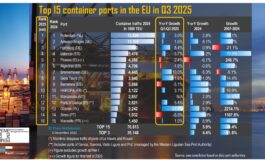
Following the strong recovery of European container ports in 2024 after the turbulence of 2023, the first half of 2025 reveals a reshuffling of growth dynamics across the top 15 EU container ports. While overall volumes remain steady, the latest figures highlight significant regional divergences and notable winners. PortEconomics member Theo Notteboom analyses, the data shows both continuity and shifts in Europe’s container port hierarchy. ✅ Baltic Hub propels Gdansk to the topGdansk leads the European ranking in terms of...
September 18th, 2025
Featured

By Theo Notteboom The global container shipping fleet has experienced significant growth over the past few decades, driven by the steady rise in international trade. Shipping lines have expanded their fleets either through organic growth—as in the case of MSC—or through a combination of organic growth and mergers & acquisitions, like Maersk. Today, the top 20 container carriers collectively operate a fleet (including both owned and chartered vessels) with a total capacity of 30 million TEU. Three years ago, this figure...
August 12th, 2025
Featured

The World Bank published the third edition of the Port Reform Toolkit - highlighting, among others the transformation of ports in recent years and the emerging issues to address. The enhanced Port Reform Toolkit 3.0 begins by analysing global trends and their impact on ports. Module 2 introduces concepts of change management. Then, in eight substantive modules, we explore port governance, privatisation, regulation, finance, and labour arrangements, followed by new modules that are now at the core of future-proofing ports:...
Page 2 of 821234...