


Containers

Containers
The trajectory of container port activity in the Americas and the Caribbean basin over the first 25 years of the millennium
By Ricardo J. Sánchez Introduction In the year 2000, the container port industry in the Americas mobilised 40.8 million TEUs; with the same regional sample, it reached 136.8 million in 2025, equivalent to 3.3 times the initial level. The global series goes from 226 million TEUs in 2000 (Clarksons Research, 2003) to 1,012.5 million in 2025 (DynaLiners, 2026). With these values, the participation of the sample of the Americas in the world total decreases from 18% to 13.5%. Latin America and the Caribbean, considered together,...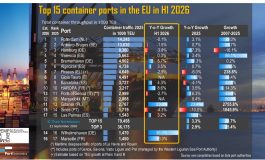
Containers
Top-15 EU container ports in H1 2026
By Theo Notteboom Mixed growth performance among the top 15 EU container ports in the first half of 2026: The combined container throughput of the three largest EU ports declined by 1.5% in H1 2026. While Hamburg recorded a robust 7.3% year-on-year increase in 2025, it was unable to sustain this growth momentum during the first half of 2026. Container volumes in Rotterdam and Antwerp-Bruges proved relatively resilient and were less affected by the slowdown. The revival of other ports in the German port system continues. Bremerhaven...
Containers
Geopolitical leverage through the international activities of State-Owned Enterprises (SOEs) in ports and maritime logistics
In their latest port study, PortEconomics co-directors Peter de Langen and Thanos Pallis examine the leverage that countries develop over others through international investments of their State-Owned Enterprises (SOEs) in ports and maritime logistics. Seaports serving international trade are pivotal connections between national economies and the world, and critical nodes in global logistics networks. Influence in a foreign port is a potential source of geopolitical leverage. SOEs have long been active in ports, shipping, and...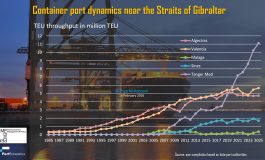
Containers
PortGraphic: Container port dynamics near Gibraltar
By Theo Notteboom The Strait of Gibraltar occupies a pivotal position along some of the world’s most important East–West trade lanes. For many years, Algeciras, strategically located at the southern tip of the Iberian Peninsula, was the first port to fully exploit this geographical advantage by developing a transhipment hub position. In the mid‑1990s, its strong transhipment orientation enabled it to capture nearly 70% of the total container volume handled by the five ports shown in the graph. Last year, its share had fallen to just...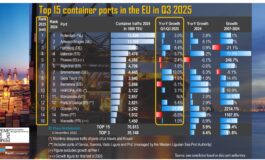
Containers
PortGraphic: Top-15 EU container ports in Q3 2025
By Theo Notteboom Following a strong recovery in 2024 after a challenging 2023, the first nine months of 2025 reveal a shift in growth dynamics across the top 15 EU container ports: Only three ports achieved double-digit growth: Gdansk leads with an impressive 21.7% increase, largely driven by the launch of its newest terminal at the Baltic Hub. Gioia Tauro continues its upward trajectory, fueled by MSC’s sustained investment and operations. Bremerhaven tops 10% growth and is expected to move from the seventh place in 2024 to the...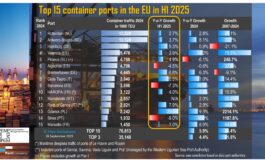
Containers
Portgraphic: Top-15 EU container ports in H1 2025
Following the strong recovery of European container ports in 2024 after the turbulence of 2023, the first half of 2025 reveals a reshuffling of growth dynamics across the top 15 EU container ports. While overall volumes remain steady, the latest figures highlight significant regional divergences and notable winners. PortEconomics member Theo Notteboom analyses, the data shows both continuity and shifts in Europe’s container port hierarchy. ✅ Baltic Hub propels Gdansk to the topGdansk leads the European ranking in terms of...
Containers
Portgraphic: fleet capacity (owned/chartered) of container shipping lines
By Theo Notteboom The global container shipping fleet has experienced significant growth over the past few decades, driven by the steady rise in international trade. Shipping lines have expanded their fleets either through organic growth—as in the case of MSC—or through a combination of organic growth and mergers & acquisitions, like Maersk. Today, the top 20 container carriers collectively operate a fleet (including both owned and chartered vessels) with a total capacity of 30 million TEU. Three years ago, this figure...
Containers
Evaluating customer satisfaction with clearing and forwarding agents: Kuwait Shuwaikh Port
PortEconomics member Theo Notteboom and Ahmed Alsalfiti (University of Antwerp and Antwerp Management School, Belgium) investigated the influence of service quality on customer satisfaction with clearing and forwarding C&F agents using the SERVQUAL model and their portstudy has been published in the Scientific Journal of Maritime Research. C&F agents play a crucial role in facilitating the clearance and delivery of goods for businesses, and their service quality is heavily dependent on port operations. The authors' research...
Containers