Containers

February 26th, 2020
Containers

The latest portstudy of PortEconomics members Theo Noteboom  and Larissa van der Lught along with Niels van Saase (Erasmus Centre for Urban, Port and Transport Economics (Erasmus UPT), Rotterdam, The Netherlands), Steve Sel and Kris Neyens (VIL-Flanders Innovation Cluster for Logistics, Antwerp, Belgium) analyzes the role of seaports in the greening of supply chains in two ways. First, the fields of action to pursue GSCM objectives in ports are identified and grouped. In the empirical part of the study, this typology is used to analyze green...
February 21st, 2020
Containers

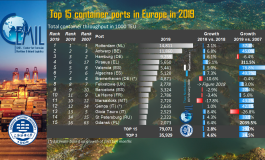
By Theo Notteboom The cargo volume handled remains a key performance indicator for ports. While also other indicators related to logistics performance, sustainability, innovation and economic impact are gaining ground, it remains relevant to observe how cargo volumes have evolved over time. The table shows the top 15 container ports in the European Union in 2019 based on container throughput expressed in TEU. It also includes container growth figures compared to 2018 and pre-crisis year 2007. The final TEU figures for Felixstowe were...
February 3rd, 2020
Containers

By George Vaggelas A decade after the concession of Pier II to COSCO Pacific, followed by the construction and the commencing of operations of Pier III and three years after the sell of the 51% of the shares of Piraeus Port Authority SA to COSCO Shipping Co., the port of Piraeus is advancing among the top container ports in Europe and internationally. In 2018, Piraeus port was the second biggest container port in the Mediterranean, the sixth biggest in Europe and the 37th in the world. No doubt, the presence of an International Terminal...
February 1st, 2020
Containers

Intra-regional container service operators are challenged to design regular and reliable liner services connecting regional ports at the lowest cost and shortest transit time while considering customer demand. This port study of PortEconomics member Theo Notteboom co-authored by Noorul Shaiful Fitri Abdul Rahman (International Maritime College Oman, Sultanate of Oman), Muhamad Nasir Rahmatdin (University Malaysia Terengganu, Malaysia) and Mohammad Khairuddin Othman (University Malaysia Terengganu, Malaysia), focuses on the selection of ports...
January 12th, 2020
Containers

The maritime and port industry experiences significant changes due to technological, operational and organizational developments. PortEconomics member George Vaggelas co-authored with Camille Leotta (University of Genoa, Italy) a port study that investigates current and future challenges for port labour in the light of the main trends shaping the port competitive environment. In this perspective, the evolution of port labour is argued to be driven by technology related factor, i.e., digitalization and automation. Digitalization can increase...
December 27th, 2019
Containers

By Theo Notteboom The year 2019 brought a range of challenges and opportunities for European container ports. In this contribution we summarize the main developments and present an outlook for 2020. Container volumes up, but concern about rising trade barriers The year 2019 will go down in history as a year that brought healthy container volume growth for most European container ports, although growth slowed down in the second quarter. The year-on-year growth figures for the top 15 European container ports in the first nine...
December 2nd, 2019
Containers

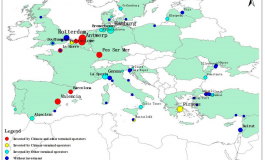
After the the Belt and Road initiative launched in 2013, Chinese terminal operators invested in ports situated along the “21st- century Maritime Silk Road (MSR)”. Identifying which ports are important is made possible through applying complex network methods and GIS analysis. PortEconomics member Cesar Ducruet co-authors with Liehui Wang (East China Normal University), Yuanbo Zheng (East China Normal University) and Fan Zhang (East China Normal University) a port study that identifies strategic hub ports and investment strategies along...
November 20th, 2019
Containers

The introduction of ever-larger containerships is a much-discussed topic in academic and business circles. The largest containership size has evolved from about 5,500 TEU in 1995 to more than 23,000 TEU in 2019. The economic rationale for further scale increases in ship size is largely dependent on the current and future market conditions in the container shipping market, the adaptive capacity of ports and terminals (both economically and technologically) and, as of late, environmental requirements and considerations. The latest paper...
November 13th, 2019
Containers

Participating as speaker in the session titled Sustainable Futures for Ports I : Energy, during the 7th Busan International Port Conference 2019, PortEconomics member Theo Notteboom made a presentation on one of the most contemporary port issues: green supply chains. In the past decades, green supply chain management (GSCM) has developed in view of integrating environmental concerns into the inter-organizational practices of supply chain management. In the past few years, tighter regulatory requirements and strong demands for a cleaner and...
September 29th, 2019
Containers

PortEconomics member, and chair of the global Port Performance Research Network (PPRN) Gordon Wilmsmeier assesses the Colombian port system and provides his thought on its future. En este momento no veo la necesidad de hacer un puerto en Tribugá The full interview (in Spanish), to Lorenzo Morales, as published in El Espectador "Para este investigador del Global Port Performance Network y profesor honorario de geografía marítima de la U. de Ciencias Aplicadas en Bremen (Alemania) y de la U. de los Andes, el país debería analizar y...
Page 13 of 34...1112131415...