Containers

September 10th, 2016
Containers

By Jean-Paul Rodrigue For many years, the shipping industry has been in a situation of overcapacity, which was depressing rates and impairing the profitability of shipping lines. To make matters worse, almost every major shipping line was ordering larger containerships, caught in a vicious circle of trying to boost profitability with economies of scale. Capacity was growing faster than demand. In such as setting, there were discussion and rumors within the industry about which major shipping company would fold first in an environment...
September 4th, 2016
Containers

By Jan Hoffman Chief, Trade Facilitation Section at UNCTAD (Linkedin) Containerships have never been bigger than today, container freight rates have never been lower, and never has so much container carrying capacity been idle. Not a trilemma, but three sides of the same coin. And after several years of calmness at the M&A front, we have new mergers among liner companies. In March 2016, the idle container ship fleet stands at 1.6 million TEU, and a shipper may pay less than 200 US$ to have his twenty foot container...
August 31st, 2016
Containers

A port study co-authored by PortEconomics member Thomas Vitsounis received the KLU Young Researcher Best Paper Award of the Annual Conference of the International Association of Maritime Economists held in Hamburg, Germany 23-26 August 2016. The study models spillover effects across container sectors (commodities) over time. In more detail, the study conceptualizes the container port throughput as a function of different evolutions of the various sectors that make up the aggregate container output. Arguing, the container cycle may be...
July 20th, 2016
Containers

Avoiding truck congestion and peaks in landside activity is one of the challenges to container terminal managers. The spreading of truck arrivals at terminals can be facilitated by widening the opening hours of terminals at the landside. Israel’s Ministry of Transport has instituted the “Good Night Program”, involving monetary incentives for importers and exporters who deliver containers to ports at night. The latest port study of PortEconomics co-director Theo Notteboom, along with David J. Bentolila (Zefat Academic College,...
July 5th, 2016
Containers

Port system development is a key theme in port geography literature. Recent decades have brought a rise in container terminal development at estuarine, coastal and offshore port locations, in part driven by scale increases in vessel size. The latest port study of PortEconomics co-director Theo Notteboom examines how container ports located upstream on rivers use processes of adaptive capacity building in an attempt to remain competitive in port systems. Theo links the development path of upstream seaports to a range of economic,...
June 28th, 2016
Containers

By Jean-Paul Rodrigue An updated graph (below) on the evolution of containerships with more detailed ship profiles and a more revealing depiction of the number of containers they can load is available in The Geography of Transport Systems webpage. Since the beginning of containerization in the mid 1950s, containerships undertook six general waves of changes, each representing new generations of containership: A) Early containerships. The first generation of containerships was composed of modified bulk vessels or tankers that...
June 22nd, 2016
Containers

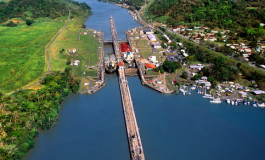
By Jean-Paul Rodrigue and Theo Notteboom Shifting Rationale The interoceanic canals of the global shipping network are undergoing a major upgrading. One year after the expansion of the Suez Canal aimed at facilitating two-way vessel traffic, we are witnessing the opening of a new and larger set of locks at the Panama Canal. The new locks are designed to allow the transfer of ships with a length of up to 366m, a width of 49m and a draft of 15.2m. These New Panamax dimensions are 25% longer, 52% wider and support a draft which is 26% deeper...
June 10th, 2016
Containers

How the One-belt-one-road (OBOR) policy might affect european port-hinterland dynamics? In 2013 Xi Jinping embarked in a strategy to “break the connectivity bottleneck” in Asia.  60 countries are already involved, with this policy impacting 4.4 billion people.  In March 2015, the ‘One Belt, One Road’ initiatives action plan was detailed. PortEconomics co-director Theo Notteboom addressed the theme during his invited presentation gave at the ESPO Conference 2016, held in 2-3 June in Dublin, Ireland. Theo also...
June 1st, 2016
Containers

By Theo Notteboom Alliances are about operational vessel-sharing co-operation between container shipping companies on multiple trade routes (mostly east-west). The first strategic alliances between shipping lines date back to the mid-1990s, a period that coincided with the introduction of the first post-Panamax containers vessels on the Europe-Far East trade. The alliance partnerships evolved as a result of mergers and acquisitions (e.g. merger between P&OCL and Nedlloyd and the take-overs by P&O Nedlloyd and SeaLand by...
May 20th, 2016
Containers

The movement of cargo in containers in Latin American and Caribbean ports grew 1.7% during 2015, according to figures unveiled in ECLAC’s new edition of its ranking of container port throughput, published in its Maritime Profile. These figures confirm two trends observed during the last years in the region: the slowdown of foreign trade shown by container terminals and great heterogeneity of the growth rates inside the region. Regional average of 1.7% container throughput growth, although still higher than the rate recorded in 2014...
Page 22 of 34...2021222324...