Containers

April 4th, 2016
Containers

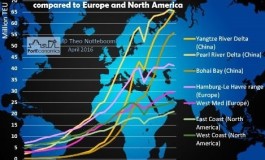
By Theo Notteboom The figure shows the evolution of container throughput in the three main container port regions in China (i.e. Yangtze River Delta, Pearly River Delta and the Bohai Rim). We compare these volume dynamics with some key port systems in North America and Europe: the port system along the North American West Coast including ports such as Seattle/Tacoma, Vancouver, LA, Long Beach and Oakland; East coast ports such as Norfolk, Charleston, New York/New Jersey, Baltimore, Savannah and Halifax; the Hamburg-Le Havre port range...
March 23rd, 2016
Containers

COMMENT: Last year was a year of differing fortunes for Belgium seaports, writes Peter de Langen. Volumes in Zeebrugge dropped by over 20%, from more than 2m teu to slightly over 1.5m teu, and PSA decided to close down its container terminal in the port. Meanwhile, volumes in Antwerp grew. Antwerp grew with roughly the amount of volumes that was lost in Zeebrugge, and here MSC and PSA are expanding and relocating their jointly operated terminal. Antwerp Port Authority is also pushing ahead with the development of a new dock, the so...
March 11th, 2016
Containers

It is widely acknowledged that the two major interoceanic canals of Suez and Panama play a central role in global shipping flows. However, this role has rarely been measured with precision both in terms of the geographic coverage and network topological properties of canal-dependent flows. Based on vessel movement data for containerships, the port study of PortEconomics associate member Cesar Ducruet- published in the 2nd issue of the 43rd volume of Maritime Policy & Management- clarifies the weight and share of canal-dependent flows...
February 23rd, 2016
Containers

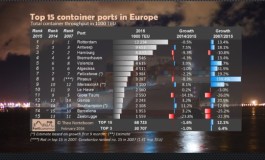
By Theo Notteboom The portgraphic shows the top 15 container ports in the European Union in 2015 based on container throughput expressed in TEU. It also includes container growth figures compared to 2014 and pre-crisis year 2007. What can we observe? 1. The total volume of the top 15 ports saw a small traffic decline of 1.6% compared to 2014, or one of the worst y-o-y growth figures in Europe's container history. Only the dramatic year 2009 brought a larger drop in container throughput handled by the top 15 ports (i.e....
February 18th, 2016
Containers

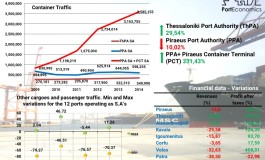
By George Vaggelas The Greek economy is going through the eighth year of economic recession as the economic crisis in Greece started at the end of 2008 and continues today. In this environment, Greek ports tried to respond to a series of challenges such as the reduction in consumption in the internal market, the reduction in the competitiveness of the Greek economy as well as some inherent challenges such as the resuction of ports personnel. The PortGraphic outlines how Greek ports (and more specifically the 12 ports operating as Societe...
February 17th, 2016
Containers

By Jonas Constante According to a recent report by the consulting firm Mckinsey & Co, across Europe as a whole, infrastructure congestion costs 1% of GDP. In 2013, globally, $400 billion a year could be saved by making more of existing infrastructure through improved demand management and maintenance. The digitalization can create value for private and public stakeholders involved in the logistic port sector through various initiatives, among which we highlight: i) eGovernment and the creation of administrative single...
February 15th, 2016
Containers

Port competition emerged as a complex and multi-faceted concept due to changes in the market environment of ports and the resulting intensification of rivalry between operators in the same port, between neighbouring ports, be-tween multi-port gateway regions and between entire port ranges. PortEconomics co-directors Theo Notteboom and Peter de Langen in their latest port study Container port competition in Europe, discuss the port competition in Europe with a main focus on container ports and terminals and they provide an in-depth...
February 14th, 2016
Containers

Port Experts and stakeholders  are invited to reflect upon the performance of the port industry in the EU, and the further need to develop performance insights on the industry level. An one-day event is organised in Lisbon on March 23rd, 2016, which can be combined with an IAPH-PIANC event on the stakeholder consultation of guidelines for port sustainability reporting the day before (March 22nd). A 2-day programme is thus offered to participants, offering excellent networking opportunities. PortEconomics members Dr. Michael Dooms, Dr....
January 30th, 2016
Containers

By Theo Notteboom The current volatility in the container business is very visible when looking at the results of the container ports in the Rhine-Scheldt Delta, the largest container port region in Europe in volume terms and ranked 6th worldwide. Dutch and Belgian ports together handled 23.54 million TEU in 2015 or just 0.45% more than in 2014. Rotterdam continues to monopolize the Dutch container port system handling 12.23 million TEU in 2015, a small decline of 0.51% compared to 2014. Amsterdam handled a modest 51,634 TEU in 2015...
January 23rd, 2016
Containers

By Jean-Paul Rodrigue In last two decades, Dubai emerged as a world class logistical platform, a role which is in part attributed to its geographical location at the crossroads of major trade routes between Asia, Europe, South Asia and East Africa. This role began to take shape in the 1960s when the growing availability of capital derived from oil exports in neighboring countries led to initial infrastructure investments, such as the first modern port facilities (Port Rashid) completed in 1971. These facilities were further expanded with...
Page 23 of 34...2122232425...