Containers

June 11th, 2015
Containers

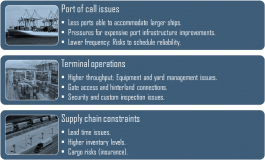
By Jean-Paul Rodrigue Maritime shipping, more than any other form of transportation, benefits from economies of scale since they have a direct impact on its operational costs. There has thus been a tendency to deploy larger ships, particularly in container shipping, to service high volume trade routes such as between Asia and Europe. PortEconomics member Jean-Paul Rodrigue comments: A common issue with the application of economies of scale is that the maritime shipping company is internalizing its benefits since they have a positive...
May 31st, 2015
Containers

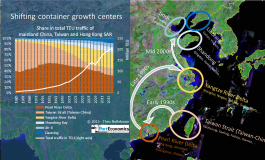
By Theo Notteboom Only 25 years ago, the container port system in mainland China was still in its infancy stage. During that time, Hong Kong acted as the only container gateway to China and Taiwanese ports Kaohsiung and Keelung benefited from Taiwan's economic success story in international trade. In May 1980, the Chinese government established the Shenzhen Special Economic Zone, the first special economic zone in China. By the late 1980s, mainland Chinese ports in the Pearl River Delta saw the first fruits of this opening up policy. Growth...
May 28th, 2015
Containers

Port users perceptions of their experience in a given port, do matter and port performance measurement needs to take this into account argue Thanos Pallis and George Vaggelas in their latest port study that was presented at the 5th International Symposium on Ship Operations, Management & Economics (SOME 2015) held in Athens, Greece, 28-29 May 2015. The port industry is experiencing an ongoing transformation due to changes in its internal and external envi-ronment. Nowadays the industry is characterized by fierce competition of...
May 11th, 2015
Containers

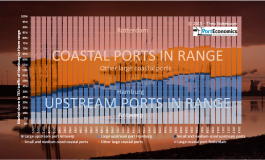
By Theo Notteboom One could think that the days for upstream ports are counted given a growing demand for a good nautical accessibility and a fast turnaround time for the ever larger container vessels. A closer look at Antwerp and Hamburg, two of the largest upstream container ports in the world, urges us to think again. In the past few decades the large upstream ports in the Hamburg-Le Havre range have gradually gained market share at the expense of large coastal ports. In the late 1970s, Antwerp on the river Scheldt and Hamburg on the...
May 3rd, 2015
Containers

Last month, DP World bought the Maher terminal in Prince Rupert, with a 2014 throughput of a little over 600,000 teu for more than a half billion US dollar - just under $1,000 per teu handled, comments Peter de Langen at his "The Analyst" column in Port Strategy. Two aspects of this deal are interesting. First, the price seems to indicate huge confidence in growing volumes: the terminal is to be expanded to a capacity of about 1.35m teu, with studies on the feasibility of a further expansion to about 2.5m teu. Second, the fact that the...
April 21st, 2015
Containers

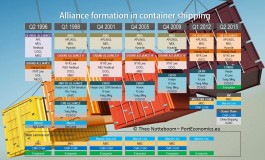
By Theo Notteboom Operational co-operation between container shipping companies comes in many forms ranging from slot-chartering and vessel-sharing agreements to multi-trade strategic alliances. The first strategic alliances between shipping lines date back to the mid-1990s, a period that coincided with the introduction of the first post-Panamax containers vessels on the Europe-Far East trade. In 1997, about 70% of the services on the main East-West trades were supplied by the four main strategic alliances. Today, four large alliances are...
April 14th, 2015
Containers

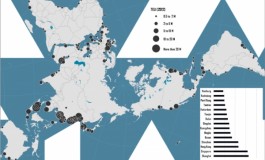
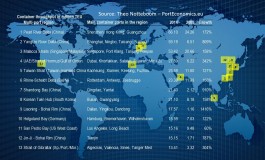
By Theo Notteboom Container port rankings look at individual ports. Following such an approach Shanghai is the largest container port in the world (35.28 million TEU in 2014) followed by Singapore (33.87 million TEU). Such rankings can be a bit misleading as regions with several medium-sized container ports might seem less important than regions with only one large load centre. When grouping seaports together in multiple-port regions we get a better picture of the container port handling hotspots in the world. The chart provides an...
April 14th, 2015
Containers

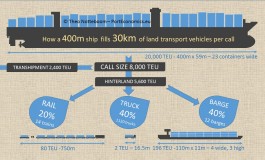
By Theo Notteboom Container vessels of more than 19,000 TEU are already operational on the Europe-Far East trade. The CSCL Globe and MSC Oscar are notable examples. Ships of over 20,000 TEU have been ordered by a number of carriers such as OOCL. The chart shows the implication of a visit of such a mega vessel to the port of Antwerp or Rotterdam, two of the largest container ports in Europe. A call of a 20,000 TEU vessel is expected to result in an average call size of 8,000 TEU. Some 70% of that volume is gateway cargo, the remaining 30%...
April 7th, 2015
Containers

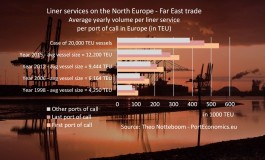
By Theo Notteboom An analysis of liner services on the North Europe – Far East trade reveals that average vessel sizes have increased from 4,250 TEU in 1998 to 12,200 TEU in 2015. The number of liner services on the North Europe – Far East trade peaked in 2006 with over 30 regular services. Today just over 20 weekly services connect North Europe to the Far East. The combination of ever large container vessels combined with a relative decline in the number of ports of call per liner service results in larger call sizes. The above chart...
March 31st, 2015
Containers

In 2014, the Panama Canal celebrated its centennial-spotlighting its legacy as an important gateway of international trade but also raising questions about its future in an increasingly integrated global economy. The Panama Canal expansion project will open a new set of locks and will complete several ancillary projects, such as dredging and widening, in early 2016 at an estimated cost of $6.2 billion. As is common with megaprojects, however, unforeseen events and cost overruns are likely to increase the final price tag. The expansion is...
Page 27 of 34...2526272829...