Containers

September 23rd, 2015
Containers

Cyprus is already putting into effect the first recommendations of a study by a team involving PortEconomics members Thanos Pallis and George Vaggelas, and partners, that aims to help the country rekindle growth as a shipping centre after several flat years. The study, prepared after a government tender, has put forward a five-point action plan designed to boost the island against the claims of other maritime hubs and open ship registries at a time of industry volatility and heightened competition. Blueprint for Action The recommendations...
September 22nd, 2015
Containers

APM Terminals has announced that it will invest more than $2bn in a new port in Nigeria, its largest single investment in a port ever. Peter de Langen through his column "The Analyst" in Port Strategy comments: "What sets this investment apart from others it has made is that APMT will develop both the container terminal and other activities. The Nigeria investment marks "a strategic shift to multi ports", said the operator. "It means we will supplement our own experience in container ports with the establishment of a free zone, an oil port...
September 17th, 2015
Containers

By Jean-Paul Rodrigue Why Transshipment? Ideally, a passenger wishing to fly from one city to another would prefer to have a direct flight. However, this is not commonly the case unless one is using the largest airports in the world such as London, Paris. New York, Hong Kong or Dubai. Even from these airports, direct flights to a wide range of destinations would not be available. The most common reason is that there is not enough volume to justify a direct service with some level of frequency. Therefore, to cope with these constraints...
September 3rd, 2015
Containers

With approximately 90% of global trade in volume being carried by sea, seaports are a core strategic resource driving the regional economy within the context of globalization and trade boom. Yet, seaports are not well integrated with mainstream economics and efforts to quantitatively analyze seaports' activity with the use of basic economic concepts remain very limited. Business cycles are considered a profound economic theory and, stimulate a wide area of research and the formulation of indicators of economic activity. To day, the cyclicality...
August 21st, 2015
Containers

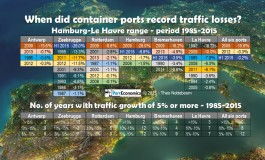
By Theo Notteboom Recently, Hamburg announced that container throughput in the Elbe port saw a decline of 6.8% in the first half of 2015 compared to the same period last year, mainly caused by a sharp decrease in the trade volumes with Russia and China. The container business is generally considered as a growth sector. Over the past decades, ports around the world have become used to welcoming traffic growth year after year. A decline in container traffic is considered as unusual. But how often have ports reported cargo losses over the...
July 30th, 2015
Containers

The capabilities and strategies required for obtaining a concession to operate a container terminal in a seaport is the theme of the study conducted by the three PortEconomics co-directors, Thanos Pallis, Theo Notteboom and Peter de Langen, and is now part of a new volume "Port Management", just published by Palgrave. The volume is edited by Prof Hercules Haralambides (Erasmus University and Port of Brindisi), and brings together a collection of seminal papers from Palgrave's journal, Maritime Economics and Logistics. It is a...
July 21st, 2015
Containers

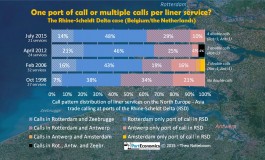
By Theo Notteboom When container shipping lines design a weekly service between Asia and North Europe, they have to decide how many and which ports of call to include in the schedule. On the North European side, they typically ensure they serve the biggest port regions. Therefore, almost all liner services on the North Europe – Far East trade have ports of call in the Rhine-Scheldt Delta (Rotterdam, Antwerp, Zeebrugge), the north German multi-port gateway region (Hamburg, Bremerhaven, Wilhelmshaven) and the southeast coast of the UK...
July 13th, 2015
Containers

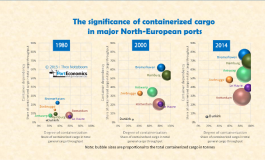
By Theo Notteboom Discussions on port development, planning and competitiveness often tend to revolve around container flows. Quite a few ports around the world have developed some kind of 'container fetish', implying they have developed a very strong focus on container throughput. But how dependent are ports on container traffic? The infographic shows the evolution in some of the main north-European container ports. Three dimensions are presented. The vertical axis shows the container dependency or the share of container throughput in the...
July 13th, 2015
Containers

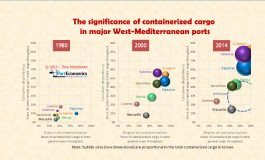
By Theo Notteboom In last week's infographic, Theo Notteboom analysed the container dependency of major North-European ports. But how is the situation in southern Europe? How dependent are West-Mediterranean ports on container traffic? As before, there are three dimensions in the infographic. The vertical axis shows the container dependency or the share of container throughput in the total throughput of the port. The horizontal axis depicts the degree of containerization or the share of containerized cargo in the total general cargo...
June 18th, 2015
Containers

By Jean-Paul Rodrigue Container ports are reflective of the world's commercial geography particularly since they dominantly handle finished and intermediate goods. Commodities are becoming more prevalent, but still remain a niche market. The map below shows container volumes in 2012 for ports above half a million TEU. Surprisingly, there is no publicly available dataset covering the traffic of container ports around the world. Some regional or national trade groups publish figures, but this data is only for an area and tends to be...
Page 26 of 34...2425262728...