Containers

April 11th, 2024
Containers

by Thanos Pallis, Theo Notteboom and Jean-Paul Rodrigue The Liner Shipping Connectivity Index (LSCI) measures the extent to which countries are linked to global shipping networks, serving as an indicator of their maritime transport sector's strength. Developed by the United Nations Conference on Trade and Development (UNCTAD), the index factors include the number of ships, container-carrying capacity, vessel size, service frequency, direct connections between countries, and shipping companies operating in a country's ports. By...
April 11th, 2024
Containers

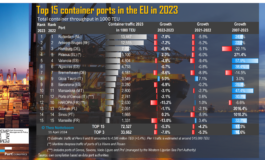
PortEconomics co-director Theo Notteboom compiled a table showing the EU container port landscape in 2023, and provides a comprehensive overview of the trends, challenges, and notable developments within the EU container port sector in 2023: By Theo Notteboom The top 15 EU ports combined handled 72.5 million TEU in 2023, or 5.3% less than in 2022. This compares to -4.2% in 2022 and +5% in 2021. The economic and geopolitical situation is reflected in the handled container volumes. The top three ports in the EU all recorded a traffic...
March 13th, 2024
Containers

In a new PortGraph PortEconomics co-director Theo Notteboom presents the container traffic evolution (in TEU) in the ports of Rotterdam, Antwerp-Bruges (i.e., the sum of Antwerp and Zeebrugge before the 2022 merger), Hamburg, and Bremerhaven. Theo Notteboom details: "Rotterdam, Antwerp-Bruges (i.e., the sum of Antwerp and Zeebrugge before the 2022 merger), Hamburg, and Bremerhaven are the top 4 container ports in Northern Europe. The period 2008-2021 led to a diverging traffic trend. Rotterdam and Antwerp-Bruges...
March 6th, 2024
Containers

By Ricardo J. Sánchez & Eliana P. Barleta Why the ranking? Although sometimes different numbers are used, it is known that maritime transport accounts for around 80% of world trade in goods in terms of volume and 70% of its value. Latin America represents approximately 7% of this sum, with a high component of raw materials of mineral and vegetable origin, and foodstuffs of all kinds. The international trade of the region is directly connected to the three main world maritime routes: Europe, North America and Asia,...
January 18th, 2024
Containers

Container liner shipping companies started expanding their business by investing in container port terminals in the late 1990s. This market entry results in an extensive presence of vertically integrated liners and terminals. A recenty study explores the competition effects of this vertical integration trend based on a regional (European) analysis. In particular, it extracts lessons from the European Commission cases on the competition effects of vertical integration. The critical analysis of the cases examined at the institutional level...
January 17th, 2024
Containers

Big news from the container shipping market, and this time not related to the Red Sea Crisis. Hapag-Lloyd will leave THE Alliance and start a partnership with Maersk under the name 'Gemini Cooperation' from February 2025 onward, immediately after the conclusion of our current 2M Alliance. Their new network will cover 7 trades:  Asia / US West Coast, Asia / US East Coast, Asia / Middle East, Asia / Mediterranean, Asia / North Europe, Middle East – India / Europe and Transatlantic. The Network will comprise of 26 mainline...
January 15th, 2024
Containers

PortEconomics member Theo Notteboom reviews the presence of the leading global container terminal operators in the top 15 EU container ports (based on 2022 TEU figures). The blue boxes refer to all types of direct or indirect terminal involvement: full ownership, joint venture or a majority or minority shareholding. A distinction is made between carrier-linked (bottom) and non carrier-linked (top) terminal operators. The table puts the current controversy in Hamburg on MSC’s offer to buy a 49.9% share in HHLA, Hamburg's largest...
December 29th, 2023
Containers

In the anniversary magazine ’10 years of Flows’, PortEconomics member Theo Notteboom highlights trade between the West and China in an interview with Flow's editor-in-chief Koen Dejaeger. These flows of goods form the backbone of container traffic in the world today. How did they originate, and how will they evolve as geopolitical tensions mount? The role China has played in the development of international freight transport cannot be overstated. Today, the geopolitical power blocs are increasingly opposing each other; a tense...
October 24th, 2023
Containers

PortEconomics members Pierre Cariou and Jason Monios, joined by Gabriel Figueiredo de Oliveira (University of Toulon, France), investigated the changes in European container port rankings to determine if and how a new dynamic phase can follow a phase of maturity in a container port range. Their portstudy examines mobility in ranking from 2000 to 2019 and sheds light on the influence of neighbouring ports in a range as well as the level of maturity of each range. Findings from three different methods (Gini coefficient...
October 19th, 2023
Containers

The METRANS Transportation Center has released the full study on "Container Terminal Automation" developed by PortEconomics members Geraldine Knatz, Theo Notteboom & Thanos Pallis In the past decade, container terminal automation has become a key theme in terminal development and operations. The progressive introduction of semi- and fully-automated terminal systems is driven, among other reasons, by the need for operations standardization, reduction in manning and increase in productivity. Yet, only certain terminals will fit the...
Page 4 of 34...23456...