Containers

June 12th, 2025
Containers

PortEconomics member Jean-Paul Rodrigue delivered a testimony in front of the Joint Economic Committee of the Congress of the United States, in Washington, DC. The hearing was on "Barriers to Supply Chain Modernisation and Factor Productivity Enhancements". Jean-Paul's contribution focused on the main barriers that North American ports, particularly container ports, are facing. He suggested a greater autonomy for port authorities with expanded governance. Many are landlords who may be required to act more as entrepreneurs.The full...
June 10th, 2025
Containers

Container liner shipping companies, under the international shipping carbon reduction indicators proposed by the International Maritime Organisation, must transform two key aspects: technology and operations. PortEconomics member Theo Notteboom, along with Yuzhe Zhao, Zhongxiu Peng (Dalian Maritime University), Jingmiao Zhou (Dalian University of Foreign Languages), Yiji Ma (Dalian Maritime University) defined a green liner shipping problem (GLSP) that integrates the deployment of a heterogeneous fleet, speed determination, and fuel...
May 26th, 2025
Containers

World ports are executing on planned infrastructure investments, community building and environmental sustainability initiatives. Important gaps have been identified in future fuels readiness, carbon emissions reporting, digitalisation and gender equality. Market trends indicate overall lower container port productivity due to larger ships with increased call sizes and less frequent calls; gains and losses on liner connectivity are split, influenced by geopolitics The survey results of IAPH’s most-engaged ports from around the...
May 10th, 2025
Containers

In a recent study published in the scholarly journal Transport Policy, Richard Borggreve and PortEconomics member Gordon Wilmsmeier examine the evolving strategies of container shipping alliances and their implications for market concentration and equality across trade routes. The study introduces Dynamic Time Warping (DTW), a technique traditionally applied in time series analysis, to cluster global trade routes based on alliance deployment patterns. This approach enables the researchers to uncover temporal similarities and shifts in...
April 25th, 2025
Containers

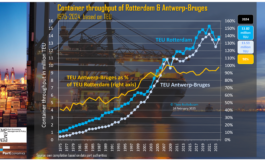
In a remarkable turn of events, the port of Antwerp-Bruges has overtaken Rotterdam in container throughput during the first quarter of 2025. Antwerp-Bruges handled 3.4 million TEU, registering a year-on-year increase of 4.5%, while Rotterdam recorded 3.3 million TEU (+2.2%). PortEconomics member Theo Notteboom,  reports: "This development marks the first time since 1966—the year the first container liner services arrived in Europe—that Rotterdam has not held the top spot among European container ports. Yet, the question...
April 2nd, 2025
Containers

The development of an approach for evaluating various maritime transportation routes in light of ongoing disruptions and evolving global factors, including changes in demand, fluctuations in fuel prices, geopolitical shifts, and environmental considerations is the aim of the latest portstudy of PortEconomics member Pierre Cariou along with Sadeque Hamdan (Bangor University), Dominique Feillet (Univ Clermont Auvergne), Ali Cheaitou (University of Sharjah) and Nadjib Brahimi (Rennes School of Business) For each alternative route,...
March 11th, 2025
Containers

In an increasingly uncertain world, seaports are no longer just logistical hubs facilitating global trade—they are becoming geopolitical focal points, caught between strategic interests, economic dependencies, and global power struggles. The geo-economic and geopolitical landscape has a major impact on seaports, which have limited control over these external factors. Geopolitical objectives and policies also have a significant impact on the strategies and operational decisions of port users.  Meanwhile, the developments over the past...
February 27th, 2025
Containers

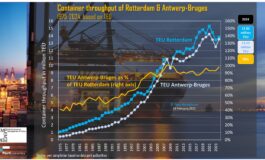
Theo Notteboom, PortEconomics co-director, analyses the evolution of container throughput at Rotterdam and Antwerp-Bruges over the past five decades and reveals a significant shift in European port dynamics. While Rotterdam has historically been the dominant container hub, Antwerp-Bruges has steadily increased its share, now nearly matching Rotterdam’s volume. As Theo Notteboom analyses: "The ports of Rotterdam (NL) and Antwerp-Bruges (BE) are situated in the Rhine-Scheldt Delta, the most significant multi-port region in Europe in terms...
February 27th, 2025
Containers

The 2024 ranking of the top 15 EU container ports highlights both stability on the top of the ranking and significant changes in port performance for the remaining ports. Rotterdam retains its position as Europe’s largest container port, handling 13.82 million TEUs, followed closely by Antwerp-Bruges at 13.53 million TEUs. Hamburg remains in third place with 7.8 million TEUs, while Valencia moves up to fourth place, benefiting from strong 14.2% growth. Following, the graphic below presents the ranking of the top 15 EU container...
Page 2 of 341234...