Containers

December 8th, 2021
Containers

By Theo Notteboom The vast majority of top 15 ports recorded container volume losses in 2020 The table shows the container throughput in TEU for the first nine months of 2021 in the top 15 containers ports in the European Union, the year-on-year growth figures for 2020 and 2009, and overall TEU growth between pre-crisis year 2007 and 2020. While the Coronavirus emerged in China in December 2019, its impact on European ports only started to be visible in March 2020. The top 15 EU ports combined handled 74.3 million TEU in 2020. Almost all top...
November 15th, 2021
Containers

Like many communication systems, maritime networks are embedded in space. But the effects of spatial properties on the network itself have not been deeply examined in previous research. Gravitational properties affect international trade, as well as container shipping flows in general, as distance represents spatial friction to exchange; yet the ability of the network and of specific nodes and links to operating at different geographic ranges of connectivity remains unknown. The latest port study of PortEconomic member Cesar Ducruet...
October 9th, 2021
Containers

Carriers announcements that they have acquired stakes in container terminal operations in North Europe, bring to the attention a port study that clearly demonstrates in a quantitative manner that ports have a much higher chance of receiving vessel calls of an alliance when one or more alliance members are having a terminal stake in the port. Big news from German ports in the last weeks. The first changes were noted in Hamburg as Cosco has undertaken a strategic investment to receive a 35% minority share in the Tollerort terminal operated...
September 23rd, 2021
Containers

PortEconomics co-director Peter de Langen wrote a policy report to help shape port policies in Brazil. The report ‘Productive Arrangements in Container Logistics: Policy Challenges for Granting Terminal Concessions’, was commissioned by the leading Brazilian terminal operator BTP, and written, in full independence, by Peter de Langen. The two central issues that are addressed are first, how to deal with shipping line owned container terminal operators and second, how to prevent dominant market positions of terminal operators or, if this...
September 14th, 2021
Containers

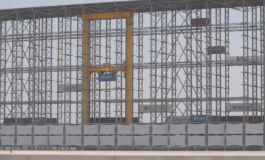
Terminal automation is a full or partial substitution of terminal operations through automated equipment and processes. Depending on how automation is defined, it is already present in many terminals, at least in its simplest form using information technologies (ITs) to manage terminal assets and supplement human activity.  Automation processes often result in two major types of automated terminals. A fully automated terminal uses a computer–IT-led system to handle a container from dockside to the pickup area through remotely...
August 26th, 2021
Containers

By Giovanni Prati, CNN How this technology could shake up logistics at major ports Dubai (CNN) In Dubai's Jebel Ali port, a new technology is being tested that aims to speed up, improve and automate the way shipping containers are stored, moved and shipped. Typically, at major ports, shipping containers awaiting transport are simply piled up on top of each other six or seven high, waiting to be moved onto ships by cranes. As well as taking up a huge amount of space, this approach means locating and picking up the right box can be...
August 3rd, 2021
Containers

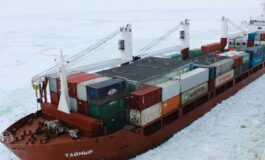
The latest portstudy of PortEconomics members Theo Notteboom and Adolf Ng, co-authored by Ziaul Haque Munim, Rana Saha and Halvor Schøyen (University of South-Eastern Norway, Horten, Norway) investigates the competitiveness of various autonomous ship categories for container shipping in the Arctic route. The authors propose a multi-criteria decision-making (MCDM) framework using four ship categories as alternatives and eight criteria for competitiveness evaluation. We analyse collected data using the Best–Worst Method (BWM), one of the...
July 1st, 2021
Containers

by Mikael Lind, Research Institutes of Sweden (RISE) and Chalmers University of Technology, Wolfgang Lehmacher, Anchor Group, Jan Hoffmann, UNCTAD, Lars Jensen, Vespucci Maritime, Theo Notteboom, Ghent University and Antwerp Maritime Academy, Torbjörn Rydbergh, Marine Benchmark, Peter Sand, BIMCO, Sandra Haraldson, RISE, Rachael White, Next Level Information & Cool Logistics, Hanane Becha, UN/CEFACT, Patrik Berglund, Xeneta Abstract Disruption and congestion are occurring across the global maritime...
June 22nd, 2021
Containers

The traditional notion of hinterland refers to the inland economic area influenced by the ports. In other words, hinterland represents the set of points of origin/destination of cargo flows, which pass through the port and generates the majority of its business. Following logistics and market transformations, the concept of hinterland has become rather dynamic and the traditional static approach may be misleading. In particular, it appears rather complex to identify hinterland’s boundaries due to the influence of drivers that are constantly...
June 22nd, 2021
Containers

In the past few days, various media sources reported that the Boring Company, which Elon Musk founded five years ago, has developed a tunnel concept with single or double lane configurations for the transport of containers using battery-powered freight vehicles. The idea of using above-ground or underground tunnel or pipeline-like systems to transport units, such as containers, is not new. Since the 1990s, many projects have looked into similar unit transport systems, particularly in Japan and northwest Europe. Ports have been on the...
Page 8 of 34...678910...