Thematic Area

September 29th, 2019
Thematic Area

PortEconomics member, and chair of the global Port Performance Research Network (PPRN) Gordon Wilmsmeier assesses the Colombian port system and provides his thought on its future. En este momento no veo la necesidad de hacer un puerto en Tribugá The full interview (in Spanish), to Lorenzo Morales, as published in El Espectador "Para este investigador del Global Port Performance Network y profesor honorario de geografía marítima de la U. de Ciencias Aplicadas en Bremen (Alemania) y de la U. de los Andes, el país debería analizar y...
September 25th, 2019
Thematic Area

In 1990 Richard O. Goss wrote four seminal articles about the economic principles underlying port policies, which were published in Maritime Policy and Management under the title Economic Policies and Seaports. These explored the economic functions of seaports, the diversity of port institutions, the need for port authorities, and the strategies that ports might adopt to promote port efficiencies. Economic principles included the existence of seaports for the benefit of traders, the use of competition to maximise public welfare, the...
September 23rd, 2019
Thematic Area

By Peter de Langen The societal impact of cruise vessels is increasingly under scrutiny, focused on the effects of cruise passengers on cruise cities and environmental effects of cruise ships. The report on emissions by Transport & Environment is a case in point. This report is one more signal of an underlying trend of an increasingly critical stance towards cruise that threatens its ‘license to operate and grow’. So far, at least in my perspective, both the cruise ports and cruise lines have not developed a ‘positive...
September 17th, 2019
Thematic Area

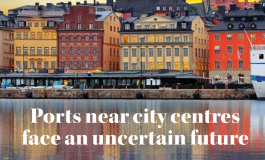
by Ricardo J. Sanchez Very often, the largest cities in the world were built next to the ocean or rivers. For this reason, ports were built and developed in cities. However, as time went by, it was questioned whether ports were needed specifically in those locations. Around the world, cities are increasingly answering "no". The latest issue of Container Management addresses the issue, taking into account the cases of Sweden and Denmark. The causes that have motivated the decision to move the ports located in the centre of cities or in...
September 5th, 2019
Thematic Area

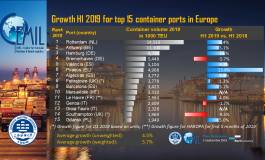
By Theo Notteboom The table shows the top 15 container ports in the European Union in 2018 based on container throughput expressed in TEU and the year-on-year growth for H1 2019. No growth figures were available for Marsaxlokk and Gioia Tauro. What do the figures reveal? First, with an overall weighted average growth of 5.7% (4.5% unweighted), the top 15 ports are performing better than in 2018 (+4.2%), 2017 (+4.6%), 2016 (+2.1%) and 2015 (-1.6%). Second, the top three ports recorded a weighted average growth of 6.3% in H1 2019...
August 30th, 2019
Thematic Area

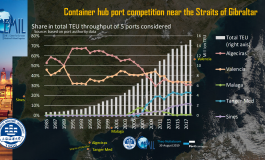
by Theo Notteboom The Straits of Gibraltar is strategically located on some of the most important East-West trade lanes. Ports in the wider region around the Straits have good reasons to convince shipping lines of making a call at their container terminal facilities for transhipment and interlining purposes. Algericas at the southern tip of the Iberian Peninsula was the first to reap the benefits of its geographical location. Its share in the total volume handled by the five ports considered in the graph reached close to 70% in the...
August 5th, 2019
Thematic Area

With Greece being a major shipping country worldwide and Piraeus being one of the most dynamic ports in Europe, the clustering of shipping and shipping related activities can be of valuable importance in the formation of a leading maritime capital as well as a significant value added for the country’s economy. In the case of Greece and more specifically in the case of Piraeus, the presence and the structure of a shipping cluster remained unexplored. The latest port study of PortEconomics members George Vaggelas and Thanos Pallis, is...
July 23rd, 2019
Thematic Area

Draft limitation, land availability, cost differences, liner and/ or inland connectivity, regulations are possible drivers for port migration and relocation. PortEconomics members Theo Notteboom and Jean-Paul Rodrigue along with Peter Hall (Simon Fraser University, Vancouver, Canada) discussed the spatial, economic, network, environmental and governance drivers and consequences from the relocation and migration of container terminals. The discussion took place during the 17th PPRN meeting, held in Athens, Greece at the eve of IAME2019...
July 19th, 2019
Thematic Area

In recent years, Piraeus has emerged as one of the most dynamic container ports in Europe and beyond. Following the concession of the major container terminal to COSCO in 2009, and eventually the privatization of the entity managing the entire port in 2016, Piraeus experienced an unprecedented growth of container traffic throughput. Today it stands among the top ten European container ports. How has this been achieved? The latest port study of PortEconomics members George Vaggelas and Thanos Pallis studies this growth in the light of global...
July 12th, 2019
Thematic Area

LNG as a marine fuel represent a viable solution for making the maritime and port industry more sustainable, as it allows reducing emissions and pollutants, such as SOx and NOx, compared with traditional fuels. Although a number of academics and practitioners has addressed the phenomenon, by investigating environmental, social economic and financial issues related to the adoption of LNG-propulsion systems in the shipping sector, prior studies predominantly assumed a ship-owner or a shipping company’ perspective. Conversely, the analysis of...
Page 26 of 59...2425262728...