Thematic Area

March 2nd, 2019
Thematic Area

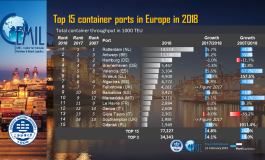
By Theo Notteboom The cargo volume handled remains a key performance indicator for ports. While also other indicators related to logistics performance, sustainability, innovation and economic impact are gaining ground, it remains relevant to observe how cargo volumes have evolved over time. The table shows the top 15 container ports in the European Union in 2018 based on container throughput expressed in TEU. It also includes container growth figures compared to 2017 and pre-crisis year 2007. What do the figures reveal? Top 15: y-o-y...
February 26th, 2019
Thematic Area

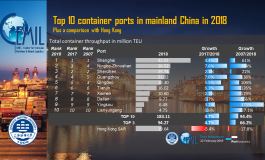
By Theo Notteboom The table provides an overview of the total TEU throughput in 2018 of the top 10 container ports in mainland China (plus Hong Kong) and also shows the growth figures 2017/2018 and 2007/2018. The figures lead to the following conclusions. Shanghai remains the no. 1 container port in mainland China and the world The top 10 ports in China handled 183 million TEU in 2018 or +4.7% compared to 2017. Shanghai in the Yangtze River Delta remains the undisputed no. 1 container port in mainland China and the world with over 42...
February 4th, 2019
Thematic Area

By Peter de Langen The recent announcement of a new container storage system, which according to the developers can triple terminal capacity, is interesting news. Container storage methods have changed little, if at all, over the last decades. But now a German industrial engineering group — an ‘outsider’ with no prior expertise in container storage systems — and DP World have jointly developed a system, similar to those in automated warehouses, to store and retrieve containers up to 11 stacks high. The value of such a...
January 29th, 2019
Thematic Area

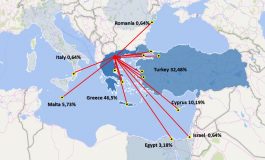
by George Vaggelas & Thanos Pallis Thessaloniki stands as the second biggest container port in Greece and a peripheral port aiming to serve the Balkans and further regions in Southeast Europe. It is almost a year since the privatization of the Thessaloniki Port Authority S.A., via the selling of the majority of the shares of the Port Authority that also acts as the single operator of the port of Thessaloniki*. The new owner has committed to invest €180 million, with the majority to be invested in the tripling of the container...
January 28th, 2019
Thematic Area

How the changing market environment in shipping and ports affects the requirements with regards to seafarers and dock workers? Which are the motivation tools and instruments for seafarers and dock workers taking into account the professional/ industry contexts? What is the role of career management and second career possibilities? PortEconomics member Theo Notteboom presented the most contemporary issues on the career path and ‘second life’ for seafarers during the final event of the “SECOND LIFE – Seafarers work and live better...
January 14th, 2019
Thematic Area

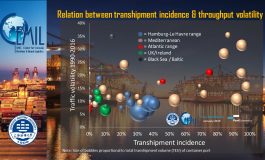
PortEconomics members Theo Notteboom, Francesco Parola and Giovanni Satta co-authored a study "The relationship between transhipment incidence and throughput volatility in North European and Mediterranean container ports". This study has recently been published in Journal of Transport Geography (74, pages 371-381). It is often argued that ports with a high sea-sea transhipment share (T/S) are more vulnerable than gateway ports which rely more on hinterland cargo. It is less clear whether the vulnerability of T/S oriented container ports...
January 14th, 2019
Thematic Area

Download PortReport No 3 - Reflections on the future of container ports in view of the new containerization behavior. Almost from its inception, there has been a clear upward trend in the disruptive force of the container during its use. However, a relative decrease in container movement has been seen in recent years although the explanation of which goes beyond disturbances in the world economy. PortEconomics member Ricardo Sanchez along with Eliana Barleta notice that the inter-annual change in throughput with respect to changes in GDP is...
January 9th, 2019
Thematic Area

The ongoing shift toward a circular economy, in which end-of-life (EOL) products are reused, remanufactured, or recycled, has major implications for seaports, especially seaports in metropolitan areas, as in such areas, huge amounts of EOL products are available. Ports are therefore relevant locations for circular economy activities. PortEconomics members Peter de Langen and Henrik Sornn-Friese latest port study, identifies the main commodities in volume terms and the set of associated activities and assesses resulting...
December 19th, 2018
Thematic Area

Cruise is a maritime activity on continuous growth for more than three decades. With the positive direct and indirect impacts diffused to the port cities or nearby touristic destinations, cruise seaports are gaining importance. The interest in hosting more cruise calls and cruise passenger movements has been supported, in general, by broader communities and decision makers. Still growing cruise business, like any other economic activity, is also associated with externalities raising social, economic, and environmental questions and...
December 10th, 2018
Thematic Area

Transport and logistics are expected to be in the future among the service sectors most impacted by Industry 4.0, due to the array of innovative applications that will be developed from emerging digital technologies related to both smart transports and “mobility as a service”. In this perspective, logistics centres constitute a fruitful research field for assessing the impact of incoming technologies on the business models of logistics companies operating in these centres, which play a pivotal role in international supply chains by...
Page 28 of 58...2627282930...