Thematic Area

June 10th, 2016
Thematic Area

How the One-belt-one-road (OBOR) policy might affect european port-hinterland dynamics? In 2013 Xi Jinping embarked in a strategy to “break the connectivity bottleneck” in Asia.  60 countries are already involved, with this policy impacting 4.4 billion people.  In March 2015, the ‘One Belt, One Road’ initiatives action plan was detailed. PortEconomics co-director Theo Notteboom addressed the theme during his invited presentation gave at the ESPO Conference 2016, held in 2-3 June in Dublin, Ireland. Theo also...
June 6th, 2016
Thematic Area

The evolution of clusters in modern ports, and the interrelated wave of port devolution in the 1990s, led to a redefinition of the role of each actor involved, including that of port authorities (PAs). The latter have been transformed to hybrid organisations, mostly disassociated from operational activities and port services provision, yet maintaining a key role as the managing bodies advancing the prospects of the port they manage and these of the respective clusters. Marketing is among the functions working towards this end. PortEconomics...
June 2nd, 2016
Thematic Area

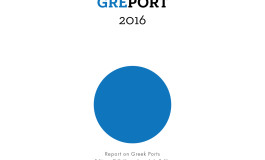
With total throughput 6.36 million tonnes of dry bulk cargo, 3.98 million TEUs, 28.23 million coastal passengers and 2.07 cruise passengers in 2014, Greek ports are important actors in local, national and regional level. In 2014, their turnover exceeded the €326 million. GREPORT 2016, the Report on Greek Ports  by PortEconomics members Thanos Pallis and George Vaggelas is the first comprehensive record and analysis of the developments of the Greek port industry over the last decade. The port study, published by Port &...
June 1st, 2016
Thematic Area

By Theo Notteboom Alliances are about operational vessel-sharing co-operation between container shipping companies on multiple trade routes (mostly east-west). The first strategic alliances between shipping lines date back to the mid-1990s, a period that coincided with the introduction of the first post-Panamax containers vessels on the Europe-Far East trade. The alliance partnerships evolved as a result of mergers and acquisitions (e.g. merger between P&OCL and Nedlloyd and the take-overs by P&O Nedlloyd and SeaLand by...
May 20th, 2016
Thematic Area

The movement of cargo in containers in Latin American and Caribbean ports grew 1.7% during 2015, according to figures unveiled in ECLAC’s new edition of its ranking of container port throughput, published in its Maritime Profile. These figures confirm two trends observed during the last years in the region: the slowdown of foreign trade shown by container terminals and great heterogeneity of the growth rates inside the region. Regional average of 1.7% container throughput growth, although still higher than the rate recorded in 2014...
May 7th, 2016
Thematic Area

On 3 May 1966 - so 50 years ago - the MS Fairland arrived in Rotterdam under the watchful eye of Queen Juliana, with 226 containers on board. From that moment on, the Sea-Land Shipping Company has been maintaining a weekly container service between New York and the West European ports of Rotterdam, Bremen and Grangemouth, and Rotterdam became Europe's first container port. The importance of container transport for global trade can hardly be overestimated – which is why the container has also been called ‘the invention of the century’....
April 30th, 2016
Thematic Area

Since the early-2000s, given the increasing profitability of the container port business, a number of financial investors were stimulated to both reach new market segments and enter the industry as investors. As additional financial resources have been increasingly requested from the sector to fuel greenfield mega-projects, M&A activity and the accelerated foreign expansion of international terminal operators (ITOs), financial investors increased have their effort by providing financial and technical support to both shipping...
April 16th, 2016
Thematic Area

Download PortReport No 1- Competition and complementarity between seaports and hinterlands for distribution activities PortEconomics celebrates the launching of PortReports, a PortEconomics series aiming to enrich business and academic insights related to the port sector. In PortReport No 1 -  authored by Jason Monios, Theo Notteboom, Gordon Wilmsmeier and Jean-Paul Rodrigue,  readers have the chance to identify types of distribution activities that ports are suitable locations for, and which of such activities are best suited to...
April 4th, 2016
Thematic Area

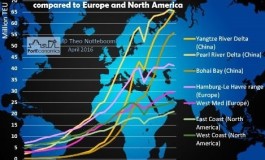
By Theo Notteboom The figure shows the evolution of container throughput in the three main container port regions in China (i.e. Yangtze River Delta, Pearly River Delta and the Bohai Rim). We compare these volume dynamics with some key port systems in North America and Europe: the port system along the North American West Coast including ports such as Seattle/Tacoma, Vancouver, LA, Long Beach and Oakland; East coast ports such as Norfolk, Charleston, New York/New Jersey, Baltimore, Savannah and Halifax; the Hamburg-Le Havre port range...
March 30th, 2016
Thematic Area

A 5,62% increase of passenger movements comparing to 2014 was registered in Mediterranean cruise ports in 2015. The variation of cruise passenger movements in the second biggest cruise region of the world is positive when one relates the numbers with the one that had taken place at the beginning of the decade. In 2015 cruise ports in the Med and its adjoining seas hosted 10,7% more passenger movements than in 2010. MedCruise the association cruise ports in the Med and its adjoining seas revealed that a total of 27.206.023 cruise...
Page 42 of 59...4041424344...