

• Home
  • About
    • Members
    • Associate Members
    • Former members
  • Thematic Areas
    • Containers
    • Cruise
    • European Port Policy
    • Ports & COVID-19
  • PortStudies
  • Presentations
  • Noticeboard
  • Viewpoints
  • PortLibrary
  • PortReport
PortEconomics
  • July 22nd, 2026
PortEconomics
  • Home
  • About
    • Members
    • Associate Members
    • Former members
  • Thematic Areas
    • Containers
    • Cruise
    • European Port Policy
    • Ports & COVID-19
  • PortStudies
    Risk-driven supply chain designs – a re-assessment with geopolitical and geoeconomic considerations

    Risk-driven supply chain designs – a re-assessment with geopolitical and geoeconomic considerations

    Rhine-Scheldt delta port system

    Rhine-Scheldt delta port system

    A metric of global maritime supply chain disruptions: The global supply chain stress index - maritime (GSCSI-M)

    A metric of global maritime supply chain disruptions: The global supply chain stress index - maritime (GSCSI-M)

    ESG disclosure as a proxy of port corporate communication and sustainable management strategy: An LDA approach

    ESG disclosure as a proxy of port corporate communication and sustainable management strategy: An LDA approach

    From coal exports to green steel production? The role of circular economy precincts for sustainable port diversification

    From coal exports to green steel production? The role of circular economy precincts for sustainable port diversification

  • Presentations
    European ports: The need to avoid the great divide

    European ports: The need to avoid the great divide

    Florence maritime regulation conference: PortEconomics members shape maritime regulation

    Florence maritime regulation conference: PortEconomics members shape maritime regulation

    New edition: Developing ports as business ecosystems

    New edition: Developing ports as business ecosystems

    European Ports: Reflection on policies and strategies for the energy transition

    European Ports: Reflection on policies and strategies for the energy transition

    IAPH World Ports Tracker 2026 reveals state of global port sustainability

    IAPH World Ports Tracker 2026 reveals state of global port sustainability

  • Noticeboard
    Call for papers: Contemporary Maritime Economics: Transformations and Emerging Perspectives

    Call for papers: Contemporary Maritime Economics: Transformations and Emerging Perspectives

    ECONSHIP2026: Call for papers

    ECONSHIP2026: Call for papers

    Call for papers: 1st Florence Maritime Regulation Conference

    Call for papers: 1st Florence Maritime Regulation Conference

    PortEconomics co-director appointed Senior Scientific Advisor to the Florence School of Regulation

    PortEconomics co-director appointed Senior Scientific Advisor to the Florence School of Regulation

    Jean Monnet Chair in European Port Policy

    Jean Monnet Chair in European Port Policy

  • Viewpoints
    European ports: The need to avoid the great divide

    European ports: The need to avoid the great divide

    New edition: Developing ports as business ecosystems

    New edition: Developing ports as business ecosystems

    Maritime and port strategies as state policies: an introductory approach

    Maritime and port strategies as state policies: an introductory approach

    European Ports: Reflection on policies and strategies for the energy transition

    European Ports: Reflection on policies and strategies for the energy transition

    Port-city integration

    Port-city integration

  • PortLibrary
  • PortReport

READ ALSO

Antwerp-Bruges surpasses Rotterdam in Q1 2025: a structural shift or short-term fluctuation?
Container throughput at Rotterdam and Antwerp-Bruges: A growing rivalry
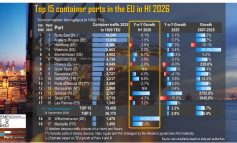
Top-15 EU container ports in 2024: strong growth despite geopolitcal tensions
European ports: The need to avoid the great divide

On 3 May 1966 – so 50 years ago – the MS Fairland arrived in Rotterdam under the watchful eye of Queen Juliana, with 226 containers on board. From that moment on, the Sea-Land Shipping Company has been maintaining a weekly container service between New York and the West European ports of Rotterdam, Bremen and Grangemouth, and Rotterdam became Europe’s first container port.

The importance of container transport for global trade can hardly be overestimated – which is why the container has also been called ‘the invention of the century’. In celebration of this anniversary, the Port Authority will not only be paying homage to the past with a special ‘dossier’, but also looking into the future. Can we think of any new inventions that could herald the dawn of a comparable revolution in transport?

Especially for the occasion, the Port of Rotterdam Authority asked journalist Charlotte van ‘t Wout to write four articles about innovations that could affect the future of the port and transport sector. We will also look back on the invention of the container.

On this site, the stories and other materials are offered as downloads: www.portofrotterdam.com/50years.

Next article Public-private interests and conflicts in ports: a content analysis approach
Previous article International Congress on Transport Infrastructure and Systems - Rome 2017

Related Posts

European ports: The need to avoid the great divide European Port Policy

European ports: The need to avoid the great divide

Florence maritime regulation conference: PortEconomics members shape maritime regulation European Port Policy

Florence maritime regulation conference: PortEconomics members shape maritime regulation

New edition: Developing ports as business ecosystems Presentations

New edition: Developing ports as business ecosystems

Weekly Timeline
Jul 22nd 3:50 PM
Thematic Area

European ports: The need to avoid the great divide

Jul 21st 1:41 PM
Thematic Area

Florence maritime regulation conference: PortEconomics members shape maritime regulation

Jul 2nd 2:45 PM
Presentations

New edition: Developing ports as business ecosystems

Jun 23rd 11:51 AM
Featured

Maritime and port strategies as state policies: an introductory approach

Jun 11th 4:40 PM
Featured

Global port integrity platform: A data-driven Assessment of Port Integrity Worldwide

Tweets by @PortEconomics
  • Containers
  • Cruise
  • EPP
  • Ports & COVID-19
  • Back to top
About PortEconomics

PortEconomics is a web-based initiative aiming to advance knowledge exchange on seaport studies. Established by maritime economists affiliated to academic institutions in Belgium, Greece and the Netherlands. It provides freely accessible research, education, information, and network-building material on critical issues of port economics, management and policies.

Additional Information
  • About
  • Login
  • Register
  • Edit Profile
  • Contact us
  • PortProfessionals
  • PortReport Series
  • Terms and Conditions
  • Cookie Policy
© PortEconomics 2025. All rights reserved.
Produced by PortEconomics
Manage Consent
To provide the best experiences, we use technologies like cookies to store and/or access device information. Consenting to these technologies will allow us to process data such as browsing behavior or unique IDs on this site. Not consenting or withdrawing consent, may adversely affect certain features and functions.
Functional Always active
The technical storage or access is strictly necessary for the legitimate purpose of enabling the use of a specific service explicitly requested by the subscriber or user, or for the sole purpose of carrying out the transmission of a communication over an electronic communications network.
Preferences
The technical storage or access is necessary for the legitimate purpose of storing preferences that are not requested by the subscriber or user.
Statistics
The technical storage or access that is used exclusively for statistical purposes. The technical storage or access that is used exclusively for anonymous statistical purposes. Without a subpoena, voluntary compliance on the part of your Internet Service Provider, or additional records from a third party, information stored or retrieved for this purpose alone cannot usually be used to identify you.
Marketing
The technical storage or access is required to create user profiles to send advertising, or to track the user on a website or across several websites for similar marketing purposes.
  • Manage options
  • Manage services
  • Manage {vendor_count} vendors
  • Read more about these purposes
View preferences
  • {title}
  • {title}
  • {title}