Viewpoints

May 31st, 2015
Viewpoints

In Antwerp, the closure of the GM plant makes a huge site available for re-development, while in Rotterdam, one of the refineries (currently owned by Q8) is up for sale, writes Peter de Langen, co-director of PortEconomics in his viewpoint- published in his Port Strategy column as 'The Analyst'. For the latter, one scenario is a buyer will transform the refinery into a terminal for bulk cargoes. These cases from the two largest European ports show that both industrial and logistics facilities have a life-cycle. Similar closures of large...
May 31st, 2015
Viewpoints

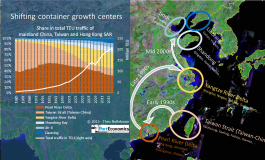
By Theo Notteboom Only 25 years ago, the container port system in mainland China was still in its infancy stage. During that time, Hong Kong acted as the only container gateway to China and Taiwanese ports Kaohsiung and Keelung benefited from Taiwan's economic success story in international trade. In May 1980, the Chinese government established the Shenzhen Special Economic Zone, the first special economic zone in China. By the late 1980s, mainland Chinese ports in the Pearl River Delta saw the first fruits of this opening up policy. Growth...
May 11th, 2015
Viewpoints

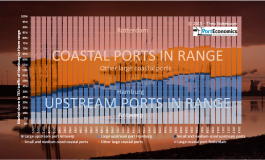
By Theo Notteboom One could think that the days for upstream ports are counted given a growing demand for a good nautical accessibility and a fast turnaround time for the ever larger container vessels. A closer look at Antwerp and Hamburg, two of the largest upstream container ports in the world, urges us to think again. In the past few decades the large upstream ports in the Hamburg-Le Havre range have gradually gained market share at the expense of large coastal ports. In the late 1970s, Antwerp on the river Scheldt and Hamburg on the...
May 9th, 2015
Viewpoints

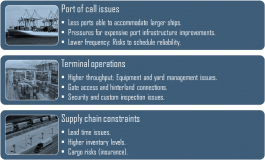
Maritime shipping and port operations are both facing economic and commercial changes in the post-recession era. From strategic changes in trade flows to the operational fickleness of supply chains, maritime shipping has shown a propensity to adapt by capturing new commercial opportunities. In an article based on his keynote speech delivered at TOC Container Supply Chain: Americas, in Cartagena, Colombia, PortEconomics member Jean-Paul Rodrigue discusses the new global principles for shipping and ports and conclude that this is "Not your...
May 8th, 2015
Viewpoints

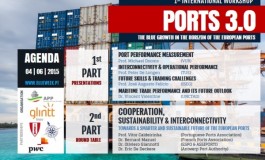
PortEconomics members Peter de Langen and Michael Dooms will discuss the future of European ports during the "1st International Workshop 3.0: The blue growth in the horizon of the European Ports". Michael Dooms will lead discussion on Port Performance measurement whereas Peter de Langen will focus on Interconnectivity and operational performance. "Ports 3.0" will take place in Lisbon on 4 June 2015, and is part of the 'blue week' events organised in Portugal.
May 7th, 2015
Viewpoints

By Thanos Pallis The deployment of bigger cruise vessels along the globe are associated with the continuous increase of the average number cruise passengers that reach a cruise port via one call alone. The figures of the Mediterranean and the adjoining seas, the second biggest cruise region of the world provides a clear examble of this trend. During the last five years, the average number of passengers per cruise call increased by 13,3%, or from 1.657 to 1.878 passengers per call. The increase within the last decade is even more...
May 3rd, 2015
Viewpoints

Last month, DP World bought the Maher terminal in Prince Rupert, with a 2014 throughput of a little over 600,000 teu for more than a half billion US dollar - just under $1,000 per teu handled, comments Peter de Langen at his "The Analyst" column in Port Strategy. Two aspects of this deal are interesting. First, the price seems to indicate huge confidence in growing volumes: the terminal is to be expanded to a capacity of about 1.35m teu, with studies on the feasibility of a further expansion to about 2.5m teu. Second, the fact that the...
April 24th, 2015
Viewpoints

The variety of pricing structures is remarkable. For instance, a substantial amount of charges are paid by shippers in South Africa, contrary to most other countries. In Singapore, virtually all revenues come from port dues and virtually none from land rents in ports or charges to shippers. The opposite is true in many US and Canadian ports; here, the majority of revenues are from land lease agreements. This suggests that 'history' may be an important factor. How can pricing structures in ports be best explained? are they based on a specific...
April 21st, 2015
Viewpoints

By Theo Notteboom Operational co-operation between container shipping companies comes in many forms ranging from slot-chartering and vessel-sharing agreements to multi-trade strategic alliances. The first strategic alliances between shipping lines date back to the mid-1990s, a period that coincided with the introduction of the first post-Panamax containers vessels on the Europe-Far East trade. In 1997, about 70% of the services on the main East-West trades were supplied by the four main strategic alliances. Today, four large alliances are...
April 20th, 2015
Viewpoints

Macroscopic patterns of global maritime flows  and global trade growth has inevitably resulted in a regular increase in the number of ports and vessels since the late nineteenth century. Yet the number of inter-port links and vessel calls has fluctuated much more widely. Over the last 125 years, three peaks of global maritime activity have coincided with periods of relative economic prosperity and great and the large-scale diffusion of technological innovations: steam shipping (1890-1925), diesel engines (1960-1970) and massive containerships...
Page 22 of 29...2021222324...