Viewpoints

August 21st, 2015
Viewpoints

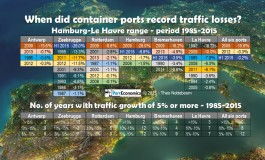
By Theo Notteboom Recently, Hamburg announced that container throughput in the Elbe port saw a decline of 6.8% in the first half of 2015 compared to the same period last year, mainly caused by a sharp decrease in the trade volumes with Russia and China. The container business is generally considered as a growth sector. Over the past decades, ports around the world have become used to welcoming traffic growth year after year. A decline in container traffic is considered as unusual. But how often have ports reported cargo losses over the...
August 7th, 2015
Viewpoints

With a local market containing 196.7m consumers, a total area of 8.5 million km2 and the seventh largest economy in the world in terms of GDP, Brazil naturally attracts attention from investors from all sectors that are interested in the opportunities in this emerging country. Recently, it's the country's 8,500 km coastline and its ports - responsible for more than 95% of the country's international trade - that are attracting the attention of international players in the maritime and port logistics sector. The Brazilian port sector has...
July 21st, 2015
Viewpoints

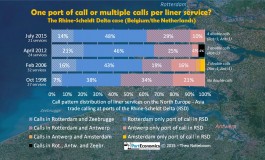
By Theo Notteboom When container shipping lines design a weekly service between Asia and North Europe, they have to decide how many and which ports of call to include in the schedule. On the North European side, they typically ensure they serve the biggest port regions. Therefore, almost all liner services on the North Europe – Far East trade have ports of call in the Rhine-Scheldt Delta (Rotterdam, Antwerp, Zeebrugge), the north German multi-port gateway region (Hamburg, Bremerhaven, Wilhelmshaven) and the southeast coast of the UK...
July 13th, 2015
Viewpoints

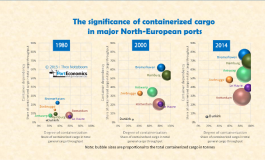
By Theo Notteboom Discussions on port development, planning and competitiveness often tend to revolve around container flows. Quite a few ports around the world have developed some kind of 'container fetish', implying they have developed a very strong focus on container throughput. But how dependent are ports on container traffic? The infographic shows the evolution in some of the main north-European container ports. Three dimensions are presented. The vertical axis shows the container dependency or the share of container throughput in the...
July 13th, 2015
Viewpoints

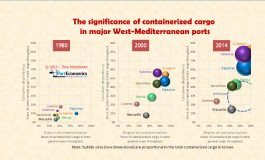
By Theo Notteboom In last week's infographic, Theo Notteboom analysed the container dependency of major North-European ports. But how is the situation in southern Europe? How dependent are West-Mediterranean ports on container traffic? As before, there are three dimensions in the infographic. The vertical axis shows the container dependency or the share of container throughput in the total throughput of the port. The horizontal axis depicts the degree of containerization or the share of containerized cargo in the total general cargo...
July 8th, 2015
Viewpoints

Fourteen years since its first attempt, the EU is still searching for a European port policy able to increase the competitiveness of European ports. PortEconomics members Thanos Pallis and George Vaggelas in their article at "Naftika Chronika" magazine argue that market access to port services is no longer the "Holy Grail" for the EU's port industry and institutions or at least is not the only one. EU has adopted a more flexible approach towards liberalisation of market access exempting the most controversial cargo handling and passenger...
June 30th, 2015
Viewpoints

The OECD report on the effects on mega-ships provides valuable insights for all players in the port industry. Peter de Langen through his column "The Analyst" in Port Strategy focuses on an important flaw in the report: the suggestion that mega ships impose infrastructure costs on the public sector. Imposing means 'forcing (an unwelcome decision or ruling) on someone'. Peter explains why he fundamentally fails to see how mega-ships force port infrastructure investments on the public sector. Read the Analyst's comment on OECD report @...
June 21st, 2015
Viewpoints

By Jean-Paul Rodrigue The current global manufacturing landscape is the outcome of successive waves of innovation and economic development and their geographical accumulation. Although the industrial revolution is often considered as a single ongoing event that began in the late 18th century, it can be better understood as four sequential paradigm shifts, or four industrial revolutions. Each revolution built upon the innovations of the prior revolution and lead to more advanced forms of manufacturing. PortEconomics member Jean-Paul...
June 18th, 2015
Viewpoints

By Jean-Paul Rodrigue Container ports are reflective of the world's commercial geography particularly since they dominantly handle finished and intermediate goods. Commodities are becoming more prevalent, but still remain a niche market. The map below shows container volumes in 2012 for ports above half a million TEU. Surprisingly, there is no publicly available dataset covering the traffic of container ports around the world. Some regional or national trade groups publish figures, but this data is only for an area and tends to be...
June 11th, 2015
Viewpoints

By Jean-Paul Rodrigue Maritime shipping, more than any other form of transportation, benefits from economies of scale since they have a direct impact on its operational costs. There has thus been a tendency to deploy larger ships, particularly in container shipping, to service high volume trade routes such as between Asia and Europe. PortEconomics member Jean-Paul Rodrigue comments: A common issue with the application of economies of scale is that the maritime shipping company is internalizing its benefits since they have a positive...
Page 21 of 29...1920212223...