

• Home
  • About
    • Members
    • Associate Members
    • Former members
  • Thematic Areas
    • Containers
    • Cruise
    • European Port Policy
    • Ports & COVID-19
  • PortStudies
  • Presentations
  • Noticeboard
  • Viewpoints
  • PortLibrary
  • PortReport
PortEconomics
  • May 3rd, 2026
PortEconomics
  • Home
  • About
    • Members
    • Associate Members
    • Former members
  • Thematic Areas
    • Containers
    • Cruise
    • European Port Policy
    • Ports & COVID-19
  • PortStudies
    Risk-driven supply chain designs – a re-assessment with geopolitical and geoeconomic considerations

    Risk-driven supply chain designs – a re-assessment with geopolitical and geoeconomic considerations

    Rhine-Scheldt delta port system

    Rhine-Scheldt delta port system

    A metric of global maritime supply chain disruptions: The global supply chain stress index - maritime (GSCSI-M)

    A metric of global maritime supply chain disruptions: The global supply chain stress index - maritime (GSCSI-M)

    ESG disclosure as a proxy of port corporate communication and sustainable management strategy: An LDA approach

    ESG disclosure as a proxy of port corporate communication and sustainable management strategy: An LDA approach

    From coal exports to green steel production? The role of circular economy precincts for sustainable port diversification

    From coal exports to green steel production? The role of circular economy precincts for sustainable port diversification

  • Presentations
    European Ports: Reflection on policies and strategies for the energy transition

    European Ports: Reflection on policies and strategies for the energy transition

    IAPH World Ports Tracker 2026 reveals state of global port sustainability

    IAPH World Ports Tracker 2026 reveals state of global port sustainability

    PortGraphic: Container port dynamics near Gibraltar

    PortGraphic: Container port dynamics near Gibraltar

    Top-10 PortReads in 2025

    Top-10 PortReads in 2025

    Port reform: World Bank publishes the third edition of its port reform toolkit

    Port reform: World Bank publishes the third edition of its port reform toolkit

  • Noticeboard
    Call for papers: Contemporary Maritime Economics: Transformations and Emerging Perspectives

    Call for papers: Contemporary Maritime Economics: Transformations and Emerging Perspectives

    ECONSHIP2026: Call for papers

    ECONSHIP2026: Call for papers

    Call for papers: 1st Florence Maritime Regulation Conference

    Call for papers: 1st Florence Maritime Regulation Conference

    PortEconomics co-director appointed Senior Scientific Advisor to the Florence School of Regulation

    PortEconomics co-director appointed Senior Scientific Advisor to the Florence School of Regulation

    Jean Monnet Chair in European Port Policy

    Jean Monnet Chair in European Port Policy

  • Viewpoints
    European Ports: Reflection on policies and strategies for the energy transition

    European Ports: Reflection on policies and strategies for the energy transition

    Port-city integration

    Port-city integration

    Commission unveils new EU Ports Strategy

    Commission unveils new EU Ports Strategy

    PortGraphic: Top-15 EU container ports in Q3 2025

    PortGraphic: Top-15 EU container ports in Q3 2025

    Maritime transport in net zero

    Maritime transport in net zero

  • PortLibrary
  • PortReport
Convergence and growth traps in container portsContainers

Convergence and growth traps in container ports

June 10th, 2021 Containers, Featured

READ ALSO

From coal exports to green steel production? The role of circular economy precincts for sustainable port diversification
Maritime transport in net zero
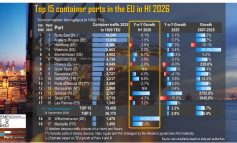
Portgraphic: Top-15 EU container ports in H1 2025
European Ports: Reflection on policies and strategies for the energy transition

PortEconomics members Pierre Cariou and Jason Monios, along with their colleagues Gabriel Figueiredo de Oliveira, and Alexandra Schaffar (LEAD, University of Toulon, France) tested the existence of a middle-rank growth trap in the container port market.

Their portstudy- published in the Transport Policy (Volume 110)- adopts an original perspective to study the dynamics of port hierarchies by applying different rank-size models, a Markov chain approach and transition modelling to a dataset featuring the annual traffic of 222 container ports from 2000 to 2015.

The main findings are that (i) the global port rank-size distribution is characterized by the importance of midsize ports with high traffic volatility; however, the impact of these ports declines over time in favour of the largest ports at the top of the hierarchical system; (ii) port growth does not lead to convergence in port size, except for in the Americas; (iii) there is a relatively low mobility of ports in the container traffic distribution with downward mobility being much higher than upward mobility. These results seem to confirm the existence of a middle-rank growth trap in port hierarchies, which suggests that medium ports should be wary of making large investments to compete with top ports and instead should focus on maintaining their existing position.

Access journal’s webpage and read the full article.

Next article Underground logistics systems to cope with internal container traffic in the port of Antwerp?
Previous article IAPH-WPSP Port Economic Impact Barometer One Year Report makes way for new IAPH Global Port Tracker

Jason Monios

Dr Jason Monios is Associate Professor in Maritime Logistics at Kedge Business School, Marseille, France. His research areas include intermodal transport and logistics, port system evolution, collaboration and integration in port hinterlands, port governance and policy, institutional and regulatory settings, port sustainability and climate change adaptation. He has led numerous research projects on these topics with a total budget of over €1m. He has over 70 peer-reviewed academic publications in addition to numerous research and consultancy reports, covering Europe, North and South America, Asia, the Middle East and Africa. He has worked with national and regional transport authorities and co-authored technical reports with UNCTAD and UN-ECLAC. Jason is a chartered member of the Chartered Institute of Logistics and Transport (CILT) and co-chair of the Intermodal Freight Transport SIG of the World Conference on Transportation Research Society (WCTRS), as well as a member of the International Association of Maritime Economists (IAME), the Port Performance Research Network (PPRN) and the Port Economics online initiative. He currently holds a visiting position at the University of Gothenburg, Sweden. ORCID: https://orcid.org/0000-0002-4916-9718

Related Posts

European Ports: Reflection on policies and strategies for the energy transition European Port Policy

European Ports: Reflection on policies and strategies for the energy transition

IAPH World Ports Tracker 2026 reveals state of global port sustainability Featured

IAPH World Ports Tracker 2026 reveals state of global port sustainability

Risk-driven supply chain designs – a re-assessment with geopolitical and geoeconomic considerations Featured

Risk-driven supply chain designs – a re-assessment with geopolitical and geoeconomic considerations

Weekly Timeline
Apr 29th 11:39 AM
Thematic Area

European Ports: Reflection on policies and strategies for the energy transition

Apr 23rd 4:58 PM
Featured

IAPH World Ports Tracker 2026 reveals state of global port sustainability

Apr 8th 1:36 PM
Featured

Risk-driven supply chain designs – a re-assessment with geopolitical and geoeconomic considerations

Mar 27th 5:31 PM
Thematic Area

Port-city integration

Mar 9th 4:35 PM
Featured

Rhine-Scheldt delta port system

Tweets by @PortEconomics
  • Containers
  • Cruise
  • EPP
  • Ports & COVID-19
  • Back to top
About PortEconomics

PortEconomics is a web-based initiative aiming to advance knowledge exchange on seaport studies. Established by maritime economists affiliated to academic institutions in Belgium, Greece and the Netherlands. It provides freely accessible research, education, information, and network-building material on critical issues of port economics, management and policies.

Additional Information
  • About
  • Login
  • Register
  • Edit Profile
  • Contact us
  • PortProfessionals
  • PortReport Series
  • Terms and Conditions
  • Cookie Policy
© PortEconomics 2025. All rights reserved.
Produced by PortEconomics
Manage Consent
To provide the best experiences, we use technologies like cookies to store and/or access device information. Consenting to these technologies will allow us to process data such as browsing behavior or unique IDs on this site. Not consenting or withdrawing consent, may adversely affect certain features and functions.
Functional Always active
The technical storage or access is strictly necessary for the legitimate purpose of enabling the use of a specific service explicitly requested by the subscriber or user, or for the sole purpose of carrying out the transmission of a communication over an electronic communications network.
Preferences
The technical storage or access is necessary for the legitimate purpose of storing preferences that are not requested by the subscriber or user.
Statistics
The technical storage or access that is used exclusively for statistical purposes. The technical storage or access that is used exclusively for anonymous statistical purposes. Without a subpoena, voluntary compliance on the part of your Internet Service Provider, or additional records from a third party, information stored or retrieved for this purpose alone cannot usually be used to identify you.
Marketing
The technical storage or access is required to create user profiles to send advertising, or to track the user on a website or across several websites for similar marketing purposes.
  • Manage options
  • Manage services
  • Manage {vendor_count} vendors
  • Read more about these purposes
View preferences
  • {title}
  • {title}
  • {title}