

• Home
  • About
    • Members
    • Associate Members
    • Former members
  • Thematic Areas
    • Containers
    • Cruise
    • European Port Policy
    • Ports & COVID-19
  • PortStudies
  • Presentations
  • Noticeboard
  • Viewpoints
  • PortLibrary
  • PortReport
PortEconomics
  • May 4th, 2026
PortEconomics
  • Home
  • About
    • Members
    • Associate Members
    • Former members
  • Thematic Areas
    • Containers
    • Cruise
    • European Port Policy
    • Ports & COVID-19
  • PortStudies
    Risk-driven supply chain designs – a re-assessment with geopolitical and geoeconomic considerations

    Risk-driven supply chain designs – a re-assessment with geopolitical and geoeconomic considerations

    Rhine-Scheldt delta port system

    Rhine-Scheldt delta port system

    A metric of global maritime supply chain disruptions: The global supply chain stress index - maritime (GSCSI-M)

    A metric of global maritime supply chain disruptions: The global supply chain stress index - maritime (GSCSI-M)

    ESG disclosure as a proxy of port corporate communication and sustainable management strategy: An LDA approach

    ESG disclosure as a proxy of port corporate communication and sustainable management strategy: An LDA approach

    From coal exports to green steel production? The role of circular economy precincts for sustainable port diversification

    From coal exports to green steel production? The role of circular economy precincts for sustainable port diversification

  • Presentations
    European Ports: Reflection on policies and strategies for the energy transition

    European Ports: Reflection on policies and strategies for the energy transition

    IAPH World Ports Tracker 2026 reveals state of global port sustainability

    IAPH World Ports Tracker 2026 reveals state of global port sustainability

    PortGraphic: Container port dynamics near Gibraltar

    PortGraphic: Container port dynamics near Gibraltar

    Top-10 PortReads in 2025

    Top-10 PortReads in 2025

    Port reform: World Bank publishes the third edition of its port reform toolkit

    Port reform: World Bank publishes the third edition of its port reform toolkit

  • Noticeboard
    Call for papers: Contemporary Maritime Economics: Transformations and Emerging Perspectives

    Call for papers: Contemporary Maritime Economics: Transformations and Emerging Perspectives

    ECONSHIP2026: Call for papers

    ECONSHIP2026: Call for papers

    Call for papers: 1st Florence Maritime Regulation Conference

    Call for papers: 1st Florence Maritime Regulation Conference

    PortEconomics co-director appointed Senior Scientific Advisor to the Florence School of Regulation

    PortEconomics co-director appointed Senior Scientific Advisor to the Florence School of Regulation

    Jean Monnet Chair in European Port Policy

    Jean Monnet Chair in European Port Policy

  • Viewpoints
    European Ports: Reflection on policies and strategies for the energy transition

    European Ports: Reflection on policies and strategies for the energy transition

    Port-city integration

    Port-city integration

    Commission unveils new EU Ports Strategy

    Commission unveils new EU Ports Strategy

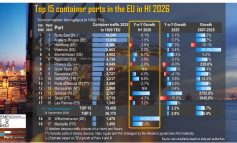
    PortGraphic: Top-15 EU container ports in Q3 2025

    PortGraphic: Top-15 EU container ports in Q3 2025

    Maritime transport in net zero

    Maritime transport in net zero

  • PortLibrary
  • PortReport
Cruise ports: the most popular 2016Cruise

Cruise ports: the most popular 2016

December 29th, 2016 Cruise, Featured, Presentations

READ ALSO

Port-cities, ports and cruise: Enhancing a mutually beneficial symbiosis
Cruise Port-City Compass
Berth allocation in cruise ports: ports and cruise lines need to work together
European Ports: Reflection on policies and strategies for the energy transition

PortEconomics is celebrating the ending of 2016 recapping the articles that have captured the interest of the visitors of our web initiative so far for 2016.

Our most popular papers on Cruise ports in 2016 were:

1. Mediterranean cruise ports: traffic growth continues
A 5,62% increase of passenger movements comparing to 2014 was registered in Mediterranean cruise ports in 2015. The variation of cruise passenger movements in the second biggest cruise region of the world is positive when one relates the numbers with the one that had taken place at the beginning of the decade. In 2015 cruise ports in the Med and its adjoining seas hosted 10,7% more passenger movements than in 2010. PortEconomics co-director Thanos Pallis, under his capacity as a Secretary General of ΜedCruise, along with Kleopatra Arapi published a related article on the 2015 trends of cruise statistics in MedCruise ports. [Link]

2. Cruise ports and sustainability: contemporary issues
The aspirations of the cruise companies and how they are shapping the challenges that cruise ports are facing today was the key issue addressed by PortEconomics member George Vaggelas during the presentation titled “Cruise ports and sustainability – Contemporary issues”. [Link]

3. Cruising for better port pricing
Cruises are increasingly relevant in port development so taking a look at pricing can be insightful, writes PortEconomics co-director Peter de Langen. In Spain, dues charged by the port authority for cruise ships, expressed per passenger, vary from about €1 to about €6, depending on the port and ship capacity. These costs seem below the costs for the infrastructure and facilities. As a comparison, average ‘airside’ revenues of the Spanish airport company (AENA) are more than €9 per passenger. [Link]

4. Cruise ports expand activities caring about performance, economic impact and users satisfaction
PortEconomics co-director Thanos Pallis comments on Mediterranean cruise port authorities caring about performance, measuringeconomic impact and sharing users’ satisfaction – in a viewpoint that has been originally published at the 49th issue of International Cruise and Ferry Review. [Link]

5. Unveiling the critical elements for attracting homeporting
A new port study by PortEconomics member George Vaggelas, co-authored by Spyros Niavis (University of Thessaly), defines the parameters and elements that affect the potential of a cruise port to become a homeport. The study, published in the third issue of first volume of the scholarly journal Maritime Business Review, incorporates an ordinal regression model linking the likelihood of ports to attract homeport traffic with seven explanatory variables. The model has been applied in a sample of 47 Mediterranean cruise ports and the results unveil which factors that are of crucial importance for the attractiveness of a cruise homeport. [Link]

Next article Port Authorities: most popular 2016
Previous article Container ports: the most popular 2016

Related Posts

European Ports: Reflection on policies and strategies for the energy transition European Port Policy

European Ports: Reflection on policies and strategies for the energy transition

IAPH World Ports Tracker 2026 reveals state of global port sustainability Featured

IAPH World Ports Tracker 2026 reveals state of global port sustainability

Risk-driven supply chain designs – a re-assessment with geopolitical and geoeconomic considerations Featured

Risk-driven supply chain designs – a re-assessment with geopolitical and geoeconomic considerations

Weekly Timeline
Apr 29th 11:39 AM
Thematic Area

European Ports: Reflection on policies and strategies for the energy transition

Apr 23rd 4:58 PM
Featured

IAPH World Ports Tracker 2026 reveals state of global port sustainability

Apr 8th 1:36 PM
Featured

Risk-driven supply chain designs – a re-assessment with geopolitical and geoeconomic considerations

Mar 27th 5:31 PM
Thematic Area

Port-city integration

Mar 9th 4:35 PM
Featured

Rhine-Scheldt delta port system

Tweets by @PortEconomics
  • Containers
  • Cruise
  • EPP
  • Ports & COVID-19
  • Back to top
About PortEconomics

PortEconomics is a web-based initiative aiming to advance knowledge exchange on seaport studies. Established by maritime economists affiliated to academic institutions in Belgium, Greece and the Netherlands. It provides freely accessible research, education, information, and network-building material on critical issues of port economics, management and policies.

Additional Information
  • About
  • Login
  • Register
  • Edit Profile
  • Contact us
  • PortProfessionals
  • PortReport Series
  • Terms and Conditions
  • Cookie Policy
© PortEconomics 2025. All rights reserved.
Produced by PortEconomics
Manage Consent
To provide the best experiences, we use technologies like cookies to store and/or access device information. Consenting to these technologies will allow us to process data such as browsing behavior or unique IDs on this site. Not consenting or withdrawing consent, may adversely affect certain features and functions.
Functional Always active
The technical storage or access is strictly necessary for the legitimate purpose of enabling the use of a specific service explicitly requested by the subscriber or user, or for the sole purpose of carrying out the transmission of a communication over an electronic communications network.
Preferences
The technical storage or access is necessary for the legitimate purpose of storing preferences that are not requested by the subscriber or user.
Statistics
The technical storage or access that is used exclusively for statistical purposes. The technical storage or access that is used exclusively for anonymous statistical purposes. Without a subpoena, voluntary compliance on the part of your Internet Service Provider, or additional records from a third party, information stored or retrieved for this purpose alone cannot usually be used to identify you.
Marketing
The technical storage or access is required to create user profiles to send advertising, or to track the user on a website or across several websites for similar marketing purposes.
  • Manage options
  • Manage services
  • Manage {vendor_count} vendors
  • Read more about these purposes
View preferences
  • {title}
  • {title}
  • {title}