


• Home
  • About
    • Members
    • Associate Members
    • Former members
  • Thematic Areas
    • Containers
    • Cruise
    • European Port Policy
    • Ports & COVID-19
  • PortStudies
  • Presentations
  • Noticeboard
  • Viewpoints
  • PortLibrary
  • PortReport
PortEconomics
  • March 19th, 2026
PortEconomics
  • Home
  • About
    • Members
    • Associate Members
    • Former members
  • Thematic Areas
    • Containers
    • Cruise
    • European Port Policy
    • Ports & COVID-19
  • PortStudies
    Rhine-Scheldt delta port system

    Rhine-Scheldt delta port system

    A metric of global maritime supply chain disruptions: The global supply chain stress index - maritime (GSCSI-M)

    A metric of global maritime supply chain disruptions: The global supply chain stress index - maritime (GSCSI-M)

    ESG disclosure as a proxy of port corporate communication and sustainable management strategy: An LDA approach

    ESG disclosure as a proxy of port corporate communication and sustainable management strategy: An LDA approach

    From coal exports to green steel production? The role of circular economy precincts for sustainable port diversification

    From coal exports to green steel production? The role of circular economy precincts for sustainable port diversification

    Maritime transport in net zero

    Maritime transport in net zero

  • Presentations
    PortGraphic: Container port dynamics near Gibraltar

    PortGraphic: Container port dynamics near Gibraltar

    Top-10 PortReads in 2025

    Top-10 PortReads in 2025

    Port reform: World Bank publishes the third edition of its port reform toolkit

    Port reform: World Bank publishes the third edition of its port reform toolkit

    When will we admit that maritime transport will not be decarbonised by 2050?

    When will we admit that maritime transport will not be decarbonised by 2050?

    Digital technologies for efficient and resilient sea-land logistics

    Digital technologies for efficient and resilient sea-land logistics

  • Noticeboard
    Call for papers: Contemporary Maritime Economics: Transformations and Emerging Perspectives

    Call for papers: Contemporary Maritime Economics: Transformations and Emerging Perspectives

    ECONSHIP2026: Call for papers

    ECONSHIP2026: Call for papers

    Call for papers: 1st Florence Maritime Regulation Conference

    Call for papers: 1st Florence Maritime Regulation Conference

    PortEconomics co-director appointed Senior Scientific Advisor to the Florence School of Regulation

    PortEconomics co-director appointed Senior Scientific Advisor to the Florence School of Regulation

    Jean Monnet Chair in European Port Policy

    Jean Monnet Chair in European Port Policy

  • Viewpoints
    Commission unveils new EU Ports Strategy

    Commission unveils new EU Ports Strategy

    PortGraphic: Top-15 EU container ports in Q3 2025

    PortGraphic: Top-15 EU container ports in Q3 2025

    Maritime transport in net zero

    Maritime transport in net zero

    Portgraphic: Top-15 EU container ports in H1 2025

    Portgraphic: Top-15 EU container ports in H1 2025

    Portgraphic: fleet capacity (owned/chartered) of container shipping lines

    Portgraphic: fleet capacity (owned/chartered) of container shipping lines

  • PortLibrary
  • PortReport
Demand, supply and markets: challenges and opportunities in the shipping businessCategory

Demand, supply and markets: challenges and opportunities in the shipping business

November 9th, 2016 Category, Featured, Viewpoints

READ ALSO

Regional analysis of Liner Shipping Connectivity: What does the revised LSCI reveal?
COVID-19 and maritime transport: navigating the crisis and lessons learned
COVID-19 and maritime transport: impact and responses
Rhine-Scheldt delta port system

HoffmanBy Jan Hoffman

The UNCTAD Review of Maritime Transport 2016 has been launched this week. This year, we have placed a special focus on “Challenges and Opportunities for Developing Countries”. Here are a few selected personal picks:

Demand

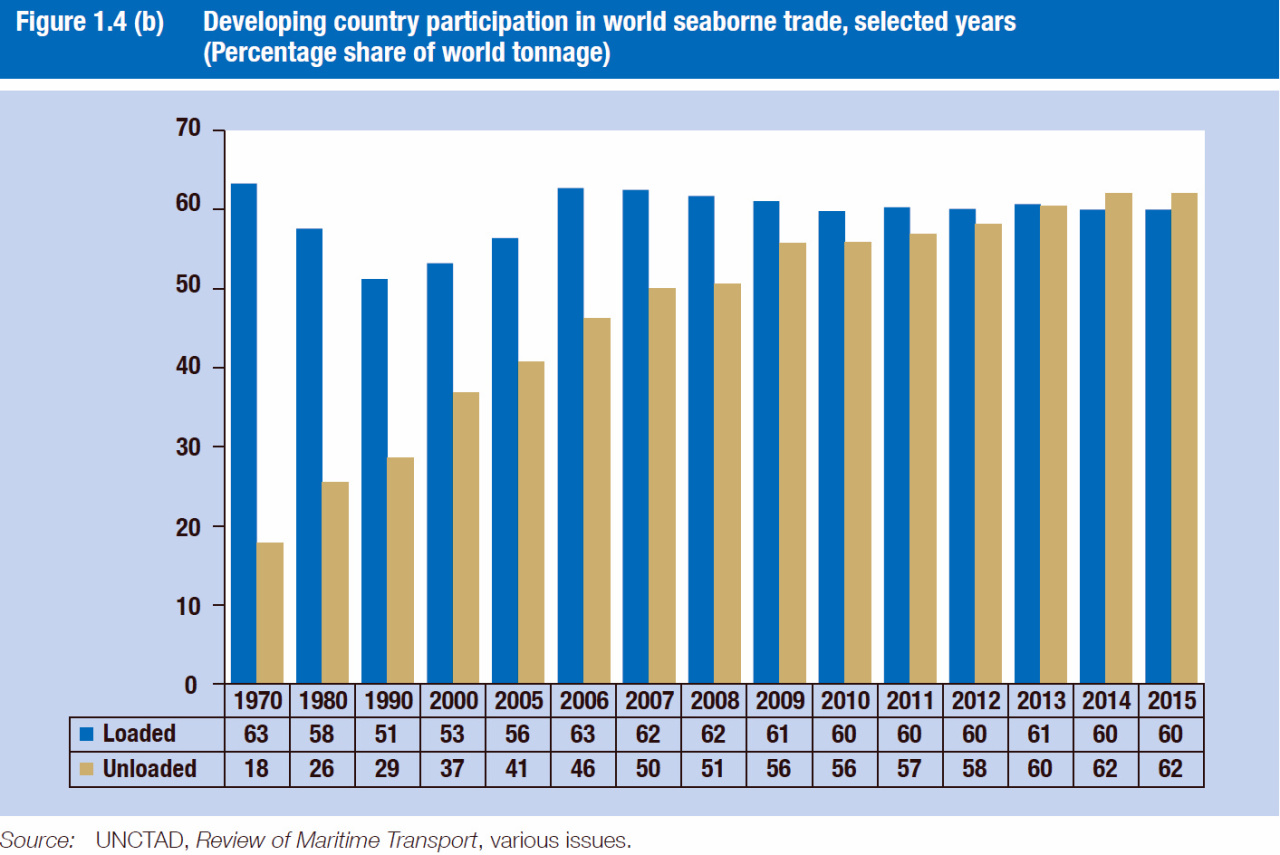
We have a new geography of trade, which can be depicted quite nicely with our data on seaborne trade. Developing countries are no longer just the suppliers of high volume/ low value raw materials, but instead now also import large volumes of oil, iron ore, coal et al, participating in global value chains and the globalized production of manufactured goods.
demand-review-of-maritime-transport

Supply

Developing countries are increasingly participating in a range of maritime business sectors. Between building, owning, manning, vessel registration, and scrapping, we see different players in different sectors.

supply-review-of-maritime-transport-2016

Source: UNCTAD RMT, based on data from Clarksons Research

As at January 2016, the top five shipowning economies in terms of dwt were Greece, Japan, China, Germany and Singapore, while the top five economies by flag of registration were Panama, Liberia, the Marshall Islands, Hong Kong (China) and Singapore. The largest shipbuilding countries are China, Japan and the Republic of Korea, accounting for over 91 per cent of gross tonnage constructed. Most demolitions take place in Asia; four countries – Bangladesh, India, Pakistan and China – accounted for 95 per cent of ship scrapping gross tonnage. The largest suppliers of seafarers are China, Indonesia and the Philippines.

As countries specialize in different maritime subsectors, a process of concentration of the industry occurs.

As each maritime business locates in a smaller number of countries, most countries host a decreasing number of maritime businesses, albeit with growing market shares in the subsectors. There are ample opportunities for developing countries to generate income and employment and help promote foreign trade. Policymakers are advised to identify and invest in maritime sectors in which their countries may have a comparative advantage. Supporting “the” maritime sector is no longer a policy choice. Rather, the challenge is to identify and support selected maritime businesses. Policymakers need to carefully assess the competitive environment for each maritime subsector they wish to develop, and to consider the value added of a sector for the State economy, including possible synergies and spillover effects to other sectors – maritime and beyond.

Markets

Container ships have never been bigger than at present, container freight rates have rarely been lower, and a record number of containerships are idle. In 2016 the largest bankruptcy ever to take place in container shipping unfolded, after the board of Hanjin Shipping voted to file for court receivership.

I have discussed earlier the problems of ever larger ships and the underlying economics of the demand and supply curves. Data on containership fleet deployment confirms the trend: As ships get bigger, the  number of providers per country goes down.
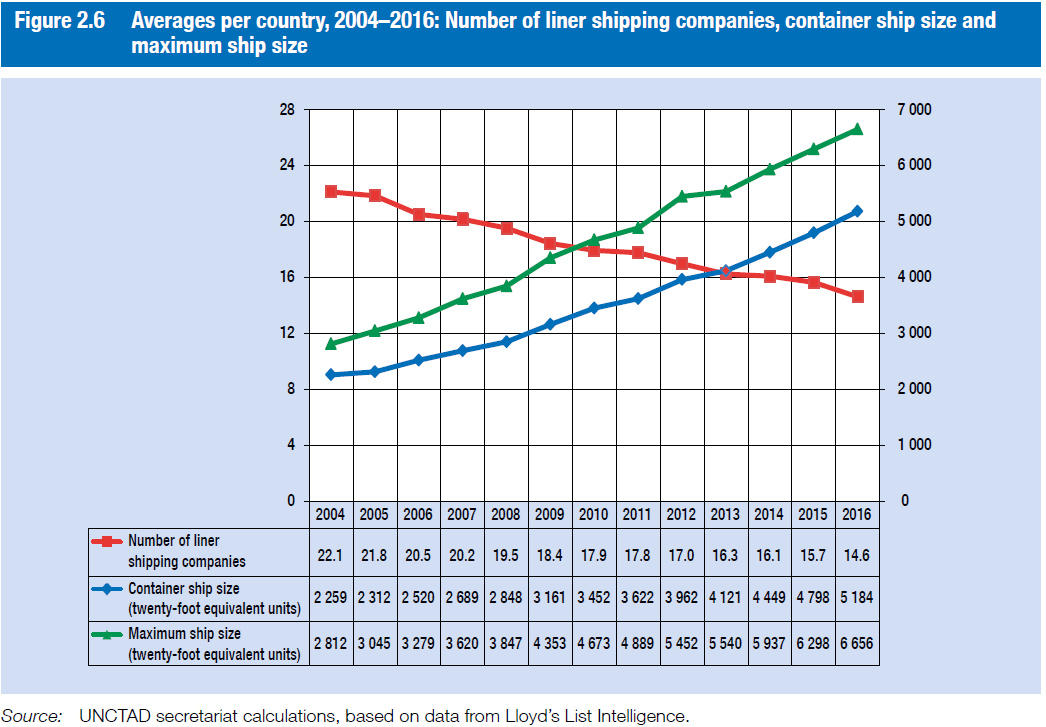
markets-review-of-maritime-transport-2016

Outlook

Shipping will continue to be the most important mode of transport for international trade, with the lowest environmental impact per ton–mile of transported cargo. The long-term perspectives for seaborne trade and maritime businesses are good. Policymakers are advised to identify and invest in maritime sectors in which their countries may have a comparative advantage.

In past centuries, maritime nations benefited from synergies between different maritime businesses. Shipowners flew national flags and generally employed their compatriots; they called at home ports and had their ships built and repaired in national shipyards. An experienced captain could find land-based employment close to home, in maritime and port administrations or through a classification society that certified national shipbuilding. Later on, steel from recycled ships could be reused for new constructions. In principle, such synergies remain valid. However, other aspects have gained in importance. There may be more synergies between shipbuilding and other industrial activities such as car manufacturing than between shipbuilding and shipowning. Labour costs and qualifications are of differing levels of importance in different sectors. Vessel registration is often provided by countries that may also be active in offshore financial and non-maritime services, while the clustering of insurance-related and legal services may be beneficial for trading and ship operations. Often, different types of clusters are not found in the same country.

Overall, there are good opportunities for many developing countries. For Least Developed Countries and for Small and Vulnerable Economies, however, it is more difficult to participate in the business (i.e. as providers) or to benefit from the larger ships (i.e. as users). The growth and concentration in maritime transport continues to be good news for some, and not so good news for others.”

Note: Dr. Jan Hoffmann has been appointed Chief of UNCTAD’s Trade Logistics Branch. He is the President of the International Association of Maritime Economists (IAME). Τhe article was first published at the authors blog https://janhoffmann.live and is reproduced with the kind permission of the author. 
Next article Coordination in hinterland chains: an institutional analysis of port-related transport
Previous article Ocean Yearbook: call for papers

Related Posts

Rhine-Scheldt delta port system Featured

Rhine-Scheldt delta port system

Commission unveils new EU Ports Strategy European Port Policy

Commission unveils new EU Ports Strategy

PortGraphic: Container port dynamics near Gibraltar Containers

PortGraphic: Container port dynamics near Gibraltar

Weekly Timeline
Mar 9th 4:35 PM
Featured

Rhine-Scheldt delta port system

Mar 6th 1:23 PM
Thematic Area

Commission unveils new EU Ports Strategy

Feb 18th 1:46 PM
Thematic Area

PortGraphic: Container port dynamics near Gibraltar

Feb 12th 12:25 PM
Featured

A metric of global maritime supply chain disruptions: The global supply chain stress index – maritime (GSCSI-M)

Jan 14th 12:56 PM
Noticeboard

Call for papers: Contemporary Maritime Economics: Transformations and Emerging Perspectives

Tweets by @PortEconomics
  • Containers
  • Cruise
  • EPP
  • Ports & COVID-19
  • Back to top
About PortEconomics

PortEconomics is a web-based initiative aiming to advance knowledge exchange on seaport studies. Established by maritime economists affiliated to academic institutions in Belgium, Greece and the Netherlands. It provides freely accessible research, education, information, and network-building material on critical issues of port economics, management and policies.

Additional Information
  • About
  • Login
  • Register
  • Edit Profile
  • Contact us
  • PortProfessionals
  • PortReport Series
  • Terms and Conditions
  • Cookie Policy
© PortEconomics 2025. All rights reserved.
Produced by PortEconomics
Manage Consent
To provide the best experiences, we use technologies like cookies to store and/or access device information. Consenting to these technologies will allow us to process data such as browsing behavior or unique IDs on this site. Not consenting or withdrawing consent, may adversely affect certain features and functions.
Functional Always active
The technical storage or access is strictly necessary for the legitimate purpose of enabling the use of a specific service explicitly requested by the subscriber or user, or for the sole purpose of carrying out the transmission of a communication over an electronic communications network.
Preferences
The technical storage or access is necessary for the legitimate purpose of storing preferences that are not requested by the subscriber or user.
Statistics
The technical storage or access that is used exclusively for statistical purposes. The technical storage or access that is used exclusively for anonymous statistical purposes. Without a subpoena, voluntary compliance on the part of your Internet Service Provider, or additional records from a third party, information stored or retrieved for this purpose alone cannot usually be used to identify you.
Marketing
The technical storage or access is required to create user profiles to send advertising, or to track the user on a website or across several websites for similar marketing purposes.
  • Manage options
  • Manage services
  • Manage {vendor_count} vendors
  • Read more about these purposes
View preferences
  • {title}
  • {title}
  • {title}