


• Home
  • About
    • Members
    • Associate Members
    • Former members
  • Thematic Areas
    • Containers
    • Cruise
    • European Port Policy
    • Ports & COVID-19
  • PortStudies
  • Presentations
  • Noticeboard
  • Viewpoints
  • PortLibrary
  • PortReport
PortEconomics
  • September 24th, 2026
PortEconomics
  • Home
  • About
    • Members
    • Associate Members
    • Former members
  • Thematic Areas
    • Containers
    • Cruise
    • European Port Policy
    • Ports & COVID-19
  • PortStudies
    Geopolitical leverage through the international activities of State-Owned Enterprises (SOEs) in ports and maritime logistics

    Geopolitical leverage through the international activities of State-Owned Enterprises (SOEs) in ports and maritime logistics

    Risk-driven supply chain designs – a re-assessment with geopolitical and geoeconomic considerations

    Risk-driven supply chain designs – a re-assessment with geopolitical and geoeconomic considerations

    Rhine-Scheldt delta port system

    Rhine-Scheldt delta port system

    A metric of global maritime supply chain disruptions: The global supply chain stress index - maritime (GSCSI-M)

    A metric of global maritime supply chain disruptions: The global supply chain stress index - maritime (GSCSI-M)

    ESG disclosure as a proxy of port corporate communication and sustainable management strategy: An LDA approach

    ESG disclosure as a proxy of port corporate communication and sustainable management strategy: An LDA approach

  • Presentations
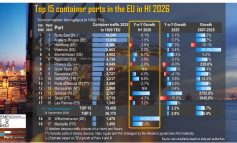
    Top-15 EU container ports in H1 2026

    Top-15 EU container ports in H1 2026

    European ports: The need to avoid the great divide

    European ports: The need to avoid the great divide

    Florence maritime regulation conference: PortEconomics members shape maritime regulation

    Florence maritime regulation conference: PortEconomics members shape maritime regulation

    New edition: Developing ports as business ecosystems

    New edition: Developing ports as business ecosystems

    European Ports: Reflection on policies and strategies for the energy transition

    European Ports: Reflection on policies and strategies for the energy transition

  • Noticeboard
    Call for papers: Contemporary Maritime Economics: Transformations and Emerging Perspectives

    Call for papers: Contemporary Maritime Economics: Transformations and Emerging Perspectives

    ECONSHIP2026: Call for papers

    ECONSHIP2026: Call for papers

    Call for papers: 1st Florence Maritime Regulation Conference

    Call for papers: 1st Florence Maritime Regulation Conference

    PortEconomics co-director appointed Senior Scientific Advisor to the Florence School of Regulation

    PortEconomics co-director appointed Senior Scientific Advisor to the Florence School of Regulation

    Jean Monnet Chair in European Port Policy

    Jean Monnet Chair in European Port Policy

  • Viewpoints
    Top-15 EU container ports in H1 2026

    Top-15 EU container ports in H1 2026

    European ports: The need to avoid the great divide

    European ports: The need to avoid the great divide

    New edition: Developing ports as business ecosystems

    New edition: Developing ports as business ecosystems

    Maritime and port strategies as state policies: an introductory approach

    Maritime and port strategies as state policies: an introductory approach

    European Ports: Reflection on policies and strategies for the energy transition

    European Ports: Reflection on policies and strategies for the energy transition

  • PortLibrary
  • PortReport
The Analyst: e-commerce, service differentiation and port operationsFeatured

The Analyst: e-commerce, service differentiation and port operations

November 24th, 2020 Featured, Viewpoints

primaryfreight.com

READ ALSO

Geopolitical leverage through the international activities of State-Owned Enterprises (SOEs) in ports and maritime logistics
Commission unveils new EU Ports Strategy
Investments and financing challenges of the EU’s port managing bodies; findings from a comprehensive survey
Top-15 EU container ports in H1 2026

By Peter de Langen

E-commerce had been growing impressively before COVID-19, with growth rates as much as 10 times higher than the growth of sales of physical stores.

COVID-19 has obviously accelerated that growth. Currently, around 20 per cent of all retail sales are online, with huge differences between commodities. For books the online share is over 50 per cent, for groceries the share is, in most countries, still below five per cent.

It seems fairly obvious that the rapid growth will continue once the pandemic is over, one noticeable reason is that many stores are closing and as a consequence it is harder to purchase offline, especially for specific products (ever tried to find a specific light bulb or board game in a physical store?….).

The e-commerce model deeply changes physical goods flows, as consumers can easily purchase foreign products online. The recent announcement of a strategic cooperation agreement between ZIM and Alibaba demonstrates the traction of global e-commerce flows. The Chinese e-commerce platform’s customers can directly purchase sea freight from ZIM.

These e-commerce flows are, apparently, more time sensitive than most container flows. ZIM specifically targeted e-commerce customers for a faster direct service connecting South China ports and Los Angeles, while CMA CGM has also developed a direct service on the Pacific trades aimed partially at e-commerce flows. Thus, e-commerce is probably a main driver of new initiatives to introduce the time-based service differentiation of shipping lines.

Shipping lines, such as CMA CGM and APL offer priority offloading and a ‘terminal fast track’ service. Cargoes using this service will be stowed in ‘priority discharge’ slots.

If these attempts to offer a differentiated, faster service succeed – and caution is due as previous efforts, such as ‘Daily Maersk’ failed – ports and terminals may need to be able to embrace such priority services and extend them into priority intermodal products.

So far, shipping lines offer priority discharge services only in the Port of Los Angeles, a port with huge call sizes and serious congestion issues. It seems unlikely such a premium product will eventually be offered at all ports. In some ports with moderate call sizes, the demand may not be there.

Competition may emerge between ports for implementing such a premium product. Having such a service may turn out to have an impact, as it may attract more time sensitive (e-commerce) flows and over time strengthen the position of the winning port in service networks.

First published @Port Strategy

Next article Entry strategies in inland container terminals: a comparison between Yangtze river and Rhine river
Previous article Resilience & adaptability of shipping, ports & supply chains to internal & external shocks

Related Posts

Top-15 EU container ports in H1 2026 Containers

Top-15 EU container ports in H1 2026

Geopolitical leverage through the international activities of State-Owned Enterprises (SOEs) in ports and maritime logistics Category

Geopolitical leverage through the international activities of State-Owned Enterprises (SOEs) in ports and maritime logistics

European ports: The need to avoid the great divide European Port Policy

European ports: The need to avoid the great divide

Weekly Timeline
Sep 22nd 10:21 AM
Thematic Area

Top-15 EU container ports in H1 2026

Sep 17th 12:11 PM
Category

Geopolitical leverage through the international activities of State-Owned Enterprises (SOEs) in ports and maritime logistics

Jul 22nd 3:50 PM
Thematic Area

European ports: The need to avoid the great divide

Jul 21st 1:41 PM
Thematic Area

Florence maritime regulation conference: PortEconomics members shape maritime regulation

Jul 2nd 2:45 PM
Presentations

New edition: Developing ports as business ecosystems

Tweets by @PortEconomics
  • Containers
  • Cruise
  • EPP
  • Ports & COVID-19
  • Back to top
About PortEconomics

PortEconomics is a web-based initiative aiming to advance knowledge exchange on seaport studies. Established by maritime economists affiliated to academic institutions in Belgium, Greece and the Netherlands. It provides freely accessible research, education, information, and network-building material on critical issues of port economics, management and policies.

Additional Information
  • About
  • Login
  • Register
  • Edit Profile
  • Contact us
  • PortProfessionals
  • PortReport Series
  • Terms and Conditions
  • Cookie Policy
© PortEconomics 2025. All rights reserved.
Produced by PortEconomics
Manage Consent
To provide the best experiences, we use technologies like cookies to store and/or access device information. Consenting to these technologies will allow us to process data such as browsing behavior or unique IDs on this site. Not consenting or withdrawing consent, may adversely affect certain features and functions.
Functional Always active
The technical storage or access is strictly necessary for the legitimate purpose of enabling the use of a specific service explicitly requested by the subscriber or user, or for the sole purpose of carrying out the transmission of a communication over an electronic communications network.
Preferences
The technical storage or access is necessary for the legitimate purpose of storing preferences that are not requested by the subscriber or user.
Statistics
The technical storage or access that is used exclusively for statistical purposes. The technical storage or access that is used exclusively for anonymous statistical purposes. Without a subpoena, voluntary compliance on the part of your Internet Service Provider, or additional records from a third party, information stored or retrieved for this purpose alone cannot usually be used to identify you.
Marketing
The technical storage or access is required to create user profiles to send advertising, or to track the user on a website or across several websites for similar marketing purposes.
  • Manage options
  • Manage services
  • Manage {vendor_count} vendors
  • Read more about these purposes
View preferences
  • {title}
  • {title}
  • {title}