

• Home
  • About
    • Members
    • Associate Members
    • Former members
  • Thematic Areas
    • Containers
    • Cruise
    • European Port Policy
    • Ports & COVID-19
  • PortStudies
  • Presentations
  • Noticeboard
  • Viewpoints
  • PortLibrary
  • PortReport
PortEconomics
  • December 26th, 2025
PortEconomics
  • Home
  • About
    • Members
    • Associate Members
    • Former members
  • Thematic Areas
    • Containers
    • Cruise
    • European Port Policy
    • Ports & COVID-19
  • PortStudies
    ESG disclosure as a proxy of port corporate communication and sustainable management strategy: An LDA approach

    ESG disclosure as a proxy of port corporate communication and sustainable management strategy: An LDA approach

    From coal exports to green steel production? The role of circular economy precincts for sustainable port diversification

    From coal exports to green steel production? The role of circular economy precincts for sustainable port diversification

    Maritime transport in net zero

    Maritime transport in net zero

    Onboard carbon capture, utilisation and storage (CCUS) supply chain optimisation: an application to vessels active in the offshore wind industry

    Onboard carbon capture, utilisation and storage (CCUS) supply chain optimisation: an application to vessels active in the offshore wind industry

    Geopolitical risks and port-related carbon emissions: evidence and policy implications

    Geopolitical risks and port-related carbon emissions: evidence and policy implications

  • Presentations
    Top-10 PortReads in 2025

    Top-10 PortReads in 2025

    Port reform: World Bank publishes the third edition of its port reform toolkit

    Port reform: World Bank publishes the third edition of its port reform toolkit

    When will we admit that maritime transport will not be decarbonised by 2050?

    When will we admit that maritime transport will not be decarbonised by 2050?

    Digital technologies for efficient and resilient sea-land logistics

    Digital technologies for efficient and resilient sea-land logistics

    The World Ports Tracker in TOC Europe

    The World Ports Tracker in TOC Europe

  • Noticeboard
    Call for papers: 1st Florence Maritime Regulation Conference

    Call for papers: 1st Florence Maritime Regulation Conference

    PortEconomics co-director appointed Senior Scientific Advisor to the Florence School of Regulation

    PortEconomics co-director appointed Senior Scientific Advisor to the Florence School of Regulation

    Jean Monnet Chair in European Port Policy

    Jean Monnet Chair in European Port Policy

    Two tenure track assistant professor positions in maritime logistics or maritime management

    Two tenure track assistant professor positions in maritime logistics or maritime management

    Portgraphic: Top-15 EU container ports in H1 2025

    Portgraphic: Top-15 EU container ports in H1 2025

  • Viewpoints
    PortGraphic: Top-15 EU container ports in Q3 2025

    PortGraphic: Top-15 EU container ports in Q3 2025

    Maritime transport in net zero

    Maritime transport in net zero

    Portgraphic: Top-15 EU container ports in H1 2025

    Portgraphic: Top-15 EU container ports in H1 2025

    Portgraphic: fleet capacity (owned/chartered) of container shipping lines

    Portgraphic: fleet capacity (owned/chartered) of container shipping lines

    In a tight spot: American ports in global supply chains

    In a tight spot: American ports in global supply chains

  • PortLibrary
  • PortReport
LNG bunkering solutions in portsEuropean Port Policy

LNG bunkering solutions in ports

July 12th, 2019 European Port Policy, Featured, PortStudies

READ ALSO

Digital technologies for efficient and resilient sea-land logistics
Green strategies in ports: stakeholder management perspectives
Operational productivity and financial performance: pure transhipment hubs vs gateway terminals
Top-10 PortReads in 2025

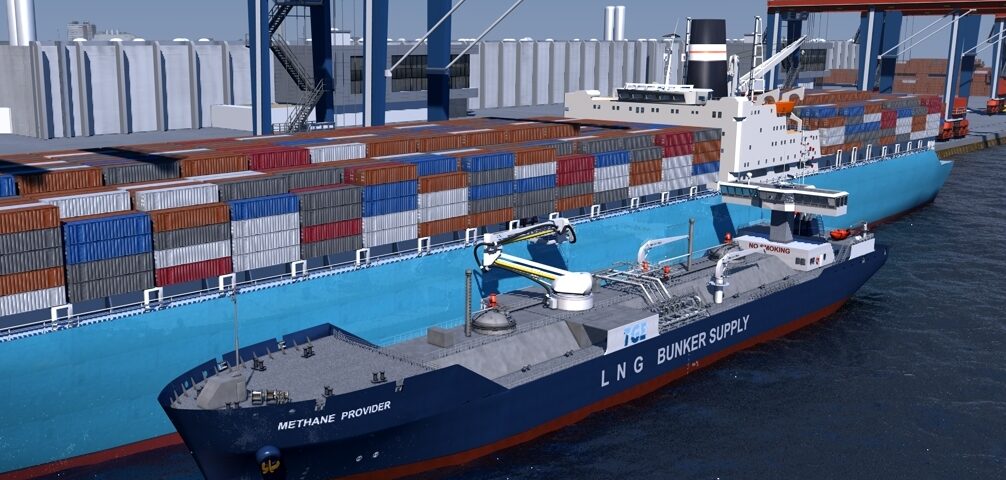
LNG as a marine fuel represent a viable solution for making the maritime and port industry more sustainable, as it allows reducing emissions and pollutants, such as SOx and NOx, compared with traditional fuels. Although a number of academics and practitioners has addressed the phenomenon, by investigating environmental, social economic and financial issues related to the adoption of LNG-propulsion systems in the shipping sector, prior studies predominantly assumed a ship-owner or a shipping company’ perspective. Conversely, the analysis of several issues related to LNG bunkering and storage technological options in ports are still underexplored.

The latest port study of PortEconomics members Giovanni Satta and Francesco Parola, along with Okan Duru (Engineering College of Engineering, Singapore) and Camille Leotta (University of Genoa) investigates LNG bunkering and storage solutions in the port context by reviewing extant literature. In order to identify the most discussed and the underexplored research areas, a systematic literature review is carried out on a broad sample of papers addressing LNG bunkering in ports. The literature review returns a picture of a fragmented research field, in terms of both scope of analysis and methodological approach.

The findings identify main research streams and literature gaps thus favouring the development of a future research agenda, which aims to support both academics and practitioners.

The study, presented in the International Association of Maritime Economists 2019 Conference (IAME 2019) held 25-28 June, Athens, Greece and you can find and download the authors’ version of the paper and presentation via PortEconomics.
Next article Shipping alliances connectivity and the growth of Piraeus to major hub
Previous article PortGraphic: when being an outsider is no option-the search for alliance membership in container shipping

Giovanni Satta

Giovanni Satta is Assistant Professor at the University of Genoa, Department of Economics and Business. He received a PhD in "Logistics, transport and territory" from the Italian Centre of Excellence on Integrated Logistics (CIELI). During the annual IAME meeting in Marseille in July 2013 was declared winner of the prestigious 5th Maritime Economics & Logistics PhD Competition, sponsored by Palgrave Macmillan. Giovanni received the award for his PhD dissertation "Time and space in the internationalization process of container port MNEs: the determinants of foreign entry modes". His research and teaching interests include logistics and transport, strategic management and corporate governance. Giovanni has been involved in several research projects on these topics. In particular, he is currently involved in the FP7 EU Project PORTOPIA, that aims at building an integrated knowledge base and management system of port performance to serve the industry's stakeholders. He is a member of the International Association of Maritime Economists (IAME) and of the Port Performance Research Network (PPRN). Giovanni regularly participates as speaker at many conferences and workshops on port and maritime logistics themes and (co-)organizes special tracks/sessions in management conferences (EURAM 2013-2015). He has been member of the local organizing committee of the IAME 2013 Conference in Marseille (3-5 July). Giovanni extensively published in port and maritime logistics themes in a number of international peer-reviewed journals, such as Journal of Transport Geography, Maritime Policy & Management, Maritime Economics & Logistics, International Journal of Logistics Research and Applications, R&D Management, Journal of International Management, Tourism Geographies, International Journal of Shipping and Transport Logistics and others. Giovanni joined as associate member PortEconomics.eu a web-based initiative aiming to advance knowledge exchange on port economics, management and policies.

Related Posts

Top-10 PortReads in 2025 Featured

Top-10 PortReads in 2025

PortGraphic: Top-15 EU container ports in Q3 2025 Containers

PortGraphic: Top-15 EU container ports in Q3 2025

European Port Policy

Call for papers: 1st Florence Maritime Regulation Conference

The 1st Florence Maritime Regulation Conference aims to discuss regulatory advancements that accelerate the...
Weekly Timeline
Dec 16th 1:12 PM
Featured

Top-10 PortReads in 2025

Dec 4th 12:46 PM
Thematic Area

PortGraphic: Top-15 EU container ports in Q3 2025

Dec 1st 2:00 PM
Thematic Area

Call for papers: 1st Florence Maritime Regulation Conference

Dec 1st 1:50 PM
Featured

ESG disclosure as a proxy of port corporate communication and sustainable management strategy: An LDA approach

Nov 27th 4:33 PM
Thematic Area

PortEconomics co-director appointed Senior Scientific Advisor to the Florence School of Regulation

Tweets by @PortEconomics
  • Containers
  • Cruise
  • EPP
  • Ports & COVID-19
  • Back to top
About PortEconomics

PortEconomics is a web-based initiative aiming to advance knowledge exchange on seaport studies. Established by maritime economists affiliated to academic institutions in Belgium, Greece and the Netherlands. It provides freely accessible research, education, information, and network-building material on critical issues of port economics, management and policies.

Additional Information
  • About
  • Login
  • Register
  • Edit Profile
  • Contact us
  • PortProfessionals
  • PortReport Series
  • Terms and Conditions
  • Cookie Policy
© PortEconomics 2025. All rights reserved.
Produced by PortEconomics
Manage Consent
To provide the best experiences, we use technologies like cookies to store and/or access device information. Consenting to these technologies will allow us to process data such as browsing behavior or unique IDs on this site. Not consenting or withdrawing consent, may adversely affect certain features and functions.
Functional Always active
The technical storage or access is strictly necessary for the legitimate purpose of enabling the use of a specific service explicitly requested by the subscriber or user, or for the sole purpose of carrying out the transmission of a communication over an electronic communications network.
Preferences
The technical storage or access is necessary for the legitimate purpose of storing preferences that are not requested by the subscriber or user.
Statistics
The technical storage or access that is used exclusively for statistical purposes. The technical storage or access that is used exclusively for anonymous statistical purposes. Without a subpoena, voluntary compliance on the part of your Internet Service Provider, or additional records from a third party, information stored or retrieved for this purpose alone cannot usually be used to identify you.
Marketing
The technical storage or access is required to create user profiles to send advertising, or to track the user on a website or across several websites for similar marketing purposes.
  • Manage options
  • Manage services
  • Manage {vendor_count} vendors
  • Read more about these purposes
View preferences
  • {title}
  • {title}
  • {title}