

• Home
  • About
    • Members
    • Associate Members
    • Former members
  • Thematic Areas
    • Containers
    • Cruise
    • European Port Policy
    • Ports & COVID-19
  • PortStudies
  • Presentations
  • Noticeboard
  • Viewpoints
  • PortLibrary
  • PortReport
PortEconomics
  • December 13th, 2025
PortEconomics
  • Home
  • About
    • Members
    • Associate Members
    • Former members
  • Thematic Areas
    • Containers
    • Cruise
    • European Port Policy
    • Ports & COVID-19
  • PortStudies
    ESG disclosure as a proxy of port corporate communication and sustainable management strategy: An LDA approach

    ESG disclosure as a proxy of port corporate communication and sustainable management strategy: An LDA approach

    From coal exports to green steel production? The role of circular economy precincts for sustainable port diversification

    From coal exports to green steel production? The role of circular economy precincts for sustainable port diversification

    Maritime transport in net zero

    Maritime transport in net zero

    Onboard carbon capture, utilisation and storage (CCUS) supply chain optimisation: an application to vessels active in the offshore wind industry

    Onboard carbon capture, utilisation and storage (CCUS) supply chain optimisation: an application to vessels active in the offshore wind industry

    Geopolitical risks and port-related carbon emissions: evidence and policy implications

    Geopolitical risks and port-related carbon emissions: evidence and policy implications

  • Presentations
    Port reform: World Bank publishes the third edition of its port reform toolkit

    Port reform: World Bank publishes the third edition of its port reform toolkit

    When will we admit that maritime transport will not be decarbonised by 2050?

    When will we admit that maritime transport will not be decarbonised by 2050?

    Digital technologies for efficient and resilient sea-land logistics

    Digital technologies for efficient and resilient sea-land logistics

    The World Ports Tracker in TOC Europe

    The World Ports Tracker in TOC Europe

    Newly-upgraded IAPH World Ports Tracker identifies major sustainability and market trends

    Newly-upgraded IAPH World Ports Tracker identifies major sustainability and market trends

  • Noticeboard
    Call for papers: 1st Florence Maritime Regulation Conference

    Call for papers: 1st Florence Maritime Regulation Conference

    PortEconomics co-director appointed Senior Scientific Advisor to the Florence School of Regulation

    PortEconomics co-director appointed Senior Scientific Advisor to the Florence School of Regulation

    Jean Monnet Chair in European Port Policy

    Jean Monnet Chair in European Port Policy

    Two tenure track assistant professor positions in maritime logistics or maritime management

    Two tenure track assistant professor positions in maritime logistics or maritime management

    Portgraphic: Top-15 EU container ports in H1 2025

    Portgraphic: Top-15 EU container ports in H1 2025

  • Viewpoints
    PortGraphic: Top-15 EU container ports in Q3 2025

    PortGraphic: Top-15 EU container ports in Q3 2025

    Maritime transport in net zero

    Maritime transport in net zero

    Portgraphic: Top-15 EU container ports in H1 2025

    Portgraphic: Top-15 EU container ports in H1 2025

    Portgraphic: fleet capacity (owned/chartered) of container shipping lines

    Portgraphic: fleet capacity (owned/chartered) of container shipping lines

    In a tight spot: American ports in global supply chains

    In a tight spot: American ports in global supply chains

  • PortLibrary
  • PortReport
Maritime container terminal infrastructure, network corporatization, and global terminal operatorsContainers

Maritime container terminal infrastructure, network corporatization, and global terminal operators

August 25th, 2022 Containers, Featured, PortStudies, Uncategorized

READ ALSO

PortGraphic: Top-15 EU container ports in Q3 2025
Two tenure track assistant professor positions in maritime logistics or maritime management
Onboard carbon capture, utilisation and storage (CCUS) supply chain optimisation: an application to vessels active in the offshore wind industry
PortGraphic: Top-15 EU container ports in Q3 2025

Maritime shipping lines and global terminal operators have benefited from economies of scale to expand geographically and functionally their infrastructure, leading to a corporatized network. Terminal operators are key asset managers seeking value creation by expanding the global maritime container terminal infrastructure network. While corporatization has systematically ensured that terminal capacity was created to accommodate the rise in global trade volumes, the network hit its boundaries when confronted with COVID-19 induced global supply chain disruptions.

In their latest port study, published in Journal of International Business Policy, PortEconomics members Theo Notteboom and Jean-Paul Rodrigue provide a better understanding of the importance of infrastructure and observed corporatization as a framework for explaining economic processes, notably when transport infrastructures are extensive and capital-intensive.

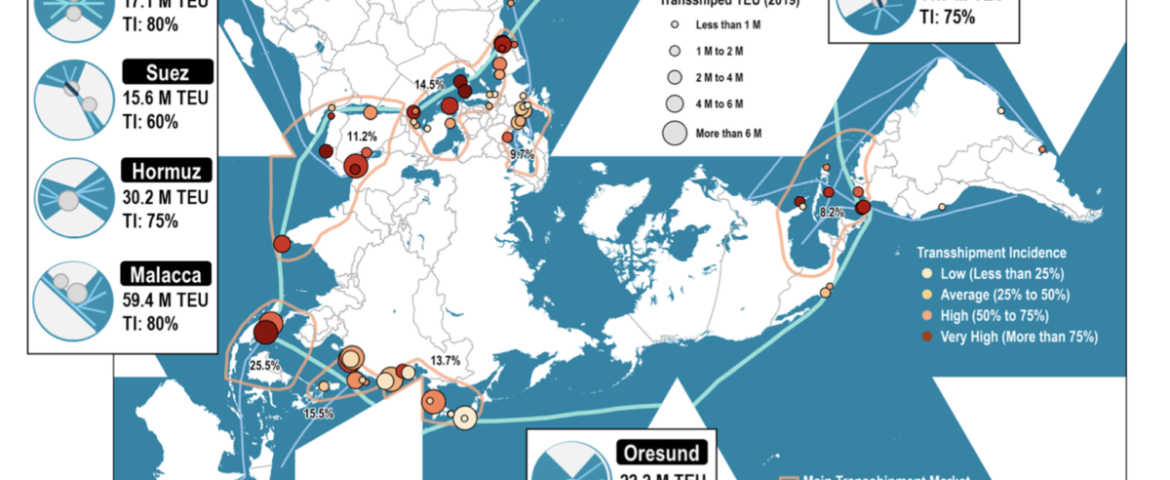
The structure of the global container shipping network is analyzed to unveil the realities of liner service networks operated by shipping lines, and the market structure and consolidation in container shipping and terminal operations. The discussion on the corporatization of the global maritime infrastructure network for container handling is embedded in international business literature.

This study extracts the main implications of the current structure and governance of the global maritime infrastructure network for international business policy, with a particular focus on the current market structure and network resilience.
You might access the study here: Notteboom, T., Rodrigue, JP. (2022). Maritime container terminal infrastructure, network corporatization, and global terminal operators: Implications for international business policy. J Int Bus Policy (2022). https://doi.org/10.1057/s42214-022-00142-z 
Next article Port integrity commitments and corruption risks in different shipping markets
Previous article Container terminal automation: revealing distinctive terminal characteristics and operating parameters

Related Posts

PortGraphic: Top-15 EU container ports in Q3 2025 Containers

PortGraphic: Top-15 EU container ports in Q3 2025

ESG disclosure as a proxy of port corporate communication and sustainable management strategy: An LDA approach Featured

ESG disclosure as a proxy of port corporate communication and sustainable management strategy: An LDA approach

From coal exports to green steel production? The role of circular economy precincts for sustainable port diversification Featured

From coal exports to green steel production? The role of circular economy precincts for sustainable port diversification

Weekly Timeline
Dec 4th 12:46 PM
Thematic Area

PortGraphic: Top-15 EU container ports in Q3 2025

Dec 1st 2:00 PM
Thematic Area

Call for papers: 1st Florence Maritime Regulation Conference

Dec 1st 1:50 PM
Featured

ESG disclosure as a proxy of port corporate communication and sustainable management strategy: An LDA approach

Nov 27th 4:33 PM
Thematic Area

PortEconomics co-director appointed Senior Scientific Advisor to the Florence School of Regulation

Nov 25th 10:49 AM
Thematic Area

Jean Monnet Chair in European Port Policy

Tweets by @PortEconomics
  • Containers
  • Cruise
  • EPP
  • Ports & COVID-19
  • Back to top
About PortEconomics

PortEconomics is a web-based initiative aiming to advance knowledge exchange on seaport studies. Established by maritime economists affiliated to academic institutions in Belgium, Greece and the Netherlands. It provides freely accessible research, education, information, and network-building material on critical issues of port economics, management and policies.

Additional Information
  • About
  • Login
  • Register
  • Edit Profile
  • Contact us
  • PortProfessionals
  • PortReport Series
  • Terms and Conditions
  • Cookie Policy
© PortEconomics 2025. All rights reserved.
Produced by PortEconomics
Manage Consent
To provide the best experiences, we use technologies like cookies to store and/or access device information. Consenting to these technologies will allow us to process data such as browsing behavior or unique IDs on this site. Not consenting or withdrawing consent, may adversely affect certain features and functions.
Functional Always active
The technical storage or access is strictly necessary for the legitimate purpose of enabling the use of a specific service explicitly requested by the subscriber or user, or for the sole purpose of carrying out the transmission of a communication over an electronic communications network.
Preferences
The technical storage or access is necessary for the legitimate purpose of storing preferences that are not requested by the subscriber or user.
Statistics
The technical storage or access that is used exclusively for statistical purposes. The technical storage or access that is used exclusively for anonymous statistical purposes. Without a subpoena, voluntary compliance on the part of your Internet Service Provider, or additional records from a third party, information stored or retrieved for this purpose alone cannot usually be used to identify you.
Marketing
The technical storage or access is required to create user profiles to send advertising, or to track the user on a website or across several websites for similar marketing purposes.
  • Manage options
  • Manage services
  • Manage {vendor_count} vendors
  • Read more about these purposes
View preferences
  • {title}
  • {title}
  • {title}