

• Home
  • About
    • Members
    • Associate Members
    • Former members
  • Thematic Areas
    • Containers
    • Cruise
    • European Port Policy
    • Ports & COVID-19
  • PortStudies
  • Presentations
  • Noticeboard
  • Viewpoints
  • PortLibrary
  • PortReport
PortEconomics
  • February 19th, 2026
PortEconomics
  • Home
  • About
    • Members
    • Associate Members
    • Former members
  • Thematic Areas
    • Containers
    • Cruise
    • European Port Policy
    • Ports & COVID-19
  • PortStudies
    A metric of global maritime supply chain disruptions: The global supply chain stress index - maritime (GSCSI-M)

    A metric of global maritime supply chain disruptions: The global supply chain stress index - maritime (GSCSI-M)

    ESG disclosure as a proxy of port corporate communication and sustainable management strategy: An LDA approach

    ESG disclosure as a proxy of port corporate communication and sustainable management strategy: An LDA approach

    From coal exports to green steel production? The role of circular economy precincts for sustainable port diversification

    From coal exports to green steel production? The role of circular economy precincts for sustainable port diversification

    Maritime transport in net zero

    Maritime transport in net zero

    Onboard carbon capture, utilisation and storage (CCUS) supply chain optimisation: an application to vessels active in the offshore wind industry

    Onboard carbon capture, utilisation and storage (CCUS) supply chain optimisation: an application to vessels active in the offshore wind industry

  • Presentations
    PortGraphic: Container port dynamics near Gibraltar

    PortGraphic: Container port dynamics near Gibraltar

    Top-10 PortReads in 2025

    Top-10 PortReads in 2025

    Port reform: World Bank publishes the third edition of its port reform toolkit

    Port reform: World Bank publishes the third edition of its port reform toolkit

    When will we admit that maritime transport will not be decarbonised by 2050?

    When will we admit that maritime transport will not be decarbonised by 2050?

    Digital technologies for efficient and resilient sea-land logistics

    Digital technologies for efficient and resilient sea-land logistics

  • Noticeboard
    Call for papers: Contemporary Maritime Economics: Transformations and Emerging Perspectives

    Call for papers: Contemporary Maritime Economics: Transformations and Emerging Perspectives

    ECONSHIP2026: Call for papers

    ECONSHIP2026: Call for papers

    Call for papers: 1st Florence Maritime Regulation Conference

    Call for papers: 1st Florence Maritime Regulation Conference

    PortEconomics co-director appointed Senior Scientific Advisor to the Florence School of Regulation

    PortEconomics co-director appointed Senior Scientific Advisor to the Florence School of Regulation

    Jean Monnet Chair in European Port Policy

    Jean Monnet Chair in European Port Policy

  • Viewpoints
    PortGraphic: Top-15 EU container ports in Q3 2025

    PortGraphic: Top-15 EU container ports in Q3 2025

    Maritime transport in net zero

    Maritime transport in net zero

    Portgraphic: Top-15 EU container ports in H1 2025

    Portgraphic: Top-15 EU container ports in H1 2025

    Portgraphic: fleet capacity (owned/chartered) of container shipping lines

    Portgraphic: fleet capacity (owned/chartered) of container shipping lines

    In a tight spot: American ports in global supply chains

    In a tight spot: American ports in global supply chains

  • PortLibrary
  • PortReport
Shipping technologies: from wind to coal … and breakbulk to containersCategory

Shipping technologies: from wind to coal … and breakbulk to containers

September 15th, 2020 Category, Containers, Featured, Presentations, Thematic Area

READ ALSO

PortEconomics members among best-performing scholars globally
Ports and their influence on local air pollution and public health: A global analysis
Revisiting port system delineation through an analysis of maritime interdependencies among seaports
PortGraphic: Container port dynamics near Gibraltar

by Cesar Ducreat

Our recurrent focus on the present and future of containerization makes us forget older revolutions such as the sail to steam transition in the late nineteenth and early twentieth centuries.

Are such revolutions comparable with each other? Do they obey similar mechanisms, in terms of spatio-temporal diffusion, port competition, and hierarchical dynamics, shipping network reorganization? Research on this is only at its eve.

Our most recent research provides preliminary results using the archival corpus of the Lloyd’s List Shipping Index. This source is the only possible one to offer a global focus.

Surprisingly, since the first edition of the Shipping Index (1735), only two research papers mentioned this source in the entire literature on shipping, ports, and beyond. Henry Rees (1955) considered it as a possible source for schools to study, and Douglas K. Fleming (1968) said this “might be” a very useful source for research. Yet, it covers the great majority of the world fleet and details the daily movements of the insured vessels between ports of the world. After the tedious extraction of one single 100-pages printed volume every five years or so between 1880 and 2008, the database comprises 836,171 movements connecting 5,619 ports over nearly 130 years.

A dedicated OCR software (Optical Character Recognition) has been created by the CNRS for this purpose. Research is ongoing to further consolidate this database and enrich the results as the potential is huge. Several publications of the ERC World Seastems project (2013-2019) have already been published using the Shipping Index but the diagrams posted here today are new (for more info here).
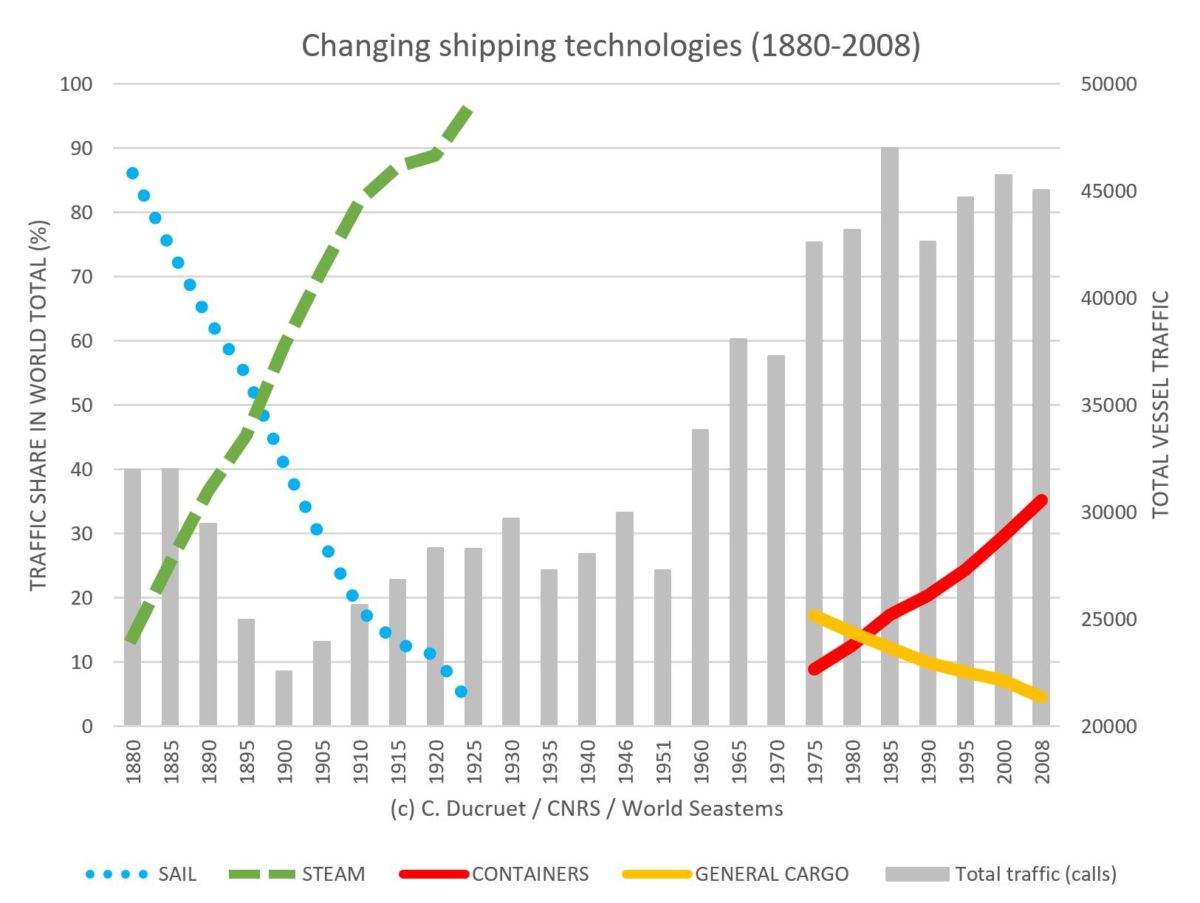
Changing Shipping Technologies (1880-2008)

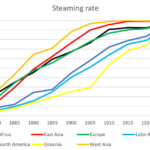
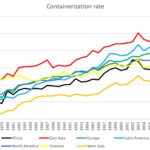
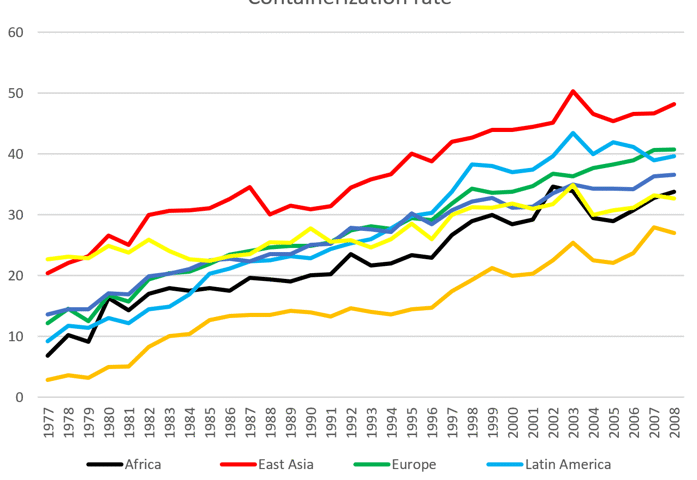
The respective shift from sail to steam and from breakbulk (general cargo) to containers can’t be directly compared as the first concerns a propulsion mechanism and the second is about the way cargo is packed onboard. Common points emerge however when looking at the consequences on ports and shipping networks, which are already well related in the literature in history, economics, and geography. This motivates further dialogues among disciplines. The rapidity of the shifts, as seen in the first figure, had been a challenge for ports to adapt to such transitions. The changing technology had, in both cases, enormous impacts on speed (terminal cargo handling for containers, maritime navigation for steamers) and on infrastructures, due to the great economies of scale permitted and the growing size of ships. Both transitions also provided more safety.

Last but not least, the two last figures show that Asia as a whole had been each time the most impregnated region or early mover. Western powers’ commercial appetite motivated the launch of the best-equipped vessels towards their targeted “market” (West Asia for steamers – British Empire; East Asia for containers – factory of the world). Africa and West Asia are late adopters of containerization, while Oceania and the Americas were late adopters of the steam engine.

Steaming Rate
Containerisation rate


Different regions reacted differently to innovation, depending on natural conditions, market access, etc. with a varying degree of resilience. Future works shall look at shipping network structure and port hierarchies.

The research leading to these results has received funding from the European Research Council under the European Union’s Seventh Framework Programme (FP/2007-2013) / ERC Grant Agreement n. [313847] “World Seastems”.

Next article IAPH-WPSP COVID19 port economic impact barometer: half year report
Previous article Cruise shipping supply chains and the impacts of disruptions: the Caribbean

Related Posts

PortGraphic: Container port dynamics near Gibraltar Containers

PortGraphic: Container port dynamics near Gibraltar

A metric of global maritime supply chain disruptions: The global supply chain stress index - maritime (GSCSI-M) Featured

A metric of global maritime supply chain disruptions: The global supply chain stress index - maritime (GSCSI-M)

PortGraphic: Top-15 EU container ports in Q3 2025 Containers

PortGraphic: Top-15 EU container ports in Q3 2025

Weekly Timeline
Feb 18th 1:46 PM
Thematic Area

PortGraphic: Container port dynamics near Gibraltar

Feb 12th 12:25 PM
Featured

A metric of global maritime supply chain disruptions: The global supply chain stress index – maritime (GSCSI-M)

Jan 14th 12:56 PM
Noticeboard

Call for papers: Contemporary Maritime Economics: Transformations and Emerging Perspectives

Jan 4th 12:46 PM
Thematic Area

PortGraphic: Top-15 EU container ports in Q3 2025

Dec 16th 1:12 PM
Featured

Top-10 PortReads in 2025

Tweets by @PortEconomics
  • Containers
  • Cruise
  • EPP
  • Ports & COVID-19
  • Back to top
About PortEconomics

PortEconomics is a web-based initiative aiming to advance knowledge exchange on seaport studies. Established by maritime economists affiliated to academic institutions in Belgium, Greece and the Netherlands. It provides freely accessible research, education, information, and network-building material on critical issues of port economics, management and policies.

Additional Information
  • About
  • Login
  • Register
  • Edit Profile
  • Contact us
  • PortProfessionals
  • PortReport Series
  • Terms and Conditions
  • Cookie Policy
© PortEconomics 2025. All rights reserved.
Produced by PortEconomics
Manage Consent
To provide the best experiences, we use technologies like cookies to store and/or access device information. Consenting to these technologies will allow us to process data such as browsing behavior or unique IDs on this site. Not consenting or withdrawing consent, may adversely affect certain features and functions.
Functional Always active
The technical storage or access is strictly necessary for the legitimate purpose of enabling the use of a specific service explicitly requested by the subscriber or user, or for the sole purpose of carrying out the transmission of a communication over an electronic communications network.
Preferences
The technical storage or access is necessary for the legitimate purpose of storing preferences that are not requested by the subscriber or user.
Statistics
The technical storage or access that is used exclusively for statistical purposes. The technical storage or access that is used exclusively for anonymous statistical purposes. Without a subpoena, voluntary compliance on the part of your Internet Service Provider, or additional records from a third party, information stored or retrieved for this purpose alone cannot usually be used to identify you.
Marketing
The technical storage or access is required to create user profiles to send advertising, or to track the user on a website or across several websites for similar marketing purposes.
  • Manage options
  • Manage services
  • Manage {vendor_count} vendors
  • Read more about these purposes
View preferences
  • {title}
  • {title}
  • {title}