

• Home
  • About
    • Members
    • Associate Members
    • Former members
  • Thematic Areas
    • Containers
    • Cruise
    • European Port Policy
    • Ports & COVID-19
  • PortStudies
  • Presentations
  • Noticeboard
  • Viewpoints
  • PortLibrary
  • PortReport
PortEconomics
  • May 4th, 2026
PortEconomics
  • Home
  • About
    • Members
    • Associate Members
    • Former members
  • Thematic Areas
    • Containers
    • Cruise
    • European Port Policy
    • Ports & COVID-19
  • PortStudies
    Risk-driven supply chain designs – a re-assessment with geopolitical and geoeconomic considerations

    Risk-driven supply chain designs – a re-assessment with geopolitical and geoeconomic considerations

    Rhine-Scheldt delta port system

    Rhine-Scheldt delta port system

    A metric of global maritime supply chain disruptions: The global supply chain stress index - maritime (GSCSI-M)

    A metric of global maritime supply chain disruptions: The global supply chain stress index - maritime (GSCSI-M)

    ESG disclosure as a proxy of port corporate communication and sustainable management strategy: An LDA approach

    ESG disclosure as a proxy of port corporate communication and sustainable management strategy: An LDA approach

    From coal exports to green steel production? The role of circular economy precincts for sustainable port diversification

    From coal exports to green steel production? The role of circular economy precincts for sustainable port diversification

  • Presentations
    European Ports: Reflection on policies and strategies for the energy transition

    European Ports: Reflection on policies and strategies for the energy transition

    IAPH World Ports Tracker 2026 reveals state of global port sustainability

    IAPH World Ports Tracker 2026 reveals state of global port sustainability

    PortGraphic: Container port dynamics near Gibraltar

    PortGraphic: Container port dynamics near Gibraltar

    Top-10 PortReads in 2025

    Top-10 PortReads in 2025

    Port reform: World Bank publishes the third edition of its port reform toolkit

    Port reform: World Bank publishes the third edition of its port reform toolkit

  • Noticeboard
    Call for papers: Contemporary Maritime Economics: Transformations and Emerging Perspectives

    Call for papers: Contemporary Maritime Economics: Transformations and Emerging Perspectives

    ECONSHIP2026: Call for papers

    ECONSHIP2026: Call for papers

    Call for papers: 1st Florence Maritime Regulation Conference

    Call for papers: 1st Florence Maritime Regulation Conference

    PortEconomics co-director appointed Senior Scientific Advisor to the Florence School of Regulation

    PortEconomics co-director appointed Senior Scientific Advisor to the Florence School of Regulation

    Jean Monnet Chair in European Port Policy

    Jean Monnet Chair in European Port Policy

  • Viewpoints
    European Ports: Reflection on policies and strategies for the energy transition

    European Ports: Reflection on policies and strategies for the energy transition

    Port-city integration

    Port-city integration

    Commission unveils new EU Ports Strategy

    Commission unveils new EU Ports Strategy

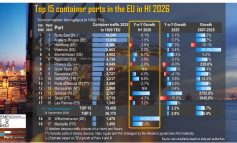
    PortGraphic: Top-15 EU container ports in Q3 2025

    PortGraphic: Top-15 EU container ports in Q3 2025

    Maritime transport in net zero

    Maritime transport in net zero

  • PortLibrary
  • PortReport
Second IAPH-WPSP port economic impact barometer report: some ports seeing significant changes in storage utilizationCategory

Second IAPH-WPSP port economic impact barometer report: some ports seeing significant changes in storage utilization

April 16th, 2020 Category, Featured, Ports & COVID-19, Thematic Area

READ ALSO

Port-city integration
PortGraphic: Container port dynamics near Gibraltar
Call for papers: Contemporary Maritime Economics: Transformations and Emerging Perspectives
European Ports: Reflection on policies and strategies for the energy transition

The Week-16 results of the IAPH-WPSP Weekly Port Economic Impact Barometer show COVID-19 crisis has 35% of ports reporting an increase in the utilization of warehousing and distribution facilities in the last week for foodstuffs and medical supplies, whilst other ports report both over- and under-utilization of their storage facilities, depending on cargo type.

The second weekly results of the World Ports Sustainability Programme’s (WPSP) Port Economic Impact Barometer have been published at the World Ports COVID19 Information Portal, following the response of 90 ports from all over the globe.

Compiled by PortEconomics members Professor Theo Notteboom (Shanghai Maritime University, Ghent University and University of Antwerp) and Professor Thanos Pallis (University of the Aegean and Universidad de Los Andes), ports reported for a second week, answering six key questions.

Read the full “Report no 2” here


A mixed picture – over-utilization in some ports with under-utilization in others

35% of ports report an increase in the utilization of warehousing and distribution facilities for foodstuffs and medical supplies, with some ports reporting capacity shortages. Last week these figures were slightly different with more ports reporting a major increase in utilization levels (10% then vs. 2% this week) and with fewer ports reporting a minor under-utilization (10% then vs. 5% this week). The situation for consumer goods has almost remained the same, although there is an increase in the share of ports dealing with major increases in utilization or facing capacity shortages (11% now vs. 8% last week). In the dry and liquid bulk markets, almost two-thirds of the respondents see no changes in utilization levels. The remaining ports are fairly evenly distributed between under-utilization and increased utilisation of storage facilities.

Several ports report an increase in port and terminal utilization due to an increase in the imports of essential goods, such as grains (rice, wheat). Stockpiling practices of importers have also emerged and as a result, a major increase in capacity utilization for these deliverables is not uncommon. Other ports reported strategic storage of liquid bulks by traders in anticipation of future commodity price developments. The most critical situation recorded is for the automotive industry. As dealers fail to collect their new cars (due to a collapse in sale), overcrowding of relevant storage areas near some quaysides has been reported.

“In the coming weeks we foresee major changes taking place in cargo flows as we begin to see the impact of blank sailings, especially in the container shipping sector on the main Asia-Europe and Transpacific trades. This will cascade into other trade lanes as well, so its vitally important for us to view the overall impact on port calls, operations, restrictions, port staffing, hinterland transportation, and storage as well as future prospects for international trade to and from ports. – Theo Notteboom, IAPH-WPSP Port Economic Impact Barometer co-author”

“Vessel calls, utilization of warehousing and distribution factories, and connections to hinterland have been affected in many different ways. Workforce practices and procedures have changed. The growing interest of ports has allowed to further detail the exact trend, and we are looking forward to reporting the conditions of many more in the next edition of the barometer – Thanos Pallis, IAPH-WPSP Port Economic Impact Barometer co-author “.

“We are pleased the report has attracted interest from around the world, with three regional port associations assisting us in getting more ports on board with their anonymous answers to six simple questions. In addition, we have engaged with a senior representation of the Transport Division of the World Bank on a conference call to discuss knowledge sharing and cooperation”  IAPH Managing Director Patrick Verhoeven

Next article Updated PortGraphic: cruise lines announced return dates (as of 17.4)
Previous article Coronavirus impacts on trade and supply chains

Related Posts

European Ports: Reflection on policies and strategies for the energy transition European Port Policy

European Ports: Reflection on policies and strategies for the energy transition

IAPH World Ports Tracker 2026 reveals state of global port sustainability Featured

IAPH World Ports Tracker 2026 reveals state of global port sustainability

Risk-driven supply chain designs – a re-assessment with geopolitical and geoeconomic considerations Featured

Risk-driven supply chain designs – a re-assessment with geopolitical and geoeconomic considerations

Weekly Timeline
Apr 29th 11:39 AM
Thematic Area

European Ports: Reflection on policies and strategies for the energy transition

Apr 23rd 4:58 PM
Featured

IAPH World Ports Tracker 2026 reveals state of global port sustainability

Apr 8th 1:36 PM
Featured

Risk-driven supply chain designs – a re-assessment with geopolitical and geoeconomic considerations

Mar 27th 5:31 PM
Thematic Area

Port-city integration

Mar 9th 4:35 PM
Featured

Rhine-Scheldt delta port system

Tweets by @PortEconomics
  • Containers
  • Cruise
  • EPP
  • Ports & COVID-19
  • Back to top
About PortEconomics

PortEconomics is a web-based initiative aiming to advance knowledge exchange on seaport studies. Established by maritime economists affiliated to academic institutions in Belgium, Greece and the Netherlands. It provides freely accessible research, education, information, and network-building material on critical issues of port economics, management and policies.

Additional Information
  • About
  • Login
  • Register
  • Edit Profile
  • Contact us
  • PortProfessionals
  • PortReport Series
  • Terms and Conditions
  • Cookie Policy
© PortEconomics 2025. All rights reserved.
Produced by PortEconomics
Manage Consent
To provide the best experiences, we use technologies like cookies to store and/or access device information. Consenting to these technologies will allow us to process data such as browsing behavior or unique IDs on this site. Not consenting or withdrawing consent, may adversely affect certain features and functions.
Functional Always active
The technical storage or access is strictly necessary for the legitimate purpose of enabling the use of a specific service explicitly requested by the subscriber or user, or for the sole purpose of carrying out the transmission of a communication over an electronic communications network.
Preferences
The technical storage or access is necessary for the legitimate purpose of storing preferences that are not requested by the subscriber or user.
Statistics
The technical storage or access that is used exclusively for statistical purposes. The technical storage or access that is used exclusively for anonymous statistical purposes. Without a subpoena, voluntary compliance on the part of your Internet Service Provider, or additional records from a third party, information stored or retrieved for this purpose alone cannot usually be used to identify you.
Marketing
The technical storage or access is required to create user profiles to send advertising, or to track the user on a website or across several websites for similar marketing purposes.
  • Manage options
  • Manage services
  • Manage {vendor_count} vendors
  • Read more about these purposes
View preferences
  • {title}
  • {title}
  • {title}