

• Home
  • About
    • Members
    • Associate Members
    • Former members
  • Thematic Areas
    • Containers
    • Cruise
    • European Port Policy
    • Ports & COVID-19
  • PortStudies
  • Presentations
  • Noticeboard
  • Viewpoints
  • PortLibrary
  • PortReport
PortEconomics
  • April 1st, 2026
PortEconomics
  • Home
  • About
    • Members
    • Associate Members
    • Former members
  • Thematic Areas
    • Containers
    • Cruise
    • European Port Policy
    • Ports & COVID-19
  • PortStudies
    Rhine-Scheldt delta port system

    Rhine-Scheldt delta port system

    A metric of global maritime supply chain disruptions: The global supply chain stress index - maritime (GSCSI-M)

    A metric of global maritime supply chain disruptions: The global supply chain stress index - maritime (GSCSI-M)

    ESG disclosure as a proxy of port corporate communication and sustainable management strategy: An LDA approach

    ESG disclosure as a proxy of port corporate communication and sustainable management strategy: An LDA approach

    From coal exports to green steel production? The role of circular economy precincts for sustainable port diversification

    From coal exports to green steel production? The role of circular economy precincts for sustainable port diversification

    Maritime transport in net zero

    Maritime transport in net zero

  • Presentations
    PortGraphic: Container port dynamics near Gibraltar

    PortGraphic: Container port dynamics near Gibraltar

    Top-10 PortReads in 2025

    Top-10 PortReads in 2025

    Port reform: World Bank publishes the third edition of its port reform toolkit

    Port reform: World Bank publishes the third edition of its port reform toolkit

    When will we admit that maritime transport will not be decarbonised by 2050?

    When will we admit that maritime transport will not be decarbonised by 2050?

    Digital technologies for efficient and resilient sea-land logistics

    Digital technologies for efficient and resilient sea-land logistics

  • Noticeboard
    Call for papers: Contemporary Maritime Economics: Transformations and Emerging Perspectives

    Call for papers: Contemporary Maritime Economics: Transformations and Emerging Perspectives

    ECONSHIP2026: Call for papers

    ECONSHIP2026: Call for papers

    Call for papers: 1st Florence Maritime Regulation Conference

    Call for papers: 1st Florence Maritime Regulation Conference

    PortEconomics co-director appointed Senior Scientific Advisor to the Florence School of Regulation

    PortEconomics co-director appointed Senior Scientific Advisor to the Florence School of Regulation

    Jean Monnet Chair in European Port Policy

    Jean Monnet Chair in European Port Policy

  • Viewpoints
    Port-city integration

    Port-city integration

    Commission unveils new EU Ports Strategy

    Commission unveils new EU Ports Strategy

    PortGraphic: Top-15 EU container ports in Q3 2025

    PortGraphic: Top-15 EU container ports in Q3 2025

    Maritime transport in net zero

    Maritime transport in net zero

    Portgraphic: Top-15 EU container ports in H1 2025

    Portgraphic: Top-15 EU container ports in H1 2025

  • PortLibrary
  • PortReport
2023 ranking: top Caribbean ports & container terminals – gateway and transshipment insightsContainers

2023 ranking: top Caribbean ports & container terminals – gateway and transshipment insights

June 20th, 2024 Containers, Featured, PortStudies

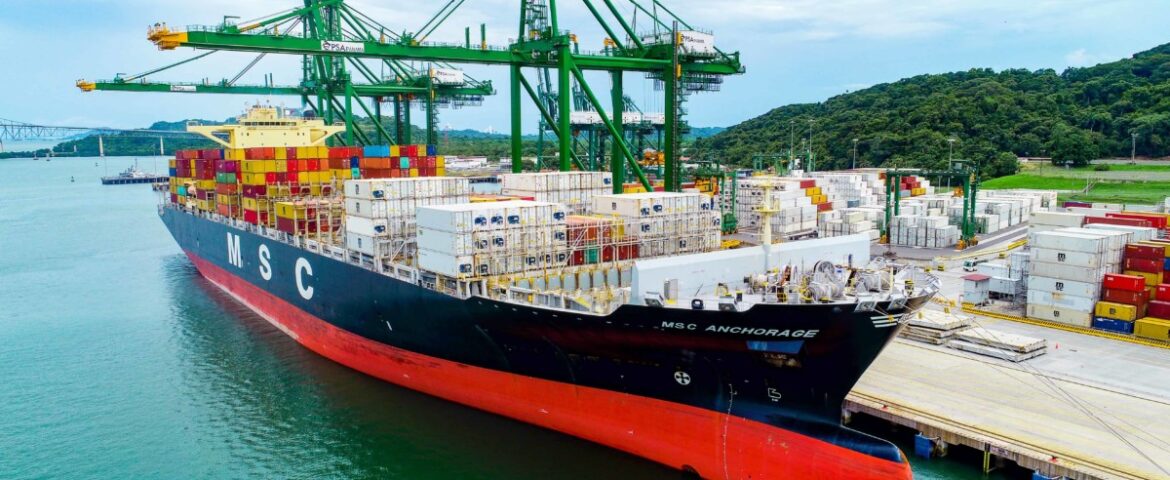
Source: PSA.

READ ALSO

Portgraphic: Top-15 EU container ports in H1 2025
Hierarchy and mobility of Latin America and Caribbean container ports
What is happening in 2024 in the container ports of the Americas?
Port-city integration

By [1] Ricardo J Sanchez [2] Eliana P. Barleta

[1] Co-chair, Kühne Professorial Chair in Logistics, School of Management, Universidad de los Andes, Colombia and Head, Caribbean Research Institute. [email protected]

[2] Ph.D. Student in Maritime Studies, University of Piraeus [email protected]

***

The ports of the Caribbean, framed by the natural beauty of the region, have the dual characteristic of being vital to regional trade, but also function as strategic transhipment nodes on international trade routes connecting Europe, North America and Asia.

It should be noted that ports on smaller islands, beyond their natural beauty, tend to have significant infrastructure deficits, obsolescence in several cases, and limited land availability to serve multiple functions such as general cargo, cruise ships, liquid and dry bulk, and containers. This makes them highly significant in terms of the challenges they face in the future. Table 1 shows that among the 25 largest ports, there is a mix of ports handling less than 100,000 TEU per year, with several handling over 1 million TEU, and up to 5 million TEU in a year.

This brief note presents an analysis of the 25 largest container ports and terminals in the Caribbean, highlighting their throughput, changes in activity over the (selected) years and their role in transhipment.

Table 1 shows the throughput in thousands of TEUs of the main Caribbean ports and container terminals from 2010 to 2023. The data shows that Panama’s Caribbean coast has consistently ranked first in terms of volumes operated, peaking (to date) in 2022 at just over 5.1 million TEUs, despite a slight decline in 2023 to 4.9 million TEUs. Panama’s Pacific coast ranks second in 2023, with remarkable growth since 2010, while Colombia’s Cartagena Bay has risen to third place in 2023, demonstrating steady growth over the years. Kingston in Jamaica has been among the top-5 in the region since 2010.

Table 1. Port throughput, 2010-2023, in TEU
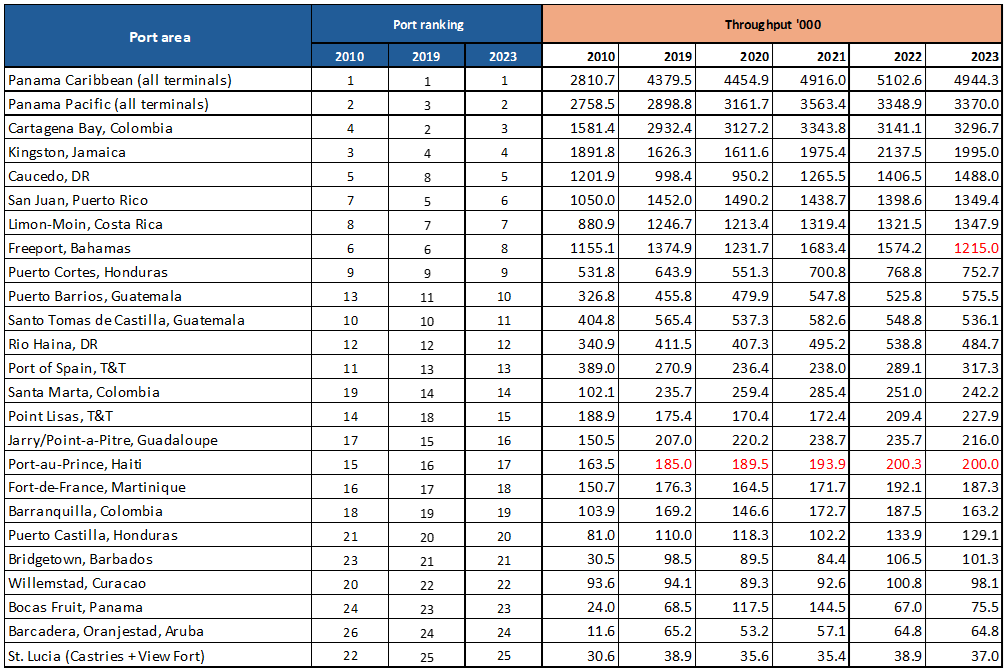
Source: authors, based on data obtained from port authorities and operators. Note: the table is based on available data to date, so there may be some omissions. Estimated or provisional figures in red.

Table 2 highlights the percentage changes in throughput in 2023 compared to previous years, providing insight into the growth and fluctuation of port activity. In the long term, since 2010, Cartagena has experienced a remarkable increase of 108.5%, underlining its expansion, within the millionaires group. Panama’s Caribbean coast also shows a significant growth of 75.9%, consolidating its crucial role as a maritime hub. Within the smaller volume ports, several ports show a 3-digit percentage change in the long term, such as Barcadera, Bridgetown, Bocas Fruit and Santa Marta.

In the medium term, i.e. variations with respect to the pre-pandemic, Caucedo, Point Lisas, Puerto Barrios and Kingston stand out. In the short term, over the previous year, the cases of Bocas, the ports of Trinidad and Tobago, Puerto Barrios, Caucedo and Cartagena stand out. However, not all ports have shown recent growth. Freeport in the Bahamas has seen a 22.8% decrease compared to 2022, as well as Barranquilla and Rio Haina.

Table 2. Port throughput, 2010-2023, variation in %.
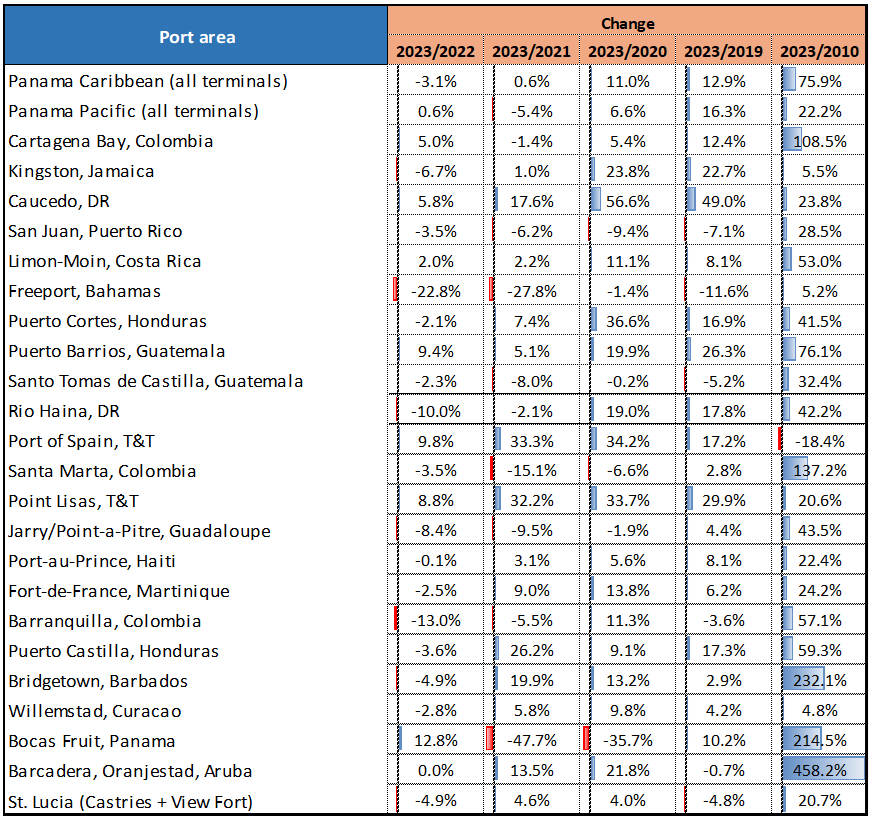
Source: authors, based on data obtained from port authorities and operators.

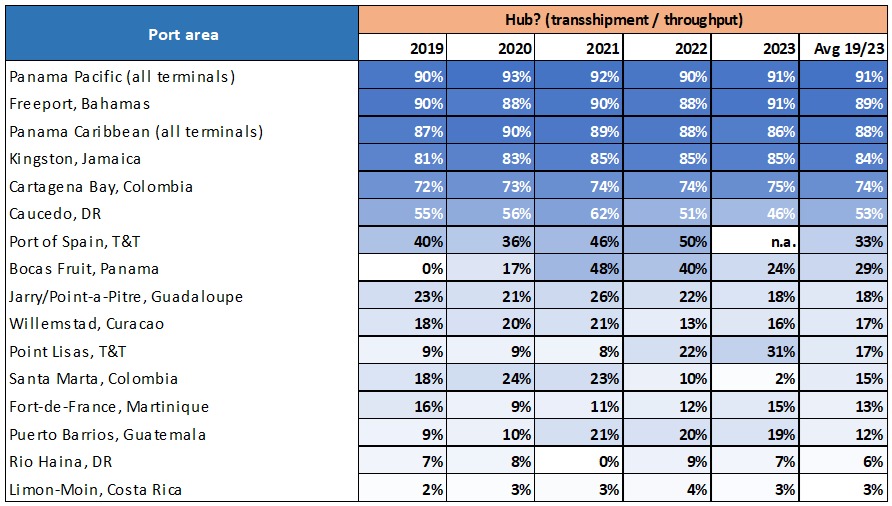
Table 3 shows the share of transhipment with respect to port throughput. Both coasts in Panama are leaders in transhipment, maintaining percentages close to 90%, which underlines their key role in the region, as well as Freeport and Kingston (all above 84% average in the last 5 years). The ports of Cartagena and Caucedo show a strong trend for transhipment, although they also exhibit their relevance as gateways. Something similar occurs with Port of Spain, although in a smaller proportion (33% of the total).

Table 3. Transshipment/throughput 2010-2023, in %
Source: authors, based on data obtained from port authorities and operators. Note: n.a. not available.

Next article Accessibility or connectivity: why is it correct to say that in the Caribbean the main logistics problem is connectivity?
Previous article Successful adoption of maritime environmental policy: The Mediterranean emission control area

Related Posts

Port-city integration European Port Policy

Port-city integration

Rhine-Scheldt delta port system Featured

Rhine-Scheldt delta port system

Commission unveils new EU Ports Strategy European Port Policy

Commission unveils new EU Ports Strategy

Weekly Timeline
Mar 27th 5:31 PM
Thematic Area

Port-city integration

Mar 9th 4:35 PM
Featured

Rhine-Scheldt delta port system

Mar 6th 1:23 PM
Thematic Area

Commission unveils new EU Ports Strategy

Feb 18th 1:46 PM
Thematic Area

PortGraphic: Container port dynamics near Gibraltar

Feb 12th 12:25 PM
Featured

A metric of global maritime supply chain disruptions: The global supply chain stress index – maritime (GSCSI-M)

Tweets by @PortEconomics
  • Containers
  • Cruise
  • EPP
  • Ports & COVID-19
  • Back to top
About PortEconomics

PortEconomics is a web-based initiative aiming to advance knowledge exchange on seaport studies. Established by maritime economists affiliated to academic institutions in Belgium, Greece and the Netherlands. It provides freely accessible research, education, information, and network-building material on critical issues of port economics, management and policies.

Additional Information
  • About
  • Login
  • Register
  • Edit Profile
  • Contact us
  • PortProfessionals
  • PortReport Series
  • Terms and Conditions
  • Cookie Policy
© PortEconomics 2025. All rights reserved.
Produced by PortEconomics
Manage Consent
To provide the best experiences, we use technologies like cookies to store and/or access device information. Consenting to these technologies will allow us to process data such as browsing behavior or unique IDs on this site. Not consenting or withdrawing consent, may adversely affect certain features and functions.
Functional Always active
The technical storage or access is strictly necessary for the legitimate purpose of enabling the use of a specific service explicitly requested by the subscriber or user, or for the sole purpose of carrying out the transmission of a communication over an electronic communications network.
Preferences
The technical storage or access is necessary for the legitimate purpose of storing preferences that are not requested by the subscriber or user.
Statistics
The technical storage or access that is used exclusively for statistical purposes. The technical storage or access that is used exclusively for anonymous statistical purposes. Without a subpoena, voluntary compliance on the part of your Internet Service Provider, or additional records from a third party, information stored or retrieved for this purpose alone cannot usually be used to identify you.
Marketing
The technical storage or access is required to create user profiles to send advertising, or to track the user on a website or across several websites for similar marketing purposes.
  • Manage options
  • Manage services
  • Manage {vendor_count} vendors
  • Read more about these purposes
View preferences
  • {title}
  • {title}
  • {title}