


• Home
  • About
    • Members
    • Associate Members
    • Former members
  • Thematic Areas
    • Containers
    • Cruise
    • European Port Policy
    • Ports & COVID-19
  • PortStudies
  • Presentations
  • Noticeboard
  • Viewpoints
  • PortLibrary
  • PortReport
PortEconomics
  • March 19th, 2026
PortEconomics
  • Home
  • About
    • Members
    • Associate Members
    • Former members
  • Thematic Areas
    • Containers
    • Cruise
    • European Port Policy
    • Ports & COVID-19
  • PortStudies
    Rhine-Scheldt delta port system

    Rhine-Scheldt delta port system

    A metric of global maritime supply chain disruptions: The global supply chain stress index - maritime (GSCSI-M)

    A metric of global maritime supply chain disruptions: The global supply chain stress index - maritime (GSCSI-M)

    ESG disclosure as a proxy of port corporate communication and sustainable management strategy: An LDA approach

    ESG disclosure as a proxy of port corporate communication and sustainable management strategy: An LDA approach

    From coal exports to green steel production? The role of circular economy precincts for sustainable port diversification

    From coal exports to green steel production? The role of circular economy precincts for sustainable port diversification

    Maritime transport in net zero

    Maritime transport in net zero

  • Presentations
    PortGraphic: Container port dynamics near Gibraltar

    PortGraphic: Container port dynamics near Gibraltar

    Top-10 PortReads in 2025

    Top-10 PortReads in 2025

    Port reform: World Bank publishes the third edition of its port reform toolkit

    Port reform: World Bank publishes the third edition of its port reform toolkit

    When will we admit that maritime transport will not be decarbonised by 2050?

    When will we admit that maritime transport will not be decarbonised by 2050?

    Digital technologies for efficient and resilient sea-land logistics

    Digital technologies for efficient and resilient sea-land logistics

  • Noticeboard
    Call for papers: Contemporary Maritime Economics: Transformations and Emerging Perspectives

    Call for papers: Contemporary Maritime Economics: Transformations and Emerging Perspectives

    ECONSHIP2026: Call for papers

    ECONSHIP2026: Call for papers

    Call for papers: 1st Florence Maritime Regulation Conference

    Call for papers: 1st Florence Maritime Regulation Conference

    PortEconomics co-director appointed Senior Scientific Advisor to the Florence School of Regulation

    PortEconomics co-director appointed Senior Scientific Advisor to the Florence School of Regulation

    Jean Monnet Chair in European Port Policy

    Jean Monnet Chair in European Port Policy

  • Viewpoints
    Commission unveils new EU Ports Strategy

    Commission unveils new EU Ports Strategy

    PortGraphic: Top-15 EU container ports in Q3 2025

    PortGraphic: Top-15 EU container ports in Q3 2025

    Maritime transport in net zero

    Maritime transport in net zero

    Portgraphic: Top-15 EU container ports in H1 2025

    Portgraphic: Top-15 EU container ports in H1 2025

    Portgraphic: fleet capacity (owned/chartered) of container shipping lines

    Portgraphic: fleet capacity (owned/chartered) of container shipping lines

  • PortLibrary
  • PortReport
IAPH-WPSP Port Economic Impact Barometer for Week 19: European ports impacted more by reduced cargo vessel callsCategory

IAPH-WPSP Port Economic Impact Barometer for Week 19: European ports impacted more by reduced cargo vessel calls

May 8th, 2020 Category, European Port Policy, Featured, Ports & COVID-19, Thematic Area

READ ALSO

PortGraphic: Container port dynamics near Gibraltar
Call for papers: Contemporary Maritime Economics: Transformations and Emerging Perspectives
PortGraphic: Top-15 EU container ports in Q3 2025
Rhine-Scheldt delta port system

In the fifth edition of the IAPH-WPSP Port Economic Impact Barometer Report, the majority reports a relatively stable situation compared to the previous weeks, with slight improvements noted in some areas of port continuity.

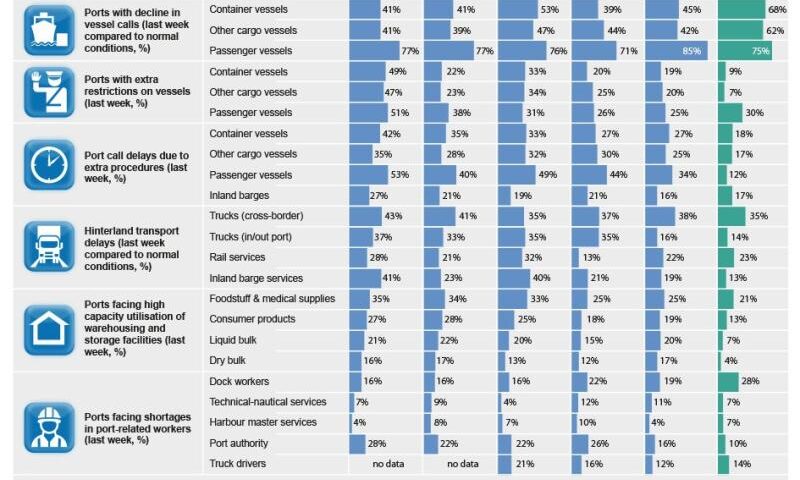
In the fifth report of the WPSP-IAPH COVID19 Port Economic Impact Barometer, a focus on European ports reveals that many of them are already feeling a greater impact of reduced cargo vessel calls than other regions of the world. The European region also has a smaller share of ports now facing capacity shortages of warehousing and storage facilities with a progressive overall decline in utilization being reported over the time period. Also, it appears that the European Region is slightly more impacted by shortages of dockworkers, with 28% reporting this occurrence during the recent week.

Compiled by PortEconomics members Theo Notteboom and Thanos Pallis the fourth edition of the weekly IAPH-WPSP Port Economic Impact Barometer Report, published every Friday, covers worldwide port developments in Week 19 (28 April – 3 May) 2020.

The full report might be downloaded here.

Full impact of reduced cargo vessel calls yet to be felt

Despite the impact of vessel calls increasing across the board, almost all of the 76 ports taking part in this week’s survey are reporting a 5 to 25% decrease. The share of ports facing significant decreases (in excess of a 25% drop) falls sharply from 10-11% in the previous two weeks to less than 2% this week. The situation for the other cargo vessels has remained fairly unchanged compared to last week. The number of ports reporting reductions of more than 25% remained at a level of 12 to 14% throughout weeks 16 to 19.

Co-author Professor Thanos Pallis commented: “The general loss of cargo for containers is probably less evident than expected, as April has closed with negative year-on-year figures that are much better than initially forecasted. The decrease in the number of container vessels is not always directly related to the COVID 19 crisis. Some report on the increase in blank sailings, mainly on the Europe-Far East routes, for others there are no more blank sailings registered but total calls are still down some 20% with respect to a normal fully operational week. Regional feeders in substitution of calls by mega vessels are working well, but shippers do not always welcome the longer transit times associated with transshipment.”

Cross border controls persist for trucks in the hinterland

About 12% of the ports surveyed report delays (6-24 hours) or heavy delays (> 24 hours) in cross-border road transportation with 6% of the ports indicating that cross-border trucking has been discontinued. Although this is a minor improvement compared to last week, the situation remains precarious for a number of ports.

Co-author Professor Thanos Pallis commented: “The general loss of cargo for containers is probably less evident than expected, as April has closed with negative year-on-year figures that are much better than initially forecasted. The decrease in the number of container vessels is not always directly related to the COVID 19 crisis. Some report on the increase in blank sailings, mainly on the Europe-Far East routes, for others there are no more blank sailings registered but total calls are still down some 20% with respect to a normal fully operational week. Regional feeders in substitution of calls by mega vessels are working well, but shippers do not always welcome the longer transit times associated with transshipment.”

Cross border controls persist for trucks in the hinterland

About 12% of the ports surveyed report delays (6-24 hours) or heavy delays (> 24 hours) in cross-border road transportation with 6% of the ports indicating that cross-border trucking has been discontinued. Although this is a minor improvement compared to last week, the situation remains precarious for a number of ports.

In some cases, ports have sought to alleviate congestion at the quayside caused by increased controls on trucks and truckers at borders by evacuating import containers en masse by rail, either to hinterland depots or to staging locations closer to the border away from the port. As an example, to facilitate improved quayside operations on the East African coast, inland rail services transporting up to several thousand TEUs improves cross-border transit with landlocked countries.

Kenya Ports Authority Head of Corporate Affairs and member of the WPSP COVID19 Task Force Bernard O. Osero commented: “every day, we dispatch 10 trains from Mombasa carrying hinterland-destined cargo to Nairobi depot, 500 kilometers away. This is about 1000 TEUs a day. In addition, from this week, we have opened a special service directly from Mombasa to Naivasha depot 650 kilometers away from Mombasa and 400 kilometers from the border, specifically for transit traffic. This is an average of 100 TEUs and it is expected to increase.”

Europe is the region most impacted so far by reduced cargo vessel calls

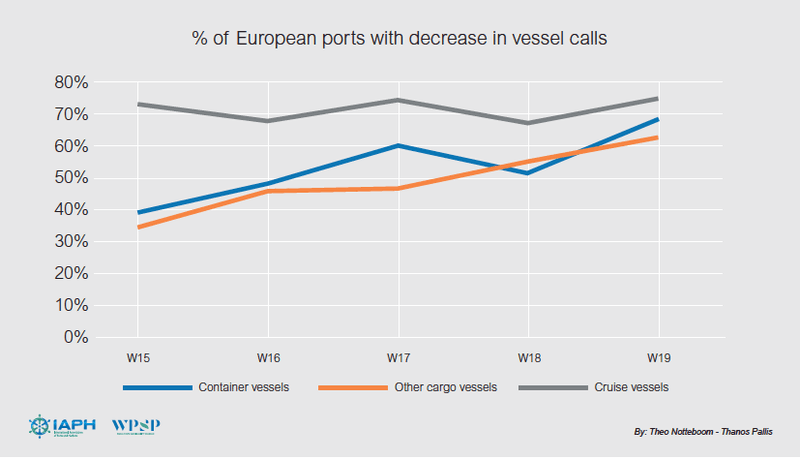
From this week onward, a new section has been added to the weekly barometer, which analyzes the results for the ports of a chosen region in more detail. This week’s regional focus is on Europe. As mentioned earlier, European ports take the largest share of the weekly global port sample, accounting for between 38% and 54% of all received answers. As an example, the share of ports facing declines in weekly calls of cargo vessels is much higher in Europe than ports globally. As shown in the graph above, the situation in European ports for container vessels and other cargo vessels has gradually deteriorated compared to the first week of the survey.
Co-author Professor Theo Notteboom commented: “In the coming weeks, several of the larger ports anticipate significant downturns in volumes due to blank sailings in the container segment. We expect these larger hubs to be impacted the most. Nonetheless, how much impact this will have on the global supply chain and how quickly economies will restart, especially in Europe, will require close monitoring.”

Note : Professor Theo Notteboom will be joining Port of Los Angeles Executive Director Gene Seroka and UNCTAD’s Chief Trade Logistics Branch Jan Hoffmann in the first of three IAPH Coronavirus Webinars next Wednesday. Entitled “Business as unusual – adapting port business models to survive and thrive in the post-COVID-19 era” the will include citations of the weekly Port Economic Impact Barometer.
Next article World Ports Sustainability Report 2020 highlights scientific contribution in fostering sustainability efforts of ports worldwide
Previous article PortGraphic: expected cruise capacity in operation per month

Related Posts

Rhine-Scheldt delta port system Featured

Rhine-Scheldt delta port system

Commission unveils new EU Ports Strategy European Port Policy

Commission unveils new EU Ports Strategy

PortGraphic: Container port dynamics near Gibraltar Containers

PortGraphic: Container port dynamics near Gibraltar

Weekly Timeline
Mar 9th 4:35 PM
Featured

Rhine-Scheldt delta port system

Mar 6th 1:23 PM
Thematic Area

Commission unveils new EU Ports Strategy

Feb 18th 1:46 PM
Thematic Area

PortGraphic: Container port dynamics near Gibraltar

Feb 12th 12:25 PM
Featured

A metric of global maritime supply chain disruptions: The global supply chain stress index – maritime (GSCSI-M)

Jan 14th 12:56 PM
Noticeboard

Call for papers: Contemporary Maritime Economics: Transformations and Emerging Perspectives

Tweets by @PortEconomics
  • Containers
  • Cruise
  • EPP
  • Ports & COVID-19
  • Back to top
About PortEconomics

PortEconomics is a web-based initiative aiming to advance knowledge exchange on seaport studies. Established by maritime economists affiliated to academic institutions in Belgium, Greece and the Netherlands. It provides freely accessible research, education, information, and network-building material on critical issues of port economics, management and policies.

Additional Information
  • About
  • Login
  • Register
  • Edit Profile
  • Contact us
  • PortProfessionals
  • PortReport Series
  • Terms and Conditions
  • Cookie Policy
© PortEconomics 2025. All rights reserved.
Produced by PortEconomics
Manage Consent
To provide the best experiences, we use technologies like cookies to store and/or access device information. Consenting to these technologies will allow us to process data such as browsing behavior or unique IDs on this site. Not consenting or withdrawing consent, may adversely affect certain features and functions.
Functional Always active
The technical storage or access is strictly necessary for the legitimate purpose of enabling the use of a specific service explicitly requested by the subscriber or user, or for the sole purpose of carrying out the transmission of a communication over an electronic communications network.
Preferences
The technical storage or access is necessary for the legitimate purpose of storing preferences that are not requested by the subscriber or user.
Statistics
The technical storage or access that is used exclusively for statistical purposes. The technical storage or access that is used exclusively for anonymous statistical purposes. Without a subpoena, voluntary compliance on the part of your Internet Service Provider, or additional records from a third party, information stored or retrieved for this purpose alone cannot usually be used to identify you.
Marketing
The technical storage or access is required to create user profiles to send advertising, or to track the user on a website or across several websites for similar marketing purposes.
  • Manage options
  • Manage services
  • Manage {vendor_count} vendors
  • Read more about these purposes
View preferences
  • {title}
  • {title}
  • {title}